
A Russian major general recently awarded the country’s highest honorary title has been killed in eastern Ukraine, according to Ukrainian forces and a senior Russian commander. Maj Gen Anton Grunis had been praised by Vladimir Putin after reporting Russian gains around Kostiantynivka — including a claim that the Ukrainian stronghold had been captured, something Kyiv rejected and independent analysts disputed.
KYIV — September 17, 2026
Ukraine’s Unmanned Systems Forces said Grunis was killed during a nighttime drone strike on September 12 in Russian-held territory in the Donetsk region.


Robert Brovdi, commander of Ukraine’s Unmanned Systems Forces, announced the death on Wednesday and said the operation had been carried out by the 427th Separate Unmanned Systems Brigade, known as Rarog.
Reuters was unable to independently verify Brovdi’s account of the strike. However, Russian Lieutenant General Apti Alaudinov subsequently confirmed that Grunis had died, without giving details about the circumstances.
Decorated weeks before his death
Grunis commanded Russia’s 4th Separate Guards Motor Rifle Brigade and had recently received the Gold Star associated with the Hero of Russia title.
His decoration followed his involvement in Russian operations around Kostiantynivka, one of the strategically important cities in Ukraine’s Donetsk region.
Earlier this year, Grunis had personally briefed Putin on Russian operations and reported that troops under his command had helped take Kostiantynivka.
But the claim was contested.
Ukraine denied that Russia had captured the city, while independent military analysts also disputed Moscow’s account.
Grunis nevertheless received public praise from Putin and was awarded the Hero of Russia title in late August.
Just over two weeks later, he was dead.
Drones move deeper into the command structure
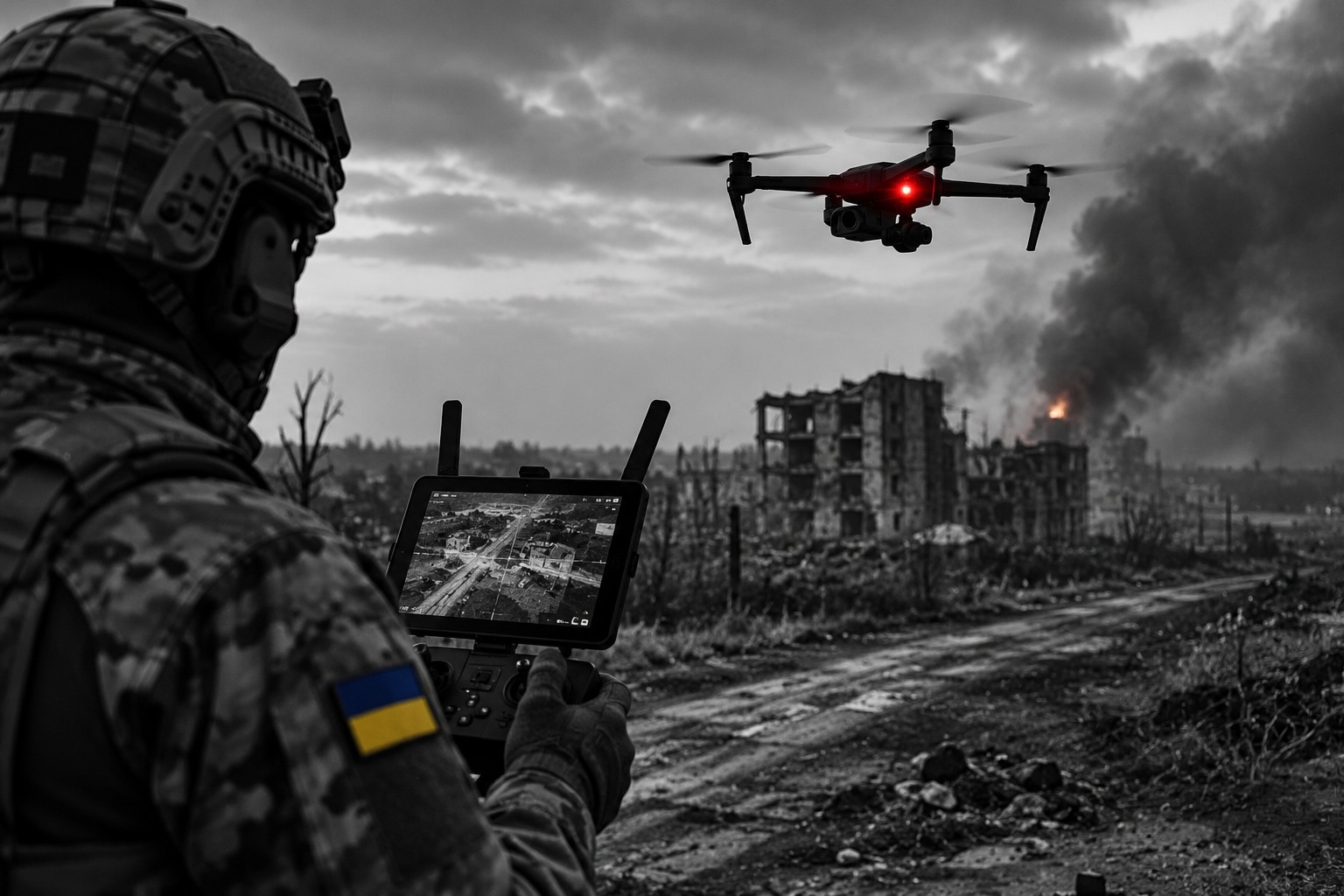
The killing illustrates how drones are continuing to reshape the battlefield in Ukraine.
Unmanned systems are no longer used primarily for reconnaissance or attacks against soldiers and vehicles directly along the front.
Longer-range and increasingly sophisticated drones are being used against command posts, logistics infrastructure, airfields and senior military personnel behind the immediate combat line.
Brovdi said Grunis was the seventh Russian commander at brigade, division or army level whose death had been confirmed following strikes by Ukraine’s Unmanned Systems Forces. That claim has not been independently verified.
The strategic importance extends beyond individual casualties.
Senior commanders traditionally operate at greater distances from direct combat. Drone warfare is reducing that separation and forcing military headquarters, communications networks and command structures to adapt.
Battle for Donetsk continues
Kostiantynivka remains important to Russia’s wider attempt to take control of the Donbas.
Russian forces have continued operations against Ukrainian defensive positions in the region, although the pace of Moscow’s advances has slowed.
Control of the remaining Ukrainian-held cities in Donetsk remains central to Russia’s military objectives and has also featured in the wider dispute between Moscow and Kyiv over the terms of any future settlement.
Grunis’s death therefore comes at a symbolically significant moment.
A commander celebrated by Moscow for battlefield success has been killed while the battle over the territory associated with that success continues.
British intelligence officer named
Separately, Britain has identified the UK serviceman who died in Ukraine on the same day as Grunis.
Major Paul Wilks, 40, an officer in the British Army’s Intelligence Corps, died in a road traffic accident away from the front lines on September 12.
The UK Ministry of Defence said the incident was not believed to have resulted from hostile action.
Wilks had served in the Intelligence Corps throughout his military career after being commissioned from Sandhurst in 2012. His deployments included Afghanistan, and he had received two Operational Service Medals.
A small number of British military personnel remain in Ukraine, where they provide security for diplomatic personnel and support Ukraine’s armed forces.
The two deaths occurred under entirely different circumstances.
But together they underline the breadth of a war now deep into its fifth year — stretching from front-line combat and increasingly sophisticated drone operations to the foreign military personnel supporting Ukraine away from the battlefield.
Newshub Editorial in Europe – 17 September 2026

Ask NF GPT
If you have an account with ChatGPT you get deeper explanations,
background and context related to what you are reading.
A Russian major general recently awarded the country’s highest honorary title has been killed in eastern Ukraine, according to Ukrainian forces and a senior Russian commander. Maj Gen Anton Grunis had been praised by Vladimir Putin after reporting Russian gains around Kostiantynivka — including a claim that the Ukrainian stronghold had been captured, something Kyiv rejected and independent analysts disputed.
Recent Comments