
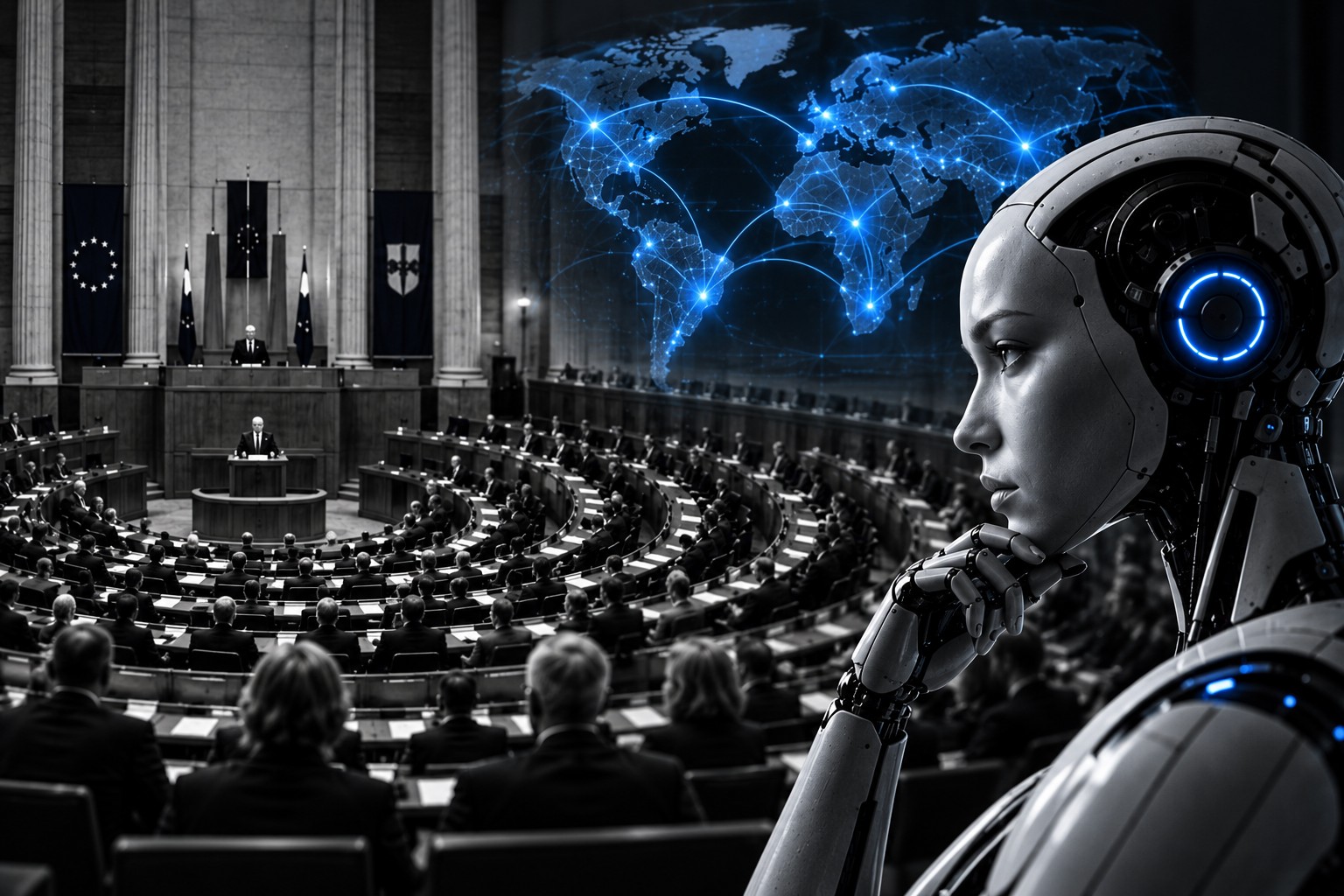
Will AI make politicians obsolete? The coming battle over who – or what – should govern us
Artificial intelligence is beginning to move from offices, smartphones and businesses into the machinery of government itself. It can analyse budgets, predict demand for hospitals, optimise transport, detect fraud and model the consequences of political decisions in seconds. The technology raises a question that until recently belonged largely to science fiction: if AI eventually becomes better than humans at administering society, will we still need politicians, political parties and elections – or could democracy itself evolve into something entirely different?
Government is partly a gigantic optimisation problem
Strip away the speeches, election campaigns and ideological battles and much of government is surprisingly practical. A municipality needs to determine where schools should be built, how buses should run, how many elderly-care places will be required and which roads need repairing. Regional authorities allocate healthcare resources. National governments collect taxes, administer benefits, manage infrastructure, forecast economic developments and distribute enormous amounts of public expenditure. These are extraordinarily complicated systems involving millions of variables, and they are also precisely the kind of problems at which increasingly capable artificial intelligence may excel.


AI can process volumes of information that no cabinet, parliament or civil service could realistically examine. Instead of analysing a handful of economic scenarios, governments could eventually run thousands or millions. A government could ask what would happen if a particular tax were reduced, electricity demand increased unexpectedly, unemployment rose in one region, immigration changed, a hospital were built in another city or a railway investment were postponed. The machine could continuously recalculate the consequences as new information arrived. Governments are already experimenting with artificial intelligence in public administration, using it to automate services, detect fraud, support decision-making and analyse complex datasets. The technological direction is therefore already visible. The much larger question is how far societies will allow it to go.
Consider a city of 500,000 people. Today its administration may employ thousands of people collecting information, producing forecasts, preparing budgets, processing applications and presenting recommendations to elected politicians. Now imagine the same city 20 years from now. Every road, bus, school, hospital, energy network and public building could produce real-time information. Population changes could be continuously modelled, traffic patterns predicted before congestion develops, electricity consumption balanced automatically and healthcare resources moved according to anticipated demand rather than historical budgets. Instead of preparing an annual transport plan, the system could adjust transport continuously. Instead of discovering a shortage of teachers after schools become overcrowded, demographic models could identify the problem years earlier.
The AI would not necessarily make the final decision. But it could make ignorance increasingly difficult to defend.
AI can optimise – but somebody must define the objective
Suppose a government suddenly has an additional €10 billion available. It could invest the money in healthcare, reduce taxes, increase defence expenditure, improve schools, subsidise housing or invest in climate infrastructure. An advanced AI might calculate the probable consequences of every option with remarkable precision. It might conclude that one alternative produces the greatest increase in GDP, another reduces inequality most effectively, a third produces the greatest improvement in life expectancy and a fourth provides the strongest national security. It could calculate secondary effects as well: employment, inflation, regional differences, household purchasing power and the impact on government debt over decades.
But which outcome is preferable? There is no purely mathematical answer. That is where politics begins. Political disagreement is sometimes disagreement about facts, but the deepest political disputes concern values. How much inequality should society tolerate? How much taxation is reasonable? How should individual liberty be balanced against collective security? How much should today’s population sacrifice for future generations? How generous should welfare systems be? How open should borders be? How much surveillance should citizens accept in exchange for security?
No supercomputer can discover an objectively correct answer to all of these questions because the questions themselves contain value judgements. AI could become extraordinarily good at answering: How do we achieve this objective? It cannot legitimately decide: Which objective should humanity choose?
That distinction may determine the future relationship between artificial intelligence and democracy.
The politician could lose considerable power
The fact that humans must ultimately choose society’s objectives does not mean today’s political system will survive unchanged. If AI becomes capable of analysing legislation, modelling consequences and administering public services, a significant part of what governments currently do could become automated. The politician of the future may therefore become less of an administrator and more of a representative of values.
Parliament might establish objectives, rights and constraints while AI-supported public administrations determine the most efficient way of achieving them. Politicians could instruct the system to reduce healthcare waiting times by 40 per cent, keep government debt below an agreed threshold, cut carbon emissions while minimising the effect on household purchasing power, or increase educational outcomes without increasing expenditure beyond a defined level. The administrative AI could calculate different pathways, identify conflicts between objectives and publish the expected consequences of each alternative.
Humans would select the destination. Machines would increasingly calculate the route.
That could radically reduce the importance of many activities that currently occupy governments, parliaments and public administrations. Thousands of pages of reports, forecasts, impact assessments and budget calculations could potentially be produced and continuously updated by machines. Legislation could be tested against enormous numbers of economic and social scenarios before being introduced. Contradictions between new laws and existing legislation could be detected automatically. Public expenditure could be monitored continuously rather than reviewed months or years afterwards.
There may eventually be little reason to employ enormous bureaucracies to perform work that computational systems can complete faster and more accurately. But reducing bureaucracy is still very different from eliminating democracy.
AI could change democracy itself
The more radical possibility is that artificial intelligence eventually challenges not merely government administration but representative democracy itself. Representative democracy developed partly because direct democracy does not scale easily. Ten million citizens cannot gather in a parliament chamber, study thousands of proposals and negotiate every national budget. People therefore elect several hundred representatives who supposedly aggregate their preferences and make decisions on their behalf. Political parties perform another aggregation function.
The result is inevitably crude. A voter may support one party’s economic policy, another party’s environmental policy and a third party’s position on immigration, yet on election day the voter generally has to choose one package. AI could eventually dismantle that package.
Imagine a secure democratic platform through which every citizen maintains an ongoing dialogue with an independent civic AI. A citizen says that healthcare should receive more money. The AI responds that achieving the requested level of healthcare spending would require approximately €600 more in annual taxation for that household or reductions elsewhere. Does the citizen still support it? Yes. The citizen wants lower emissions. The AI explains the estimated consequences for electricity prices, transport and employment. Still support it? Perhaps, but only if lower-income households are compensated. The preference has now become more precise.
Multiply this process by millions of people. For the first time in history, a democratic state could theoretically conduct millions of individual political conversations simultaneously.
This would address one of the fundamental weaknesses of conventional elections. A ballot cast once every four or five years is an extremely compressed signal. Governments subsequently interpret that vote as authority to make thousands of decisions about which the voter was never specifically consulted. AI could make democratic participation continuous rather than periodic. Citizens could establish broad preferences and modify them over time: healthcare very high priority; defence medium-high; climate high provided household costs remain within certain limits; taxation moderate; public debt low tolerance; education very high.
More importantly, the system could expose the trade-offs. Politics is easy when every question is asked separately. Would you like better hospitals? Yes. Lower taxes? Yes. Higher pensions? Yes. Stronger defence? Yes. Lower government debt? Yes. Real governments cannot deliver unlimited amounts of everything. A sophisticated civic AI could force democratic preferences to confront economic reality by showing citizens that several desired outcomes cannot simultaneously be achieved and asking which priority they are prepared to sacrifice.
That could produce a form of democracy considerably more informed than political advertising, slogans and televised debates.
Political parties could become the first casualty
If such systems developed, political parties might gradually become less important. The familiar divisions between left, right, liberal, conservative, green or nationalist emerged partly because political organisation required coalitions of people with broadly similar views. But individual political preferences are far more complicated than party labels suggest.
A person might favour low corporate taxation, generous healthcare, strict environmental rules, liberal immigration, high defence expenditure and extensive personal freedoms. Today that combination may fit no political party particularly well. An AI-mediated democracy would not necessarily require it to. Politics could move from party versus party towards issue versus issue.
This would not necessarily mean the disappearance of ideology. Humans use values, history, identity and narratives to understand society, and those differences are unlikely to vanish simply because machines become more intelligent. There will still be people who place greater importance on equality and others who prioritise individual freedom, people who favour international integration and others who prefer national sovereignty, and people willing to accept greater economic costs for environmental objectives than others.
What could disappear is the need to compress all of those views into a small number of political packages. The political party might become less a machine for governing and more a movement attempting to persuade citizens to adopt particular values and priorities.
That would represent an extraordinary shift in political power.
The greatest danger is hidden inside the machine
There is, however, an enormous problem with the idea of AI government. The most important question may not be whether AI can govern. It may be: Who governs the AI?
Every artificial intelligence operates within an architecture created by humans. Someone determines its objectives. Someone controls or selects the data. Someone establishes its legal constraints. Someone decides what the system is permitted to optimise. Someone owns or operates the computing infrastructure. An AI government therefore does not eliminate political power. It potentially relocates political power.
Instead of lobbying ministers or winning elections, future power struggles could centre on algorithms, datasets, system instructions and control of computational infrastructure. A supposedly neutral AI could optimise economic growth while systematically undervaluing privacy. Another could maximise equality while restricting individual choice. A third could prioritise national security so aggressively that surveillance becomes pervasive. All three systems might be extraordinarily efficient. None would be politically neutral.
This is why an AI-administered society would require stronger constitutional safeguards rather than weaker ones. Citizens would need to know what the system is optimising, what information it uses, who can modify its instructions and how its decisions can be challenged. Independent institutions would need the technical ability to audit government systems. Courts would need authority to overturn automated decisions. Critical systems might require multiple independent AI models rather than one central machine whose conclusions become unquestionable.
The danger is not necessarily that an intelligent machine suddenly decides to become a dictator. A more realistic danger is that human institutions gradually surrender so much decision-making to complex systems that nobody can clearly identify who remains responsible.
A black-box state would be incompatible with meaningful democracy.
The future may require an AI constitution
Democratic government rests on something more important than efficiency: accountability. Citizens must ultimately be able to ask who made a decision, why it was made, under which law, how it can be challenged and what happens if it is wrong. Those questions become more complicated when decisions emerge from computational systems processing billions of pieces of information.
Future democracies may therefore need something resembling an AI constitution: rules specifying what machines may decide, what they may only recommend, what information they may access and which decisions must always remain human.
Certain areas might be relatively straightforward. AI could optimise traffic lights, identify infrastructure maintenance requirements or forecast hospital capacity without requiring a political vote every time it acts. Other areas would demand much stronger safeguards. Criminal justice, policing, taxation, welfare eligibility, immigration and surveillance directly affect fundamental rights and cannot simply become optimisation exercises.
The constitutional principle could ultimately be simple: the greater the impact on individual rights, the stronger the requirement for human accountability and the right of appeal.
Trust will be decisive. Even technically superior government will fail if citizens believe the system is manipulating them, discriminating against them or observing them without meaningful limits. The transition towards AI government will therefore not merely be a technological project. It will be a constitutional and democratic project.
Fewer politicians could mean more democracy – or much less
The most plausible future is therefore neither today’s political system nor a world autonomously governed by machines. It is a hybrid. AI handles increasingly large parts of administration, modelling and optimisation. Civil servants supervise complex systems rather than manually processing every case. Politicians establish objectives and negotiate value conflicts. Courts protect rights and provide mechanisms for appeal. Independent institutions audit algorithms. Citizens participate more directly through digital democratic systems.
Elections may remain, but voting every four or five years may cease to be the primary mechanism through which citizens communicate political preferences. Parliaments may remain, but much of the technical work surrounding legislation could be performed almost instantly by machines. Political debate may remain, but politicians could find it harder to make claims contradicted by available evidence because competing outcomes could be modelled publicly.
The result could be fewer traditional politicians but considerably more democracy. Or, if designed badly, precisely the opposite.
An authoritarian government equipped with extremely capable AI could possess surveillance and social-control capabilities that previous dictatorships could only imagine. A democratic government could use the same underlying technology to make government more transparent, responsive and participatory. The technology itself does not determine which future emerges. Institutions do.
This may become one of the defining political questions of the coming decades.
The final decision cannot belong to the machine
Humanity has repeatedly built machines to remove labour from human life. Machines replaced physical strength. Computers automated calculation. The internet transformed access to information. Artificial intelligence is beginning to automate parts of reasoning itself. Government will not remain untouched.
There is little reason why future societies should employ enormous bureaucracies to perform tasks that machines can execute faster, cheaper and more accurately. If AI can reduce waiting times, identify waste, optimise infrastructure and make public services more responsive, refusing to use it may eventually become as irrational as insisting that national budgets be calculated by hand.
But efficient administration is not the same thing as legitimate government.
A society is not merely an optimisation problem. It is a community of people who disagree about what constitutes a good life, what obligations they have towards one another and what they want their country to become. Those disagreements are politics.
Artificial intelligence may therefore eventually remove much of the machinery surrounding politics without eliminating politics itself. Perhaps the future parliament will not spend weeks debating the technical details of how to achieve a policy. AI will already have calculated the options, costs, risks and likely consequences. Perhaps citizens will no longer be limited to selecting one political package every four years, but will continuously express priorities and see the consequences of their choices.
The human question will remain much simpler – and much harder:
Which future do we choose?
That may ultimately be the proper division of labour between humans and artificial intelligence. Humans determine the values. AI calculates the possibilities. Humans retain the right to choose.
And if that system works, artificial intelligence may not bring the end of democracy at all.
It could produce the most direct form of democracy humanity has ever attempted.
Newshub Editorial in Europe – 10 September 2026

Ask NF GPT
If you have an account with ChatGPT you get deeper explanations,
background and context related to what you are reading.
Will AI make politicians obsolete? The coming battle over who – or what – should govern us
Recent Comments