
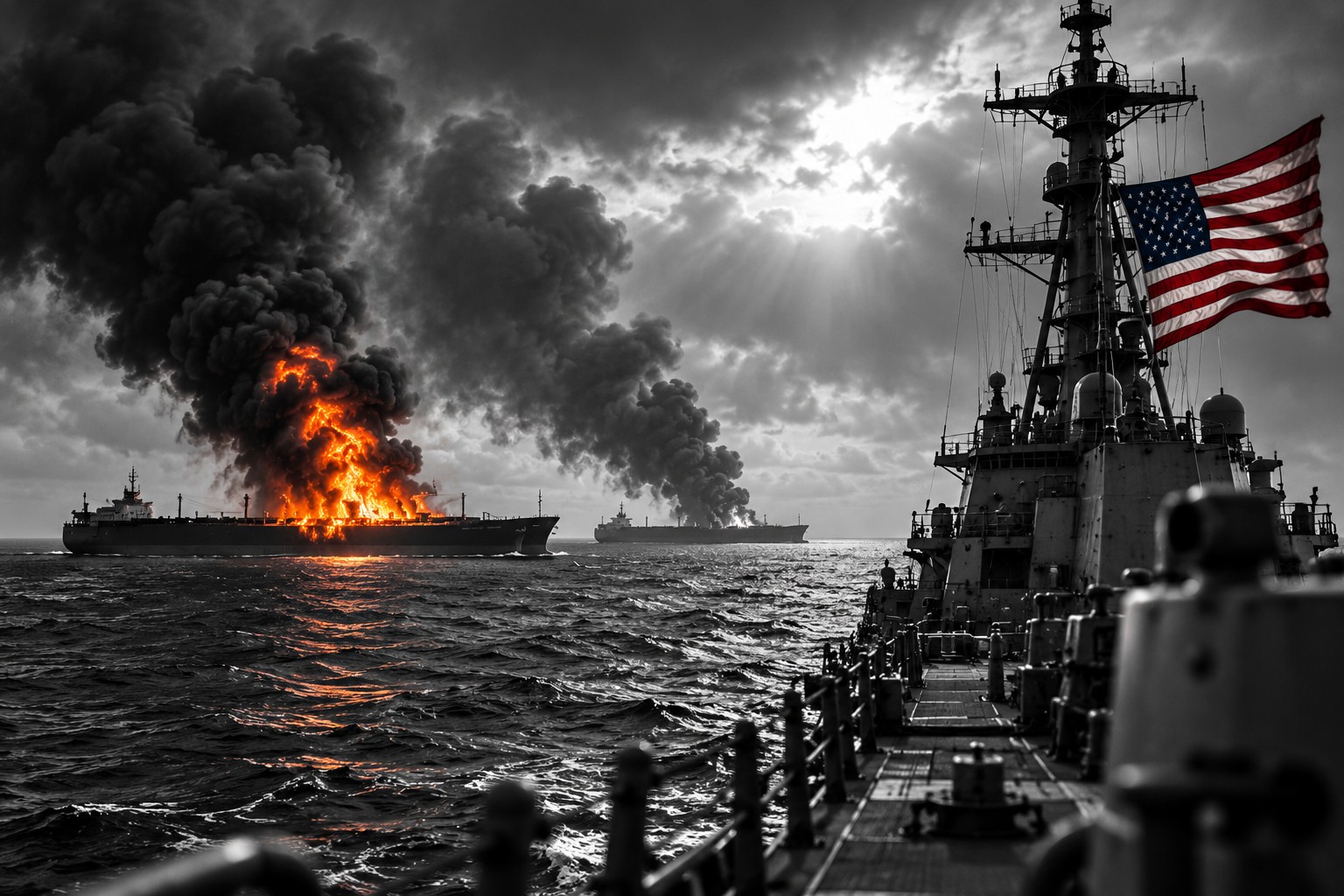
The United States says it has destroyed five Iranian oil tankers after Iran launched ballistic missiles at an American warship, triggering another round of retaliation that has spread from the Gulf of Oman to a US military base in Jordan and pushed oil prices towards $100 a barrel.
Five tankers targeted
US Central Command said American forces struck five Iranian crude carriers on Tuesday after Iran’s Islamic Revolutionary Guard Corps targeted a US Navy warship twice with ballistic missiles over two days.
Four vessels were attacked in the Gulf of Oman and another near Kharg Island, the centre of Iran’s oil-export infrastructure. According to Washington, crews were instructed to abandon the vessels before they were struck and rendered inoperable. The US warship avoided the Iranian missiles and no American personnel were injured.


Iran strikes back in Jordan
Iran responded by firing ballistic missiles at a military base near Al Azraq in Jordan used by US forces.
Jordan said its air-defence systems intercepted 18 of 20 incoming missiles, while two landed in unpopulated areas. No casualties were reported. Iran claimed that the attack caused significant damage, but US officials said American forces were accounted for and the strike had been ineffective.
The IRGC also said it had attacked ten ships, including two US vessels and eight oil tankers, attempting to move through an area of the Strait of Hormuz that Tehran has declared unsafe.
Oil markets feel the pressure
The renewed confrontation has rapidly increased concern over energy supplies. The Strait of Hormuz remains one of the world’s most important routes for crude oil and liquefied natural gas, and shipping traffic through the waterway has fallen sharply.
Oil prices moved close to $100 a barrel as markets assessed the possibility of further disruption to Gulf exports. Shipping data also showed traffic through Hormuz remaining well below recent averages.
Risk of a wider regional conflict
The latest exchange follows a period of relative calm in August but signals that Washington and Tehran are again prepared to target economically and strategically important assets.
Iran-backed Houthi forces have meanwhile launched attacks against Saudi Arabian cities and oil infrastructure, further widening the geographical scope of the violence.
With military bases, warships, tankers and energy installations increasingly becoming targets, the immediate economic danger is no longer limited to Iran and the United States. A sustained disruption of Gulf shipping could quickly affect global energy prices, inflation and financial markets far beyond the Middle East.
Newshub Editorial in Asia – 9 September 2026

Ask NF GPT
If you have an account with ChatGPT you get deeper explanations,
background and context related to what you are reading.
The United States says it has destroyed five Iranian oil tankers after Iran launched ballistic missiles at an American warship, triggering another round of retaliation that has spread from the Gulf of Oman to a US military base in Jordan and pushed oil prices towards $100 a barrel.
Recent Comments