
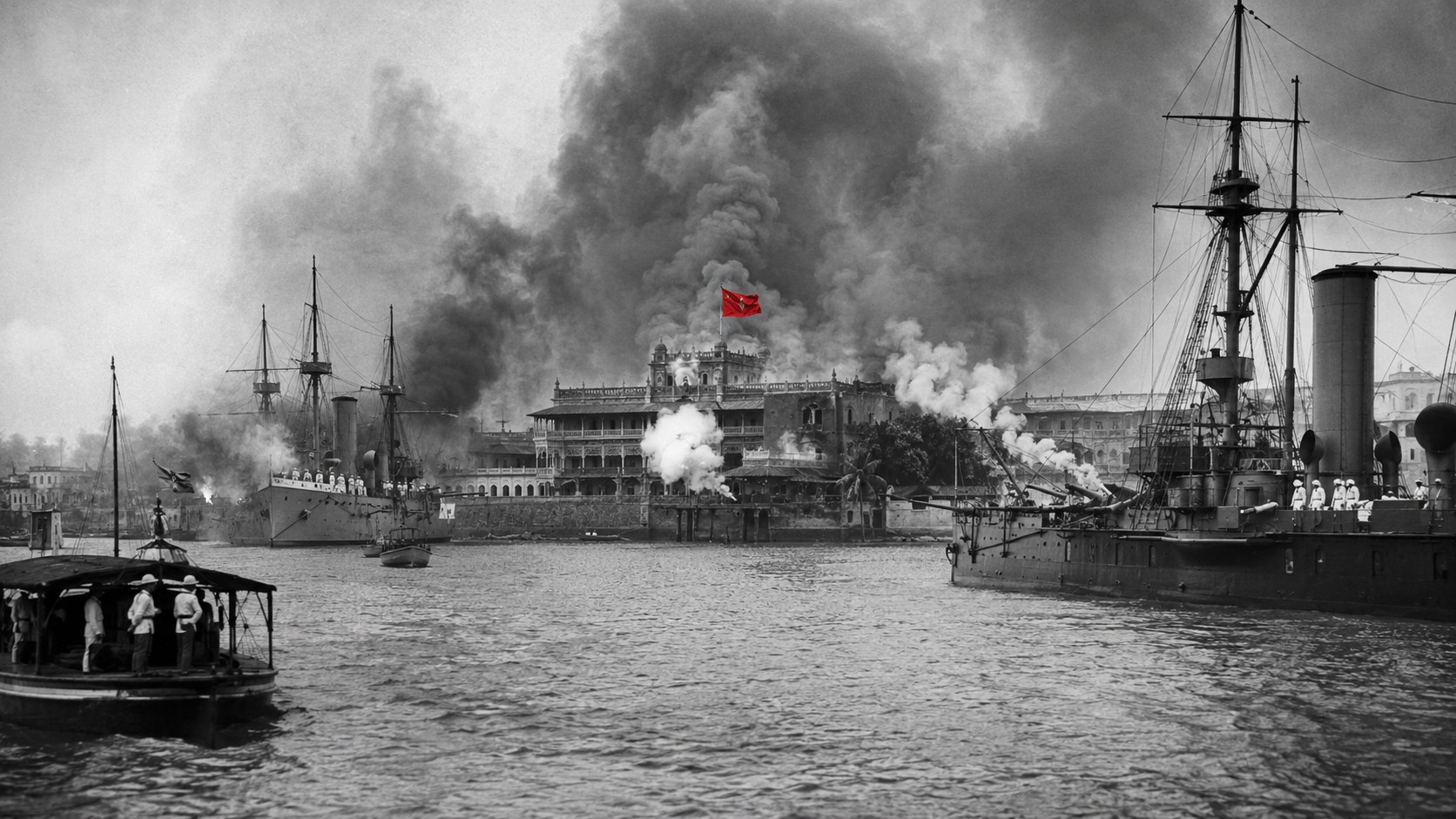
On this day in 1896, Britain and the Sultanate of Zanzibar fought what is widely regarded as the shortest war in recorded history. The Anglo-Zanzibar War began shortly after 09:00 on 27 August and ended roughly 38 minutes later, leaving the British Empire firmly in control of the strategically important East African island.
A disputed succession
The confrontation followed the sudden death of Sultan Hamad bin Thuwaini on 25 August 1896. Khalid bin Barghash immediately occupied the royal palace and declared himself the new sultan. Britain refused to recognise his accession because, under the terms of the protectorate, a new ruler was expected to receive approval from the British consul.
British officials instead supported Hamoud bin Mohammed, whom they considered more favourable to their political and commercial interests. Zanzibar occupied an important position in the Indian Ocean and had long been a centre for regional trade between East Africa, Arabia and Asia.


An ultimatum backed by warships
Britain ordered Khalid to leave the palace, disband his forces and surrender his claim to the throne. When he refused, British naval vessels assembled in the harbour alongside marines, sailors and Zanzibari troops loyal to the British-backed administration.
Khalid gathered approximately 2,800 defenders around the palace complex. His forces possessed rifles, machine guns and several artillery pieces, while the royal yacht Glasgow was positioned in the harbour. Despite the overwhelming British firepower facing him, Khalid apparently believed the threat of military action was a bluff.
The war begins and ends
The British ultimatum expired at 09:00 on 27 August. Minutes later, Royal Navy ships opened fire on the palace, rapidly destroying its artillery positions and setting parts of the largely wooden complex ablaze.
The Glasgow attempted to engage the British fleet but was quickly hit and sank in the shallow harbour. Its crew surrendered and was rescued. By approximately 09:40, the palace flag had been brought down and the bombardment stopped. Depending on the precise starting time used, historians estimate that the war lasted between 38 and 45 minutes.
A brief but deadly conflict
Its extraordinary brevity did not make the conflict bloodless. Around 500 Zanzibaris were reportedly killed or wounded, including palace defenders and civilians. On the British side, only one sailor was seriously injured.
Khalid escaped from the palace and sought refuge inside the German consulate. He was later transported to German East Africa, while Britain installed Hamoud bin Mohammed as sultan before the end of the day.
Imperial power behind the record
The Anglo-Zanzibar War is often remembered as a historical curiosity, but its consequences were substantial. It demonstrated the enormous military imbalance between European imperial powers and local states during the late nineteenth century.
Britain’s victory strengthened its political control over Zanzibar and reduced the sultanate’s remaining independence. The newly installed ruler governed with limited authority under British influence, while Zanzibar remained a British protectorate until gaining independence in 1963.
More than a 38-minute war
The conflict’s record-breaking length can obscure its wider meaning. Behind the dramatic timetable was a struggle over sovereignty, trade routes and imperial control in East Africa.
The war ended almost as soon as it began, but the political order it enforced endured for decades. What lasted less than an hour on 27 August 1896 became one of the clearest examples of nineteenth-century gunboat diplomacy.
Newshub Editorial in Africa – 27 August 2026

Ask NF GPT
If you have an account with ChatGPT you get deeper explanations,
background and context related to what you are reading.
On this day in 1896, Britain and the Sultanate of Zanzibar fought what is widely regarded as the shortest war in recorded history. The Anglo-Zanzibar War began shortly after 09:00 on 27 August and ended roughly 38 minutes later, leaving the British Empire firmly in control of the strategically important East African island.
Recent Comments