
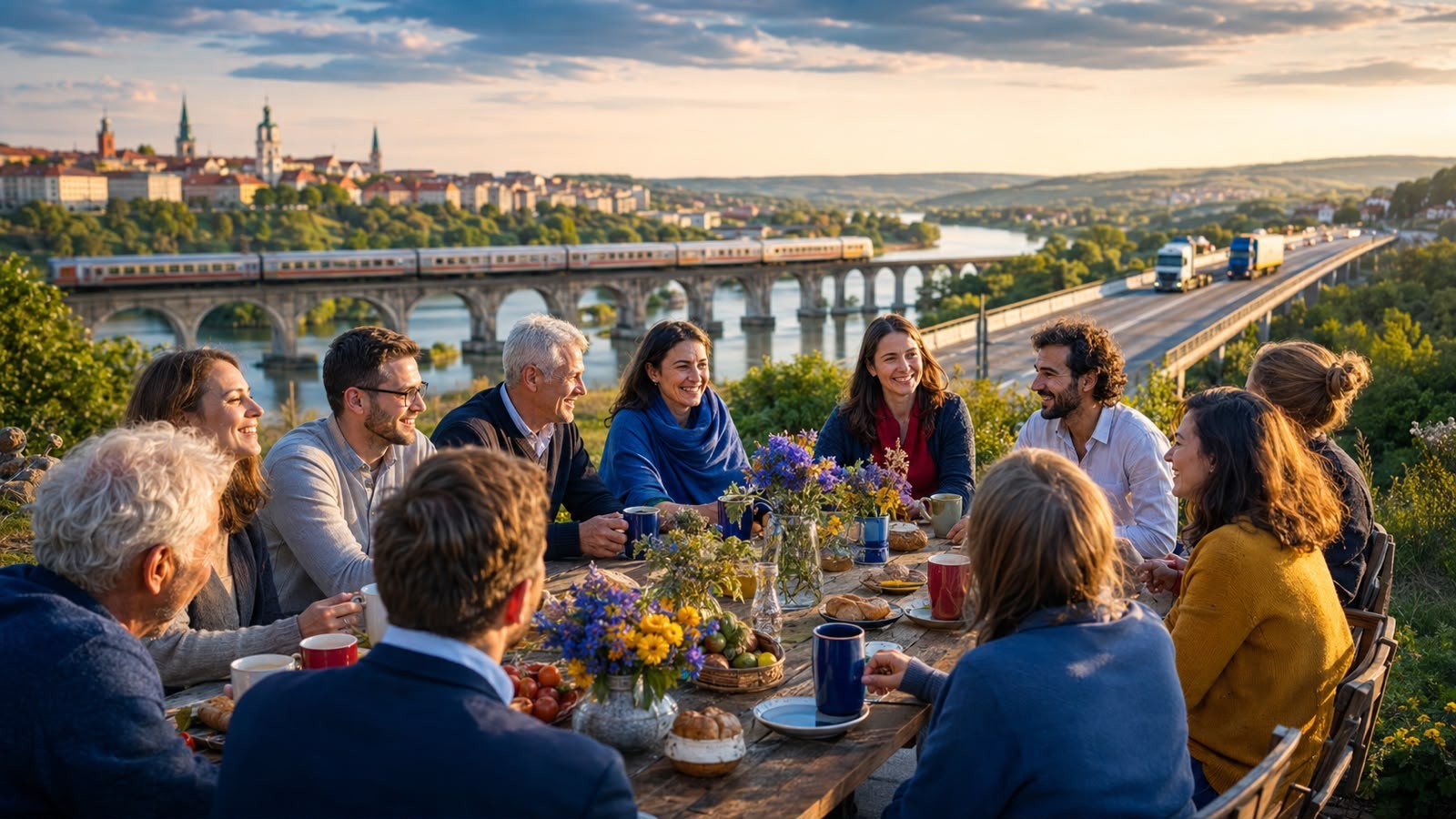
Russia and Europe could stop confronting each other — and start building together
What if the war in Ukraine is not as impossible to resolve as it appears? What if the principal obstacle is not the absence of a possible solution, but a political environment in which every compromise is treated as defeat and every act of restraint is interpreted as weakness?
The conflict has become a contest of fear, pride and prestige. Nobody wants to move first. Nobody wants to lose face, and every side is waiting for the other to blink.
Perhaps the solution is to stop playing that game.

The leaders of Europe should sit down for coffee with President Vladimir Putin and Ukrainian representatives and place a serious, balanced proposal on the table.
Russia stops the war in Ukraine. Ukraine’s freedom and sovereignty are secured. Russia and Europe begin reopening to one another. Both sides move simultaneously and on equal terms.
This would not be Europe inviting Russia back. It would not be Russia asking Europe for forgiveness. It would not involve one side opening its doors while the other remains still.
It would be a 50–50 European reset.
Release the tension from both sides
The present relationship between Russia and Europe resembles a rubber band stretched to its breaking point.
If only one side releases it, that side risks being hurt. If both sides release it at the same time, the tension disappears.
That should be the fundamental architecture of a future peace agreement.
Russia would stop its military operations in Ukraine. Europe would simultaneously begin lifting corresponding economic restrictions. Russia would reopen its market to European companies, investment and cooperation, while Europe would open equivalent sectors to legitimate Russian participation.
Every verified action by one side would be matched by a corresponding action from the other.
Nobody would be required to move first and then wait indefinitely. Nobody would receive every benefit in advance. Nobody would be forced to stand before a domestic audience and publicly announce defeat.
The mechanism could be straightforward.
Verified peace would produce an immediate economic opening. Continued peace would produce progressively deeper cooperation. Renewed military action would automatically suspend the benefits.
This would not be surrender.
It would be a simultaneous release of pressure.
Ukraine must remain free
The immediate issue that must be resolved is the war in Ukraine.
Ukraine must remain a free, sovereign and secure country. It must control its political future, its economy and its natural resources. No settlement concerning Ukraine can be concluded without full Ukrainian participation and consent.
At the same time, every territorial dispute does not have to be permanently resolved before the shooting stops.
Military movements could be frozen. Heavy weapons could be withdrawn from agreed areas. Attacks on cities, energy systems and civilian infrastructure could end immediately. International observers could be deployed to monitor compliance, while prisoners of war and detained civilians could be returned.
The most difficult territorial questions could then be placed within a long-term political and diplomatic process.
Neither Russia nor Ukraine would have to begin by publicly abandoning its legal position. The parties would stop fighting first and continue negotiating from there.
It is better to spend ten years discussing a border around a table than ten years burying people along it.
Under such an agreement, Ukraine would receive security guarantees, reconstruction assistance and deeper economic integration with Europe. Russia would receive confidence that the settlement was not merely a temporary pause before another military confrontation.
The first objective should not be to solve every historical disagreement.
It should be to stop the war quickly and create conditions in which returning to war becomes irrational.
Nobody must lose face
A sustainable settlement must take political psychology seriously.
Russia must be able to explain to its population that it ended the military phase because a new relationship with Europe had become possible.
Ukraine must be able to explain that it defended its freedom, preserved its sovereignty and secured its European future.
Europe must be able to explain that it helped protect Ukraine while replacing permanent confrontation with a safer continental order.
Nobody needs to kneel. Nobody needs to hold a victory parade over the other.
Equal dignity does not mean pretending that every action taken during the conflict has been equivalent. It means recognising that public humiliation is a poor foundation for lasting peace.
The objective should not be to win the final argument.
The objective should be to stop people from dying.
Russia and Europe are already connected
Russia and Europe are not distant civilisations without a natural relationship.
They share geography, history, commerce, science, art and culture. Russian literature, music, ballet, mathematics, engineering and medicine are woven deeply into the broader European cultural landscape.
European and Russian families, universities, companies and cities have been connected for generations.
Most Russians want many of the same things as other Europeans: safety, meaningful work, opportunities for their children, the freedom to travel and the ability to enjoy what they have built.
They want to invite friends to the dacha, prepare food, sit together and feel proud of their homes and families.
Political systems may differ, and governments may continue to distrust one another, but ordinary people are not natural enemies.
That human connection could recover much faster than diplomatic trust.
Universities could cooperate again. Researchers could restart scientific projects. Artists could perform across borders. Tourists could return. Families could visit one another, and entrepreneurs could build companies together.
Relations between governments might take years to repair.
Relations between people could begin over dinner.
The roads are still there
The war has closed routes, disrupted supply chains and stopped travel.
But geography has not changed.
The roads still exist.
Railway lines continue to connect east and west. Ports remain on the Baltic and Black Seas. Pipelines, electricity systems, border stations and freight terminals still form parts of a single continental network.
Routes stretch from Western and Central Europe through Ukraine and Russia towards the Caucasus, Central Asia and the Pacific.
Today, many of those roads and railway lines end at political barriers. After peace, they could become the arteries of a new economic area.
Imagine freight moving safely between Russian, Ukrainian and European cities. Imagine modern railway corridors, protected Black Sea shipping routes, new logistics centres and simplified customs systems.
Imagine Ukraine’s ports functioning at full capacity and its damaged infrastructure being rebuilt as part of a broader continental network.
Infrastructure can transport soldiers and weapons.
Or it can transport people, machinery, food and ideas.
That choice can be made.
Open both markets at the same time
Before Russia’s full-scale invasion of Ukraine, annual trade in goods between Russia and the European Union amounted to approximately €257.5 billion. By 2025, it had fallen to about €58.1 billion, according to European Commission figures.
The commercial relationship has been severely damaged, but the economic logic behind it has not disappeared.
Russia possesses energy, agricultural capacity, fertiliser production, metals, minerals, scientific expertise and a large domestic market.
Europe possesses investment capital, machinery, pharmaceuticals, industrial technology, consumer products and extensive international commercial networks.
Ukraine possesses agricultural strength, engineering expertise, technology, ports, energy infrastructure, mineral resources and enormous reconstruction potential.
These strengths can continue to be used against one another — or they can be connected.
A peace settlement could progressively reopen banking and civilian payments, road and railway transport, shipping and aviation, agriculture and food production, energy and electricity cooperation, machinery and industrial equipment, technology and telecommunications, tourism and cultural exchange, research and education, construction and reconstruction, investment and entrepreneurship.
The opening would have to be equal and reciprocal.
European companies would receive secure and fair access to Russia. Russian companies would receive corresponding access to Europe. Ukrainian companies would participate as sovereign partners rather than as subsidiaries of a settlement negotiated by larger powers.
Investments would receive legal protection, and commercial disputes would be handled through credible and independent arbitration.
Neither side would be permitted to use energy, finance or infrastructure as a political weapon.
Such an arrangement should not recreate the dangerous dependencies of the past.
It should build a more balanced relationship.
Turn resources into reasons for peace
Russia and Ukraine possess enormous natural and industrial resources. The region contains energy reserves, agricultural land, fertiliser production, metals, minerals, ports, pipelines and power systems.
Today, these assets are surrounded by military competition.
After peace, they could become reasons to protect the relationship.
Ukraine must retain ownership of its resources. Russia must retain ownership of its lawful resources. Any future cooperation must be voluntary, commercial and legally protected.
Joint or internationally supported projects could include gas production and storage, critical minerals and strategic metals, agriculture and fertilisers, nuclear safety and electricity infrastructure, Black Sea ports and shipping, roads, railways and freight terminals, steel and reconstruction materials, and digital and communications infrastructure.
A share of the revenue from agreed regional projects could support Ukrainian reconstruction and economic development on both sides of the border.
That would create a simple new reality.
Infrastructure would become more valuable intact than destroyed. Ports would become more valuable open than blockaded. Railways would become more valuable carrying goods than carrying weapons.
Trade cannot erase political disagreements, settle every territorial dispute or repair every human wound.
But it can help make another war economically irrational.
A stronger Russia and a stronger Europe
A future settlement should not require either Russia or Europe to become weaker.
Russia would regain broad access to European markets, investment, technology, research and human exchange. It would expand its economic choices and strengthen its potential role as a bridge between Europe and Asia.
Europe would regain access to a large neighbouring market and new transport corridors while participating in the reconstruction of Ukraine. It would strengthen its own economy and accept greater responsibility for peace on its continent.
Ukraine would no longer be trapped as a battlefield between larger powers. It could instead become a central commercial, agricultural and infrastructure bridge between Russia and the European Union.
The relationship would not be based on dependence.
It would be based on balance.
Russia should not control Europe’s energy security. Europe should not attempt to dictate Russia’s economic future. Ukraine should never be treated as territory to be divided between larger states.
Each participant would remain independent.
All three could become more prosperous through cooperation.
Begin with coffee
A final agreement would require diplomats, lawyers, military experts, economists and technical specialists. Thousands of difficult details would have to be resolved.
Security guarantees would need to be credible. Monitoring mechanisms would have to be independent. Sanctions relief would need to be connected to verifiable actions. Reconstruction financing, trade protections, disputed territories, prisoners, displaced people and compensation would all require careful negotiation.
But the decision to change direction could begin simply.
Bring the principal European leaders, President Putin and authorised Ukrainian representatives to the same place.
Pour the coffee.
Remove the speeches written for domestic audiences. Stop asking which leader must confess defeat.
Place a balanced proposal on the table.
Russia stops the war. Ukraine remains free and secure. Russia and Europe open to one another equally. Reconstruction and trade begin immediately. Every benefit expands as the peace proves itself.
Then ask three questions.
What do your people need?
What can you offer the others?
What future is more valuable than continued war?
The answers may reveal more common ground than the present political rhetoric allows anyone to admit.
The deal hiding in plain sight
This is not Europe welcoming Russia back.
It is Russia and Europe meeting each other halfway.
It is not Ukraine being traded between larger powers. It is Ukraine receiving the peace, freedom, security and economic future it needs.
Nobody receives everything. Nobody is forced to kneel. Nobody is required to accept public humiliation.
Russia gains peace, trade, investment and a respected place within a wider European economic relationship.
Ukraine gains freedom, security, reconstruction and control over its future.
Europe gains peace, growth and a safer relationship with its eastern neighbour.
The roads reopen. The railways begin moving. Ports return to commerce. Students travel. Families meet. Businesses invest. Infrastructure is rebuilt.
The war has closed borders.
It has not erased geography.
It has not erased shared interests.
And it has not erased the possibility that Russia, Ukraine and Europe could stop measuring strength through confrontation — and begin demonstrating it through peace.
Newshub Editorial in Europe – 3 August 2026

Ask NF GPT
If you have an account with ChatGPT you get deeper explanations,
background and context related to what you are reading.
What if the war in Ukraine is not as impossible to resolve as it appears? What if the principal obstacle is not the absence of a possible solution, but a political environment in which every compromise is treated as defeat and every act of restraint is interpreted as weakness?
Recent Comments