
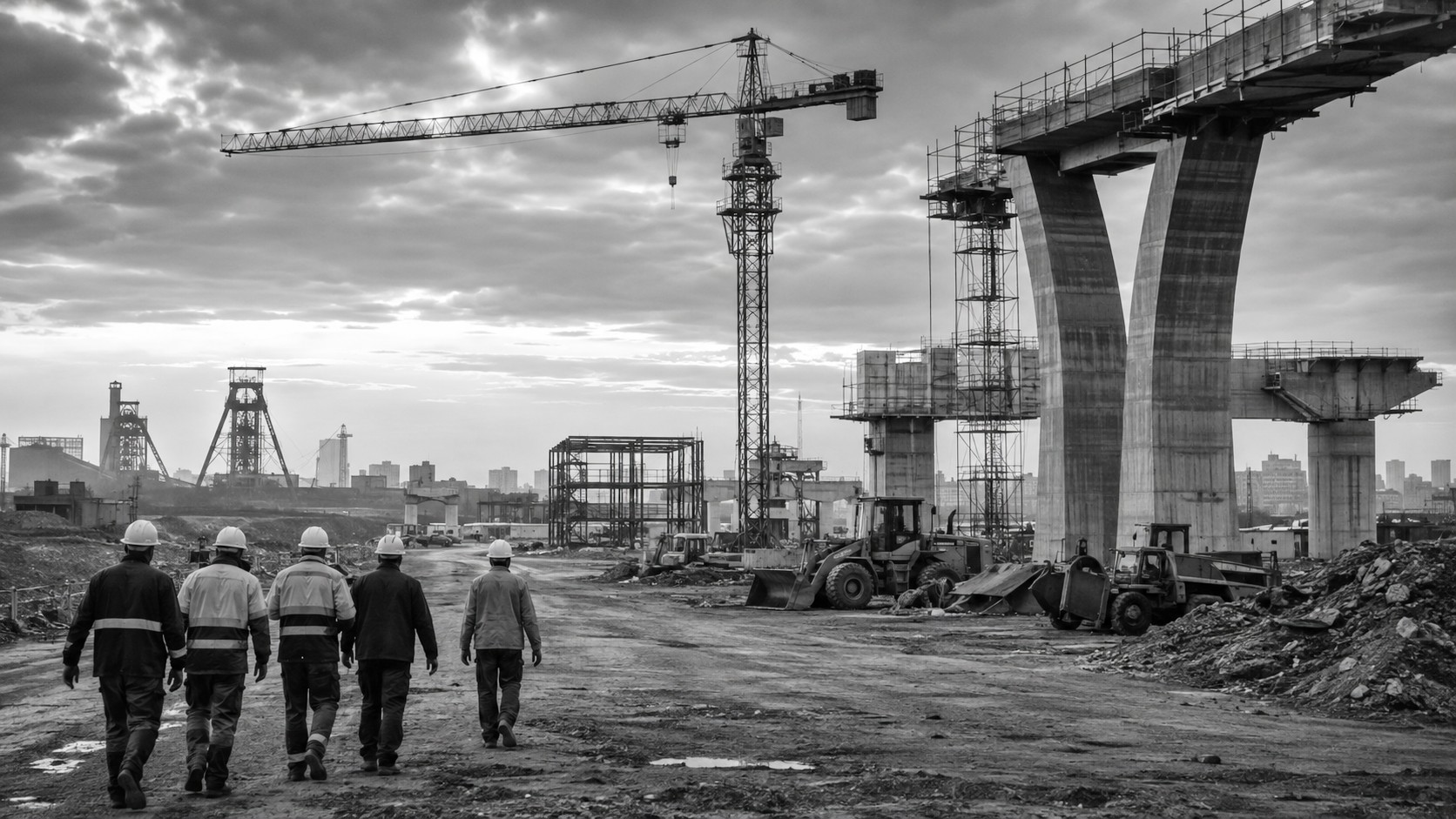
The collapse of Murray & Roberts, once one of South Africa’s most powerful engineering and construction groups, has brought an extraordinary 124-year industrial history to an end and intensified concerns that the country is undergoing premature deindustrialisation.
The company’s final valuable operations have been acquired by a consortium of investors following a prolonged financial crisis. A group led by Differential Capital completed the acquisition of Murray & Roberts’ mining interests for approximately R1.27bn in June, preserving parts of the operating business but leaving the historic holding company without a viable commercial future.
Liquidation proceedings began in 2025, while Murray & Roberts was removed from the Johannesburg Stock Exchange in January 2026.


A company that helped build modern South Africa
Murray & Roberts traced its history to 1902, when Murray & Stewart began constructing houses in the Cape Colony. The business listed on the Johannesburg Stock Exchange in 1951 and adopted its modern name following a merger with Roberts Construction in 1967.
It subsequently became a symbol of South African engineering expertise. The company participated in the construction of the Gautrain rapid railway, built Cape Town Stadium for the 2010 FIFA World Cup and served as the principal contractor for Johannesburg’s Carlton Centre.
Internationally, Murray & Roberts was involved in projects including Dubai International Airport and developed one of the world’s largest underground mining contracting businesses, with operations across Africa, Australia and the Americas.
Expansion creates financial pressure
Analysts have traced part of the company’s decline to an ambitious international diversification strategy. Murray & Roberts expanded into mining, oil and gas, energy, transport and infrastructure, exposing the group to complex projects with narrow profit margins.
Its investment in Australian engineering company Clough became particularly challenging. Murray & Roberts initially acquired a 29.3% stake in 2004 before taking complete control in 2013.
Delays, cost overruns and low-margin energy projects placed increasing pressure on the group’s finances. By early 2023, its debts had reached approximately R1.4bn after an attempt to sell Clough failed.
South African problems added to the pressure. Murray & Roberts participated in the Medupi and Kusile power station projects for Eskom, but delayed payments from the heavily indebted state electricity provider weakened cash flow. The Covid-19 pandemic then interrupted construction and mining activity around the world.
A warning for South African industry
The disappearance of Murray & Roberts follows the difficulties experienced by several other major South African industrial businesses. Construction group Group Five entered liquidation in 2019, while agro-industrial company Tongaat Hulett entered business rescue in 2022. ArcelorMittal South Africa has also reduced production amid weak demand, expensive electricity and competition from imported steel.
Manufacturing represented around 25% of South Africa’s gross domestic product during the 1980s. Its contribution has since fallen to approximately 12%. Manufacturing employment declined from around 1.4m workers in 2005 to slightly more than one million in 2021.
Large engineering companies support extensive networks of steel producers, cement suppliers, machinery manufacturers, subcontractors and skilled workers. Their loss consequently affects much more than shareholders and direct employees.
Murray & Roberts’ decline resulted from company-specific strategic and financial decisions, but it also reflects the effects of unreliable electricity, weak infrastructure investment and declining industrial competitiveness. Its collapse now leaves South Africa confronting the loss of another institution that once demonstrated the country’s ability to deliver major projects at home and abroad.
Newshub Editorial in Africa – 3 August 2026

Ask NF GPT
If you have an account with ChatGPT you get deeper explanations,
background and context related to what you are reading.
The collapse of Murray & Roberts, once one of South Africa’s most powerful engineering and construction groups, has brought an extraordinary 124-year industrial history to an end and intensified concerns that the country is undergoing premature deindustrialisation.
Recent Comments