
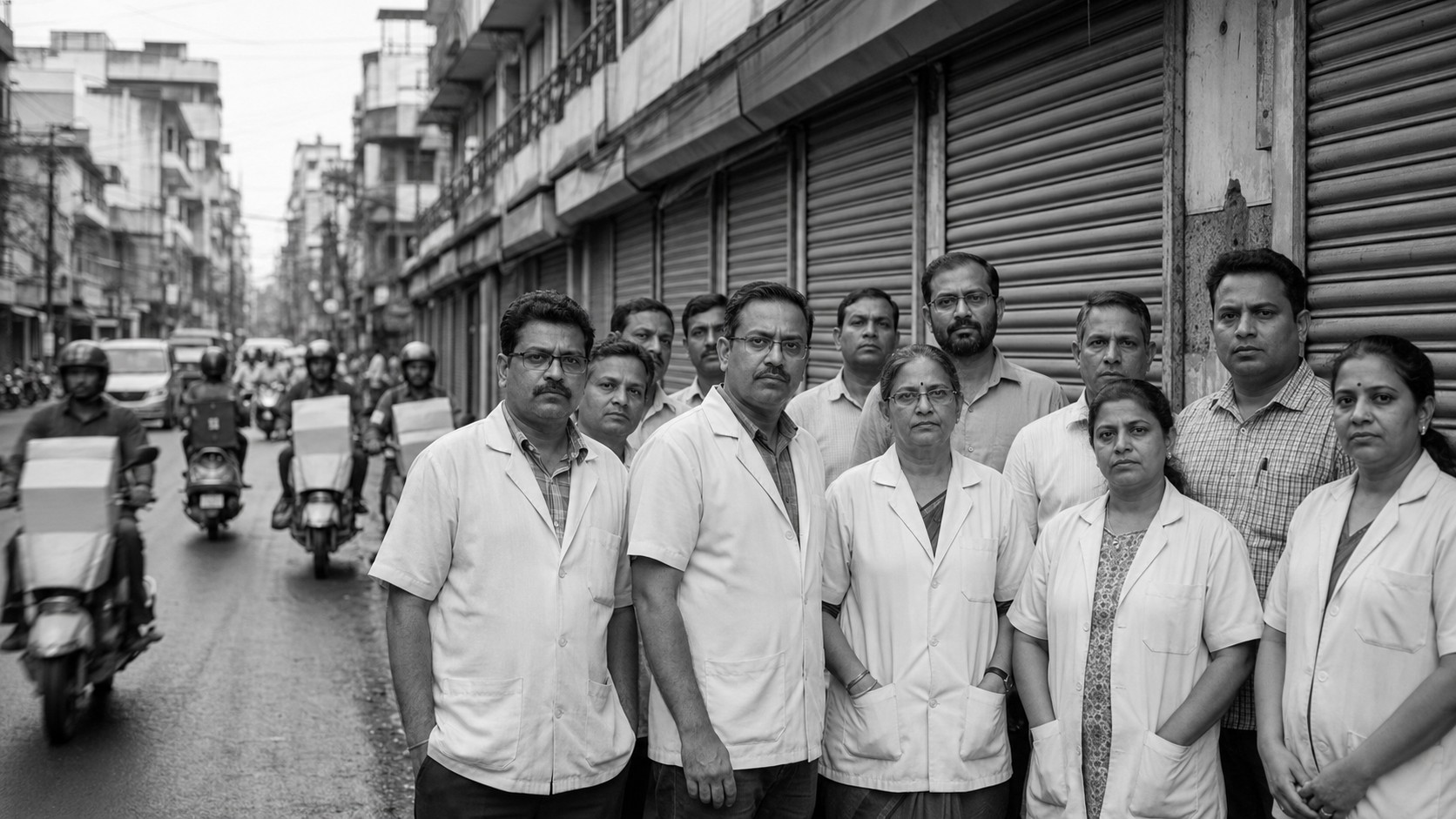
India’s independent pharmacists have intensified their campaign against online medicine retailers, arguing that deep discounts, rapid delivery services and inconsistent prescription checks are threatening both traditional businesses and patient safety. The dispute has developed into one of the country’s most significant confrontations between established retailers and digital commerce platforms.
The All India Organisation of Chemists and Druggists organised a nationwide shutdown on 20 May, supported by pharmacy owners and distributors across multiple states.
The organisation said more than 1.2m chemists and pharmaceutical distributors participated or supported the action, while around 800,000 medical shops were expected to close. Emergency pharmacies remained open in some locations to reduce the impact on patients requiring urgent medicines.


In Mumbai, approximately 20,000 medical shops reportedly joined the shutdown. Around 200 pharmacies were kept open to provide emergency services.
Discounts increase financial pressure
Traditional pharmacy owners argue that ecommerce companies are using investor funding and large corporate balance sheets to offer discounts of between 20% and 50%, levels that smaller retailers cannot match.
Industry representatives describe the practice as predatory pricing intended to capture market share before discounts are eventually reduced. Online companies counter that centralised purchasing, digital administration and more efficient distribution allow them to operate at lower cost.
For consumers, discounted medicines and home delivery can be valuable, particularly for older people, patients with chronic conditions and those living far from a well-stocked pharmacy.
The conflict therefore extends beyond competition between different retail models. It raises questions about how medicine prices, convenience and access should be balanced against the continued presence of community pharmacists.
Concerns over prescriptions and safety
Pharmacy organisations say some online platforms have supplied regulated medicines against prescriptions that were inadequately verified. They have also raised concerns about prescriptions allegedly created or altered using artificial intelligence.
Chemists argue that narcotics, sleeping pills, antibiotics and abortion medication can sometimes be obtained without the physical identity and age checks routinely expected inside licensed pharmacies.
Online operators reject broad accusations that ecommerce pharmacy is inherently unsafe. They argue that digital records can improve traceability, identify unusual purchasing patterns and provide patients with access to qualified pharmacists.
The central problem is India’s incomplete regulatory framework. Existing medicine legislation was largely written before ecommerce, while proposed national rules specifically covering electronic pharmacies have remained under discussion for years.
Temporary provisions introduced during the Covid-19 pandemic permitted home delivery of medicines. Traditional chemists now claim those measures are being used to support permanent business models without sufficient regulatory oversight.
A dispute requiring clearer rules
India has experienced similar protests before. As many as 850,000 pharmacies closed during a nationwide strike against online medicine sales in October 2015. More than a decade later, digital platforms have become larger and consumer dependence on home delivery has increased considerably.
A complete prohibition on online pharmacies could reduce access and competition. Allowing digital sales to expand without clear enforcement could create risks involving prescription abuse, counterfeit products, data privacy and unsafe storage.
A sustainable framework would require identical standards for physical and online sellers. These could include compulsory licensing, verified prescriptions, pharmacist supervision, secure patient records, cold-chain monitoring and stricter controls on regulated medicines.
The continuing backlash shows that ecommerce has changed Indian pharmaceutical retail faster than the country’s rules have evolved. Unless regulators establish a level and enforceable system, further confrontation between neighbourhood chemists and online platforms appears likely.
Newshub Editorial in Asia – 3 August 2026

Ask NF GPT
If you have an account with ChatGPT you get deeper explanations,
background and context related to what you are reading.
India’s independent pharmacists have intensified their campaign against online medicine retailers, arguing that deep discounts, rapid delivery services and inconsistent prescription checks are threatening both traditional businesses and patient safety. The dispute has developed into one of the country’s most significant confrontations between established retailers and digital commerce platforms.
Recent Comments