
• Global
    • Africa
      • Burundi
      • Ghana
      • Gambia
      • Senegal
    • Asia
      • Indonesia
      • Laos
      • Malaysia
      • South Korea
    • Caribbean
      • Central America
    • Climate & energy
      • Climate
      • Carbon
      • Coal
      • Disruptive
      • Gas
      • Nuclear
      • Oil
      • Solar
      • Water
      • Waves
      • Wind
      • Renewable
      • South America
    • Lifestyle
      • Best chefs
      • Cocktail of the week
      • History
      • Influential women
      • Newshub long-read
    • US politics
      • Epstein
    • War
  • Finance
    • Africa finance
    • Australia
    • Asia finance
    • Banking
    • Business of the week
    • Central Banks
    • China
    • Commodities
    • Corporate
    • Europe
    • Investment
    • Japan
    • MSTRpay
    • Neobanking
    • South East Asia
    • UK
    • US
  • Fintech
    • Tech
    • AI
    • Blockchain
  • Financial inclusion
  • Editorial services
  • Press releases
Sunday, August 2, 2026
  • Login
No Result
View All Result
Newshub Finance
  • Global
    • Africa
      • Burundi
      • Ghana
      • Gambia
      • Senegal
    • Asia
      • Indonesia
      • Laos
      • Malaysia
      • South Korea
    • Caribbean
      • Central America
    • Climate & energy
      • Climate
      • Carbon
      • Coal
      • Disruptive
      • Gas
      • Nuclear
      • Oil
      • Solar
      • Water
      • Waves
      • Wind
      • Renewable
      • South America
    • Lifestyle
      • Best chefs
      • Cocktail of the week
      • History
      • Influential women
      • Newshub long-read
    • US politics
      • Epstein
    • War
  • Finance
    • Africa finance
    • Australia
    • Asia finance
    • Banking
    • Business of the week
    • Central Banks
    • China
    • Commodities
    • Corporate
    • Europe
    • Investment
    • Japan
    • MSTRpay
    • Neobanking
    • South East Asia
    • UK
    • US
  • Fintech
    • Tech
    • AI
    • Blockchain
  • Financial inclusion
  • Editorial services
  • Press releases
  • Global
    • Africa
      • Burundi
      • Ghana
      • Gambia
      • Senegal
    • Asia
      • Indonesia
      • Laos
      • Malaysia
      • South Korea
    • Caribbean
      • Central America
    • Climate & energy
      • Climate
      • Carbon
      • Coal
      • Disruptive
      • Gas
      • Nuclear
      • Oil
      • Solar
      • Water
      • Waves
      • Wind
      • Renewable
      • South America
    • Lifestyle
      • Best chefs
      • Cocktail of the week
      • History
      • Influential women
      • Newshub long-read
    • US politics
      • Epstein
    • War
  • Finance
    • Africa finance
    • Australia
    • Asia finance
    • Banking
    • Business of the week
    • Central Banks
    • China
    • Commodities
    • Corporate
    • Europe
    • Investment
    • Japan
    • MSTRpay
    • Neobanking
    • South East Asia
    • UK
    • US
  • Fintech
    • Tech
    • AI
    • Blockchain
  • Financial inclusion
  • Editorial services
  • Press releases
No Result
View All Result
Newshub Finance
No Result
View All Result
Download MSTRpay app Download MSTRpay app Download MSTRpay app
ADVERTISEMENT

The hidden carbon war

The hidden carbon war

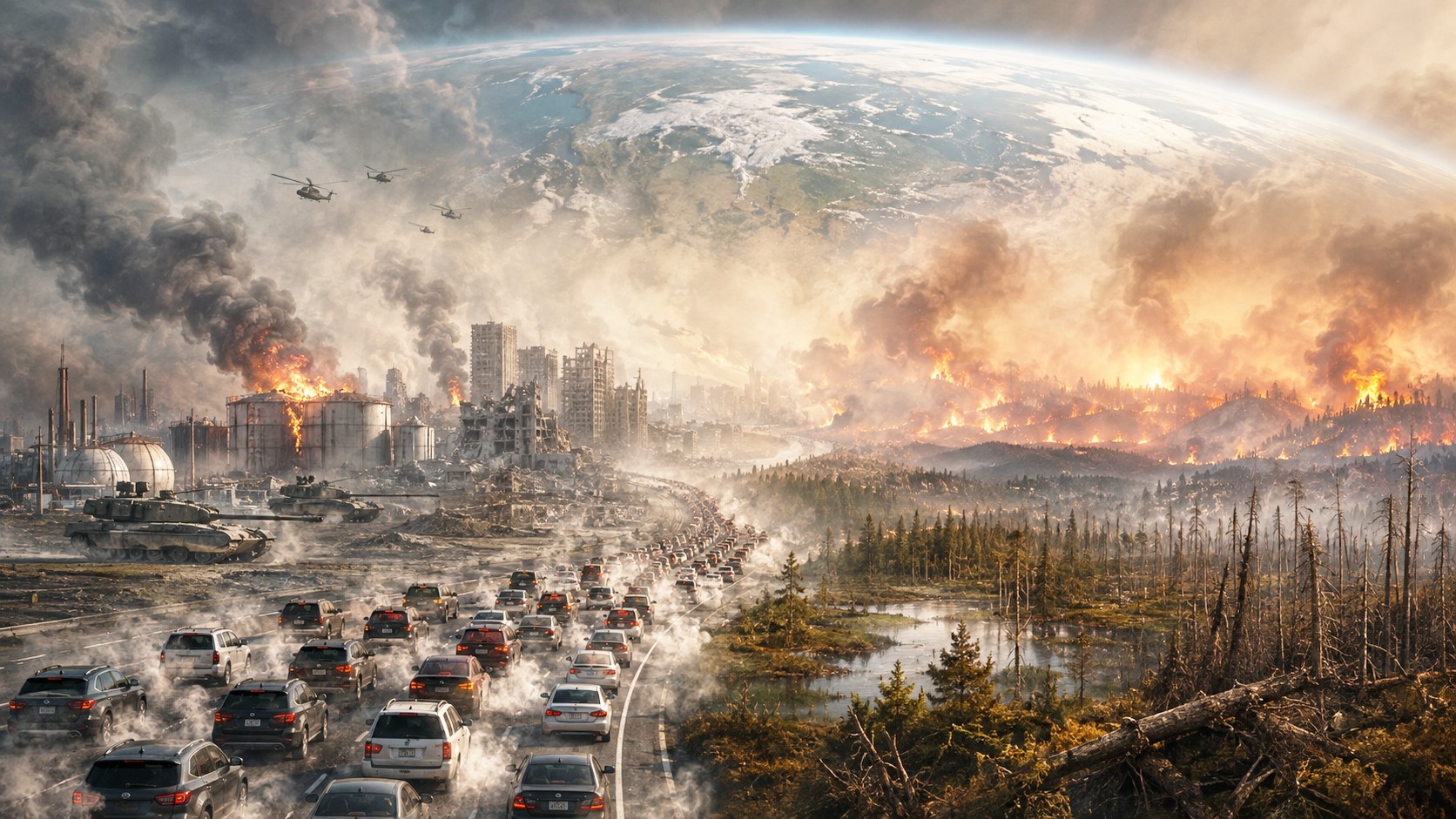
Wars, wildfires and a failing planet now equal nearly two billion cars

While governments argue over electric vehicles, household energy use and aviation, an enormous and largely unreported source of carbon emissions is accelerating in the background.

War is burning fuel, cities and infrastructure. Wildfires are releasing carbon accumulated over decades or centuries. Drought and extreme heat are weakening the forests and soils that would normally remove carbon dioxide from the atmosphere.

When these effects are combined carefully, without simply adding together every available headline figure, the result is staggering: the recent combined climate shock corresponds to approximately 1.8 billion petrol-powered cars being driven for an entire year.


Download the MSTRpay app Download the MSTRpay app Download the MSTRpay app

That is almost five times the previously discussed figure of 380 million cars.

The carbon cost of modern warfare
The latest assessment of Russia’s full-scale war against Ukraine estimates that the conflict generated approximately 311 million tonnes of carbon dioxide equivalent between February 2022 and February 2026.

The calculation includes military fuel consumption, destroyed energy infrastructure, reconstruction requirements, aviation diversions, fires and changes in civilian transport and energy use.

Of that total, approximately 114 million tonnes were attributed directly to military operations, while around 70 million tonnes were connected to fires occurring during the war, according to the Initiative on Greenhouse Gas Accounting of War and EcoAction.

The developing conflict involving Iran has also produced a substantial carbon footprint. One academic assessment estimated approximately 7.2 million tonnes of CO₂ equivalent during its initial 24 days. The uncertainty remains considerable, however, and the total will rise if destruction and reconstruction continue.

The Israel–Gaza war adds another estimated 33.2 million tonnes of CO₂ equivalent when direct military emissions, defensive infrastructure and anticipated reconstruction are included, according to research led by Queen Mary University of London.

Together, these three conflicts account for approximately 351 million tonnes of CO₂ equivalent.

Using the US Environmental Protection Agency’s estimate that an average passenger vehicle emits approximately 4.6 tonnes of CO₂ annually, the documented war emissions alone equal the yearly emissions of approximately 76 million cars.

This number is lower than 380 million because the earlier calculation appears to have used broader assumptions or projected future emissions. The present figure is based on the latest identifiable conflict assessments and should therefore be treated as the more conservative estimate.

The world’s forests are burning differently
Wildfires have always existed, and not every tonne released by a fire represents permanently additional atmospheric carbon. Some of that carbon can eventually be absorbed again as vegetation regrows.

However, that principle becomes less reliable when ancient forests, peatlands, wetlands and repeatedly burned ecosystems are destroyed. Regrowth can take decades or centuries, and some ecosystems may never fully recover.

During the March 2024 to February 2025 global fire season, wildfires released approximately 2.2 billion tonnes of carbon.

Carbon and carbon dioxide are not measured in the same units. After converting carbon into CO₂, the gross wildfire emissions amount to approximately 8.1 billion tonnes of CO₂.

This gross figure alone is equivalent to approximately 1.75 billion cars being driven for one year.

But it would be scientifically misleading simply to add all 8.1 billion tonnes to the war emissions. A substantial proportion of ordinary fire emissions is already part of the natural carbon cycle and may later be reabsorbed.

The more important finding is that fire emissions during the season were approximately 9 per cent above the long-term average, despite the globally burned area being below average.

The abnormal or excess portion was therefore approximately 670 million tonnes of CO₂. That excess alone equals the annual emissions of approximately 145 million cars.

The exceptional emissions were driven particularly by fires in Canada’s boreal forests and South America’s rainforests, dry forests and wetlands. Climate change made extreme fire conditions significantly more likely in several affected regions, according to the State of Wildfires 2024–2025 assessment.

The even larger danger: forests that stop absorbing carbon
The most consequential part of the calculation is not necessarily the visible flames. It is the carbon that forests and soils are no longer absorbing.

During the July 2023 to July 2024 El Niño period, researchers estimated that the global land carbon sink weakened by approximately 2.24 billion tonnes of carbon compared with the 2015–2022 average.

Converted into CO₂, this represents approximately 8.2 billion tonnes of carbon dioxide that remained in, or entered, the atmosphere instead of being absorbed by terrestrial ecosystems.

Fire emissions accounted for part of this change. Researchers estimated that approximately 0.3 billion tonnes of carbon — around 1.1 billion tonnes of CO₂ — were connected to fires.

The remaining deterioration came from heat, drought, ecosystem stress and reduced plant productivity, particularly in the Amazon, central Africa and Southeast Asia, according to the low-latency global carbon budget study.

The Global Carbon Budget separately concluded that the terrestrial carbon sink in 2023 was around 41 per cent weaker than in 2022 and approximately 28 per cent below its ten-year average.

This is crucial because a forest does not need to burn completely to worsen climate change.

A heat-stressed or drought-damaged forest may simply absorb less carbon. Trees may stop growing, lose leaves, die or become vulnerable to insects and subsequent fires.

From the atmosphere’s perspective, the result is effectively the same: more CO₂ remains overhead.

The combined calculation
To avoid counting the same wildfire emissions twice, the calculation should be presented as a range rather than as a single absolute number.

The conservative calculation includes:

  • Documented war emissions: 0.35 billion tonnes of CO₂e.
  • Abnormally high wildfire emissions: 0.67 billion tonnes of CO₂.
  • Reduced land absorption, excluding the estimated fire contribution: approximately 7.1 billion tonnes of CO₂.

The combined conservative atmospheric impact is therefore approximately 8.1 billion tonnes of CO₂e.

Using the EPA vehicle comparison, that equals approximately 1.76 billion petrol-powered cars being driven for one year.

In the broader ecosystem calculation, the complete estimated weakening of the land carbon sink is used together with documented war emissions. Because the complete weakening already incorporates the estimated fire contribution, exceptional wildfire emissions are not added again.

The result becomes approximately 8.6 billion tonnes of CO₂e — equivalent to approximately 1.87 billion petrol-powered cars being driven for one year.

A reasonable headline conclusion is therefore approximately 1.8 billion cars.

That is the best current representation of the combined atmospheric shock from the selected wars, exceptional fires and climate-related weakening of the planet’s terrestrial carbon sinks.

What has not been included
Even this calculation does not attempt to include everything. It excludes or only partially captures:

  • Future reconstruction of destroyed Ukrainian, Iranian, Israeli and Palestinian cities and infrastructure.
  • Other ongoing wars and military operations.
  • Emissions from global military supply chains where information is classified or unavailable.
  • Long-term loss of forests and peatlands that may take centuries to recover.
  • Carbon released by thawing permafrost.
  • Methane released by damaged pipelines, energy facilities, wetlands and warming ecosystems.
  • Additional electricity generation, cement, steel and shipping required for reconstruction.
  • Future fires resulting from forests already weakened by drought, heat or previous burning.

The actual long-term climate effect may therefore be considerably larger.

A dangerous feedback loop
The relationship between climate destruction and carbon emissions is no longer linear.

War destroys energy systems, forests, buildings and infrastructure. Reconstruction requires cement, steel, heavy machinery and transport.

Climate change produces hotter and drier conditions. Those conditions increase the probability of extreme fires.

The fires release more carbon and damage forests. The damaged forests absorb less carbon.

More carbon remains in the atmosphere, producing additional warming and creating the conditions for still more extreme fires.

This is a self-reinforcing climate loop.

The uncomfortable conclusion
Citizens are repeatedly told to drive less, recycle more and reduce household emissions.

Those measures remain important. But they exist alongside carbon events of a completely different magnitude.

A handful of wars, one extreme global fire season and a temporarily weakened terrestrial carbon sink can create an atmospheric impact comparable to placing approximately 1.8 billion additional petrol-powered cars on the road for an entire year.

The world does not only have an emissions problem.

It has a destruction problem.

And every city bombed, every peatland burned and every forest pushed beyond its ecological limit makes the atmosphere less capable of protecting us from what comes next.

Newshub Editorial in Global News – 2 August 2026

Ask NF GPT
If you have an account with ChatGPT you get deeper explanations,
background and context related to what you are reading.

Open article chat

Open an account

No Result
View All Result

Recent Posts

  • OpenAI brings safety framework into line with Europe’s AI rulebook
  • Hindustan Unilever’s mixed quarter exposes India’s inflation squeeze
  • Jamaica opens a new chapter with first casino licence
  • Ethiopia stitches its industrial future around Hawassa
  • Santander moves to tighten grip on Brazil with €1.9bn share offer

Recent Comments

    Archives

    • August 2026
    • July 2026
    • June 2026
    • May 2026
    • April 2026
    • March 2026
    • February 2026
    • January 2026
    • December 2025
    • November 2025
    • October 2025
    • September 2025
    • August 2025
    • July 2025
    • June 2025
    • May 2025
    • April 2025
    • March 2025
    • February 2025
    • January 2025
    • December 2024
    • November 2024
    • October 2024
    • September 2024
    • August 2024
    • July 2024
    • June 2024
    • May 2024
    • April 2024
    • March 2024
    • February 2024
    • January 2024
    • December 2023
    • November 2023
    • October 2023
    • September 2023
    • August 2023
    • July 2023
    • June 2023
    • May 2023
    • April 2023
    • March 2023
    • February 2023
    • January 2023
    • December 2022
    • November 2022
    • October 2022
    • September 2022
    • August 2022

    Categories

    • Africa
    • Africa finance
    • AI
    • An diesem Tag
    • Asia
    • Asia finance
    • Australia
    • Banking
    • Best chefs
    • Biden
    • Blockchain
    • Burundi
    • Business of the week
    • Carbon
    • Caribbean
    • Central America
    • Central Banks
    • China
    • Climate
    • Climate & Energy
    • Coal
    • Cocktail of the week
    • Commodities
    • Corporate
    • Deutsch
    • Deutsch PR
    • Digital Banking
    • DRC
    • English PR
    • Epstein
    • Europe
    • Financial inclusion
    • Financial insights
    • Focus on neobanking
    • Gambia
    • Gas
    • Ghana
    • Global news
    • Harris
    • History
    • India
    • India
    • Indonesia
    • Influential women
    • Invest and Rest
    • Investment
    • Italiano PR
    • Jamaica
    • Japan
    • Kenya
    • Kenya
    • Laos
    • Laos
    • LATAM
    • Lifestyle
    • Malaysia
    • Metaverse
    • MSTRpay
    • Neobanking
    • News
    • Newshub long-read
    • newshub special
    • newshub-special
    • NFT
    • Nobel Prizes 2024
    • Nuclear
    • Oil
    • Philippines
    • Press
    • Press releases
    • Pressroom
    • Renewable
    • Russia
    • Senegal
    • Senegal
    • Solar
    • South America
    • South East Asia
    • South Korea
    • South Korea
    • Stocks
    • Svensk PR
    • Tech
    • Trump
    • Trump trials
    • UFO
    • Uganda
    • UK
    • UK News
    • Ukraine
    • US
    • US politics
    • Vietnam
    • Vietnam
    • War
    • Waves
    • WEX
    • Wind
    • World safety

    Meta

    • Log in
    • Entries feed
    • Comments feed
    • WordPress.org

    Recent Posts

    • OpenAI brings safety framework into line with Europe’s AI rulebook
    • Hindustan Unilever’s mixed quarter exposes India’s inflation squeeze
    • Jamaica opens a new chapter with first casino licence
    • Ethiopia stitches its industrial future around Hawassa
    • Santander moves to tighten grip on Brazil with €1.9bn share offer

    Categories

    • Africa
    • Africa finance
    • AI
    • An diesem Tag
    • Asia
    • Asia finance
    • Australia
    • Banking
    • Best chefs
    • Biden
    • Blockchain
    • Burundi
    • Business of the week
    • Carbon
    • Caribbean
    • Central America
    • Central Banks
    • China
    • Climate
    • Climate & Energy
    • Coal
    • Cocktail of the week
    • Commodities
    • Corporate
    • Deutsch
    • Deutsch PR
    • Digital Banking
    • DRC
    • English PR
    • Epstein
    • Europe
    • Financial inclusion
    • Financial insights
    • Focus on neobanking
    • Gambia
    • Gas
    • Ghana
    • Global news
    • Harris
    • History
    • India
    • India
    • Indonesia
    • Influential women
    • Invest and Rest
    • Investment
    • Italiano PR
    • Jamaica
    • Japan
    • Kenya
    • Kenya
    • Laos
    • Laos
    • LATAM
    • Lifestyle
    • Malaysia
    • Metaverse
    • MSTRpay
    • Neobanking
    • News
    • Newshub long-read
    • newshub special
    • newshub-special
    • NFT
    • Nobel Prizes 2024
    • Nuclear
    • Oil
    • Philippines
    • Press
    • Press releases
    • Pressroom
    • Renewable
    • Russia
    • Senegal
    • Senegal
    • Solar
    • South America
    • South East Asia
    • South Korea
    • South Korea
    • Stocks
    • Svensk PR
    • Tech
    • Trump
    • Trump trials
    • UFO
    • Uganda
    • UK
    • UK News
    • Ukraine
    • US
    • US politics
    • Vietnam
    • Vietnam
    • War
    • Waves
    • WEX
    • Wind
    • World safety

    Archives

    • August 2026
    • July 2026
    • June 2026
    • May 2026
    • April 2026
    • March 2026
    • February 2026
    • January 2026
    • December 2025
    • November 2025
    • October 2025
    • September 2025
    • August 2025
    • July 2025
    • June 2025
    • May 2025
    • April 2025
    • March 2025
    • February 2025
    • January 2025
    • December 2024
    • November 2024
    • October 2024
    • September 2024
    • August 2024
    • July 2024
    • June 2024
    • May 2024
    • April 2024
    • March 2024
    • February 2024
    • January 2024
    • December 2023
    • November 2023
    • October 2023
    • September 2023
    • August 2023
    • July 2023
    • June 2023
    • May 2023
    • April 2023
    • March 2023
    • February 2023
    • January 2023
    • December 2022
    • November 2022
    • October 2022
    • September 2022
    • August 2022
    • Global
    • Finance
    • Fintech
    • Financial inclusion
    • Editorial services
    • Press releases
    Legal - Disclosure - Cookies

    © 2022-2026
    MSTRpay/Newshub Finance

    Welcome Back!

    Login to your account below

    Forgotten Password?

    Retrieve your password

    Please enter your username or email address to reset your password.

    Log In

    Add New Playlist

    No Result
    View All Result
    • Global
      • Africa
        • Burundi
        • Ghana
        • Gambia
        • Senegal
      • Asia
        • Indonesia
        • Laos
        • Malaysia
        • South Korea
      • Caribbean
        • Central America
      • Climate & energy
        • Climate
        • Carbon
        • Coal
        • Disruptive
        • Gas
        • Nuclear
        • Oil
        • Solar
        • Water
        • Waves
        • Wind
        • Renewable
        • South America
      • Lifestyle
        • Best chefs
        • Cocktail of the week
        • History
        • Influential women
        • Newshub long-read
      • US politics
        • Epstein
      • War
    • Finance
      • Africa finance
      • Australia
      • Asia finance
      • Banking
      • Business of the week
      • Central Banks
      • China
      • Commodities
      • Corporate
      • Europe
      • Investment
      • Japan
      • MSTRpay
      • Neobanking
      • South East Asia
      • UK
      • US
    • Fintech
      • Tech
      • AI
      • Blockchain
    • Financial inclusion
    • Editorial services
    • Press releases

    © 2022-2026
    MSTRpay/Newshub Finance