
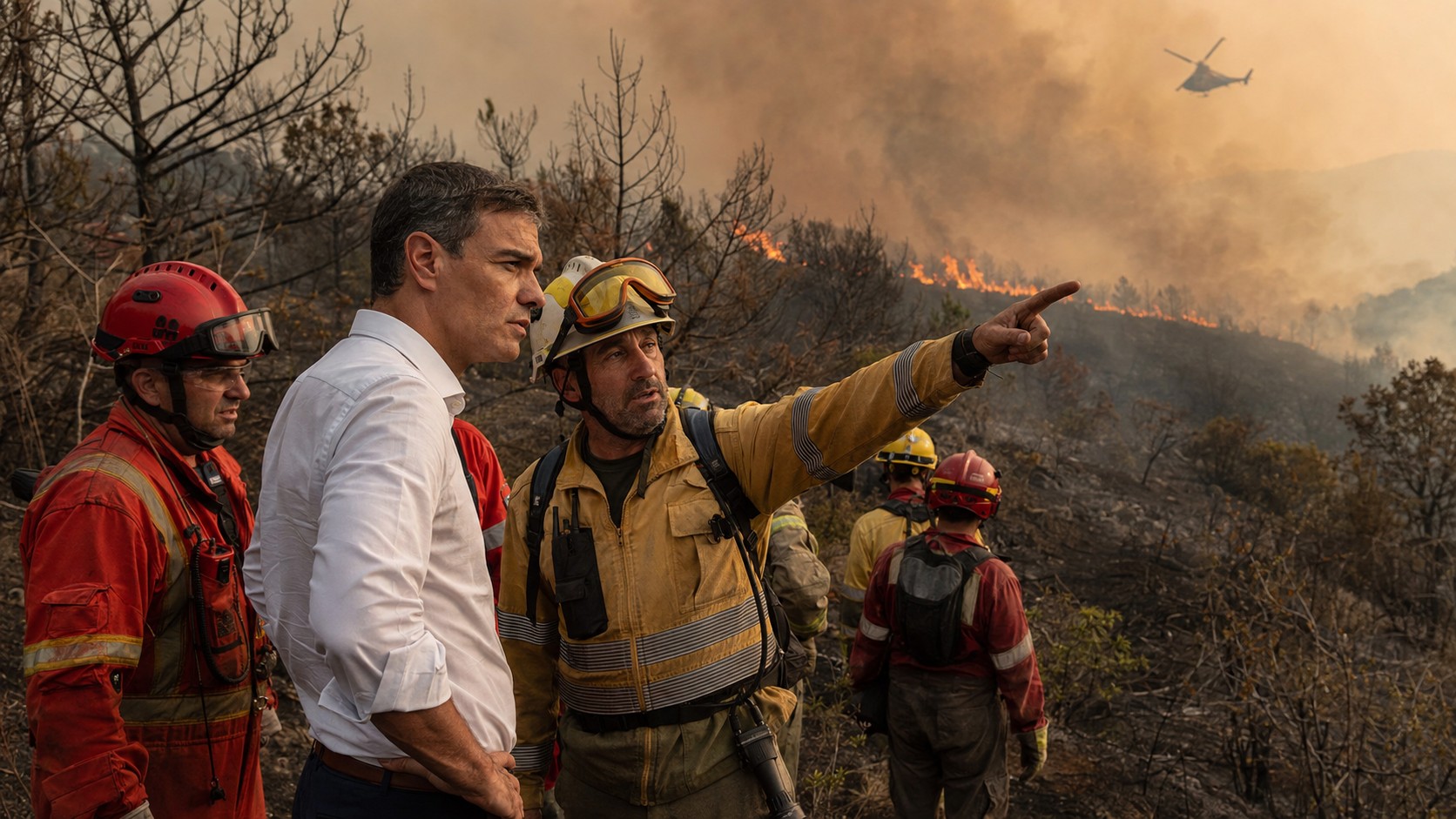
Spanish Prime Minister Pedro Sánchez has once again confronted the country’s climate sceptics with a blunt message: “Climate change kills.” His words come as Spain counts the human, environmental and economic cost of another devastating wildfire season, yet the political parties most resistant to climate action appear no closer to changing their position.
A crisis measured in lives and land
More than 207,000 hectares have burned across Spain since the beginning of 2026, according to European satellite monitoring. Entire communities have been evacuated, homes and businesses destroyed and emergency services pushed to their limits.
Sánchez argues that such disasters can no longer be treated as isolated summer emergencies. Spain is becoming hotter and drier, with longer heatwaves, more persistent droughts and increasingly dangerous combinations of wind, high temperatures and dry vegetation.


The prime minister’s language is direct because the scientific evidence is increasingly difficult to dispute. Recent research found that human-driven climate change made the weather conditions behind Spain’s latest severe fires many times more likely.
Climate change does not ignite every fire. Arson, accidents, neglected land and rural depopulation all contribute. But global heating creates the conditions in which ordinary fires can become uncontrollable disasters.
A consistent political message
Sánchez has repeatedly placed climate policy at the centre of his government’s programme since becoming prime minister in 2018. During that period, renewable energy’s share of Spain’s electricity generation has risen from approximately 40% to 60%.
After the destructive fires of 2025, his government developed a national climate emergency pact in consultation with scientists, environmental organisations and civil society. Finalised in December, the programme contains 15 broad areas of action.
These include new climate refuges for people displaced by extreme weather, improved forest management, stronger emergency coordination, additional prevention funding and faster financial assistance for affected communities.
Sánchez has presented the pact as a national security measure rather than an exclusively environmental policy. It would, however, require broad parliamentary support and substantial budget commitments.
Opposition remains unmoved
Spain’s conservative People’s Party has continued to resist the proposal. Its parliamentary spokesperson, Ester Muñoz, described the statement that climate change kills as a leftwing mantra intended to distract attention from what she called the government’s poor management of the fires.
Party representatives have argued that individual fires are caused by negligence, deliberate ignition and insufficient maintenance of rural areas rather than climate change.
The far-right Vox party has adopted an even more confrontational position. Its leader, Santiago Abascal, has repeatedly attacked what he calls climate fanatics and opposed policies associated with the European green transition.
Scientists generally reject the attempt to separate forest management from climate change. Both matter. Better removal of combustible vegetation, stronger local coordination and year-round prevention can reduce the danger, but they cannot eliminate the effects of rising temperatures and prolonged drought.
The cost of continued denial
Spain is among the European countries most exposed to global heating. Its risks include desertification, water shortages, agricultural disruption, extreme heat, flooding and fires that become too intense for conventional firefighting methods.
Sánchez’s declaration is therefore less a political slogan than a warning grounded in Spain’s recent experience. The debate is no longer about whether the climate is changing, but whether political institutions can adapt quickly enough.
For the moment, the flames may be coming under control. The political argument surrounding them is not.
Newshub Editorial in Europe – 2 August 2026

Ask NF GPT
If you have an account with ChatGPT you get deeper explanations,
background and context related to what you are reading.
Spanish Prime Minister Pedro Sánchez has once again confronted the country’s climate sceptics with a blunt message: “Climate change kills.” His words come as Spain counts the human, environmental and economic cost of another devastating wildfire season, yet the political parties most resistant to climate action appear no closer to changing their position.
Recent Comments