
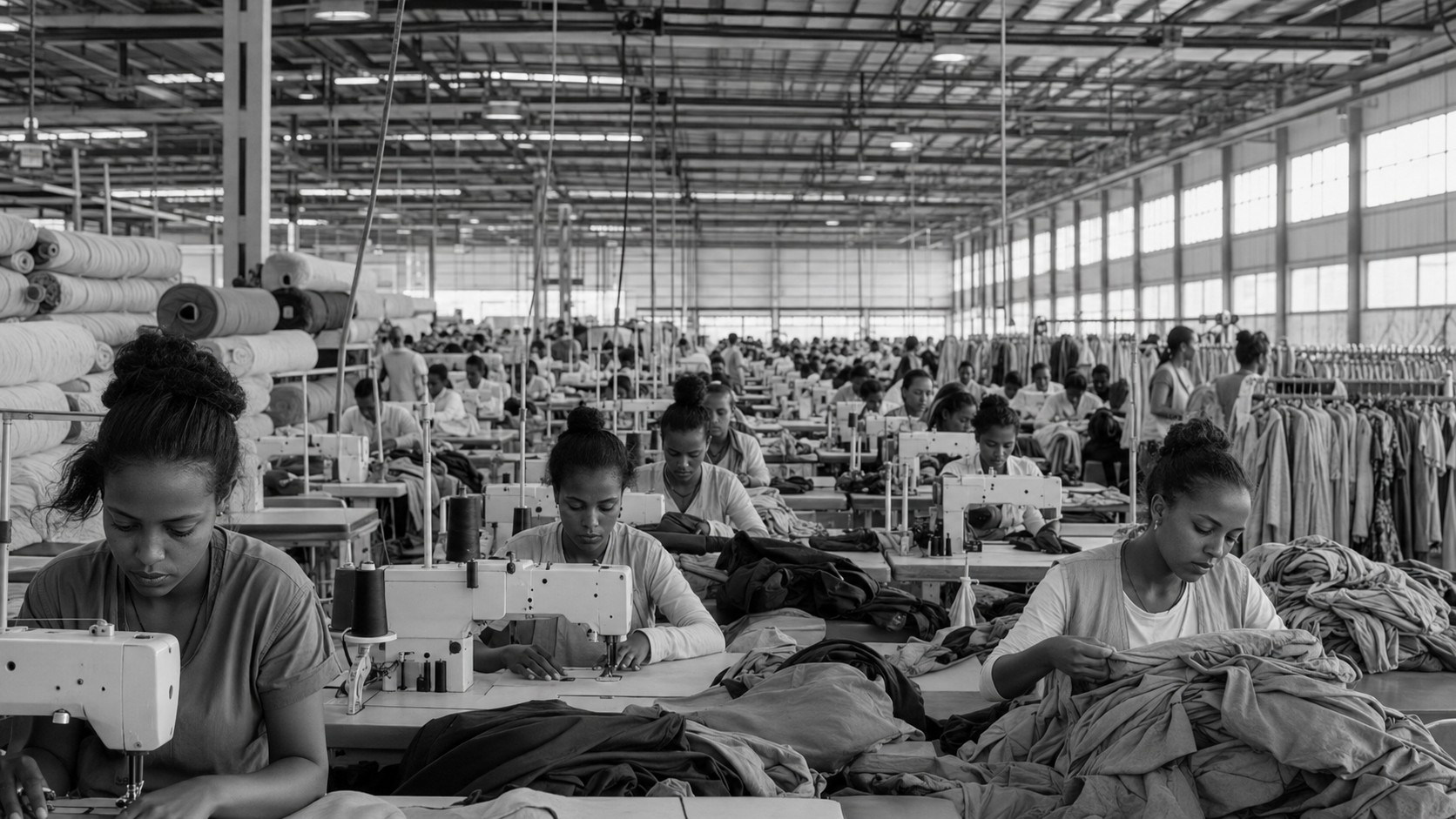
Ethiopia is betting that textiles can become the thread connecting agriculture, foreign investment and industrialisation, with 85% of production inside the country’s industrial parks now concentrated in textiles and garments. At the centre of the strategy stands the $250m Hawassa Industrial Park, Africa’s largest specialised textile manufacturing hub.
A model inspired by China
Ethiopia’s industrial park programme draws heavily on the special economic zones that helped transform China into a global manufacturing power. Designated production areas offer serviced land, factory buildings, infrastructure, tax incentives and streamlined administration intended to attract international investors.
The country now has 22 industrial parks, several of which specialise in textiles and clothing. Hawassa, Bahir Dar, Bole Lemi and Mekelle were developed to create concentrated manufacturing centres capable of serving major international brands.


Located approximately 275 kilometres south of Addis Ababa, Hawassa Industrial Park opened in 2017. The 140-hectare site contains 52 factory sheds and was designed specifically for textile and apparel manufacturing. Ethiopia’s Industrial Parks Development Corporation describes it as one of the country’s principal export-focused manufacturing centres.
Cotton offers enormous potential
Ethiopia has more than three million hectares considered suitable for cotton cultivation, yet less than 3% of that potential is currently being used. This creates an opportunity to connect domestic cotton farmers with spinning, weaving, dyeing and garment factories.
However, much of the industry still depends on imported thread, fabric and other inputs. Local cotton varieties are not always compatible with modern machinery installed by international manufacturers, reducing productivity and increasing costs.
Developing improved seeds, irrigation systems, farmer training and domestic processing facilities will therefore be essential if Ethiopia wants to build a fully integrated industry rather than remain dependent on imported materials.
According to figures cited by the UN Development Programme, textiles and garments account for 85% of Ethiopia’s industrial park production. Hawassa alone employed more than 35,000 people at its peak, while industrial parks across the country have attracted hundreds of investors. African Business reports that many of the new jobs have gone to young women entering formal employment for the first time.
Progress interrupted by major shocks
The programme’s expansion has not been straightforward. The Covid-19 pandemic reduced global clothing demand, while Ethiopia’s conflict in Tigray disrupted production and forced the suspension of operations at some sites.
Ethiopia’s removal from the US African Growth and Opportunity Act also deprived exporters of valuable tariff-free access to the American market. Supply-chain disruption, rising input costs and difficulties transporting goods through the Red Sea have added further pressure.
Before these setbacks, however, exports from government-operated industrial parks had been growing by an average of approximately 50% annually. Net exports reached $163m in 2019–20, approaching half of Ethiopia’s manufactured exports, according to the World Bank.
Hawassa demonstrates that Ethiopia can construct modern factories and attract international manufacturers. The greater challenge is now to build the domestic supply chains, skilled workforce, reliable infrastructure and stable business environment needed to keep those factories competitive.
If that connection can be completed, Ethiopia’s vast but underused cotton resources could turn its industrial parks from isolated manufacturing zones into the foundation of a broader African textile economy.
Newshub Editorial in Africa – 2 August 2026

Ask NF GPT
If you have an account with ChatGPT you get deeper explanations,
background and context related to what you are reading.
Ethiopia is betting that textiles can become the thread connecting agriculture, foreign investment and industrialisation, with 85% of production inside the country’s industrial parks now concentrated in textiles and garments. At the centre of the strategy stands the $250m Hawassa Industrial Park, Africa’s largest specialised textile manufacturing hub.
Recent Comments