
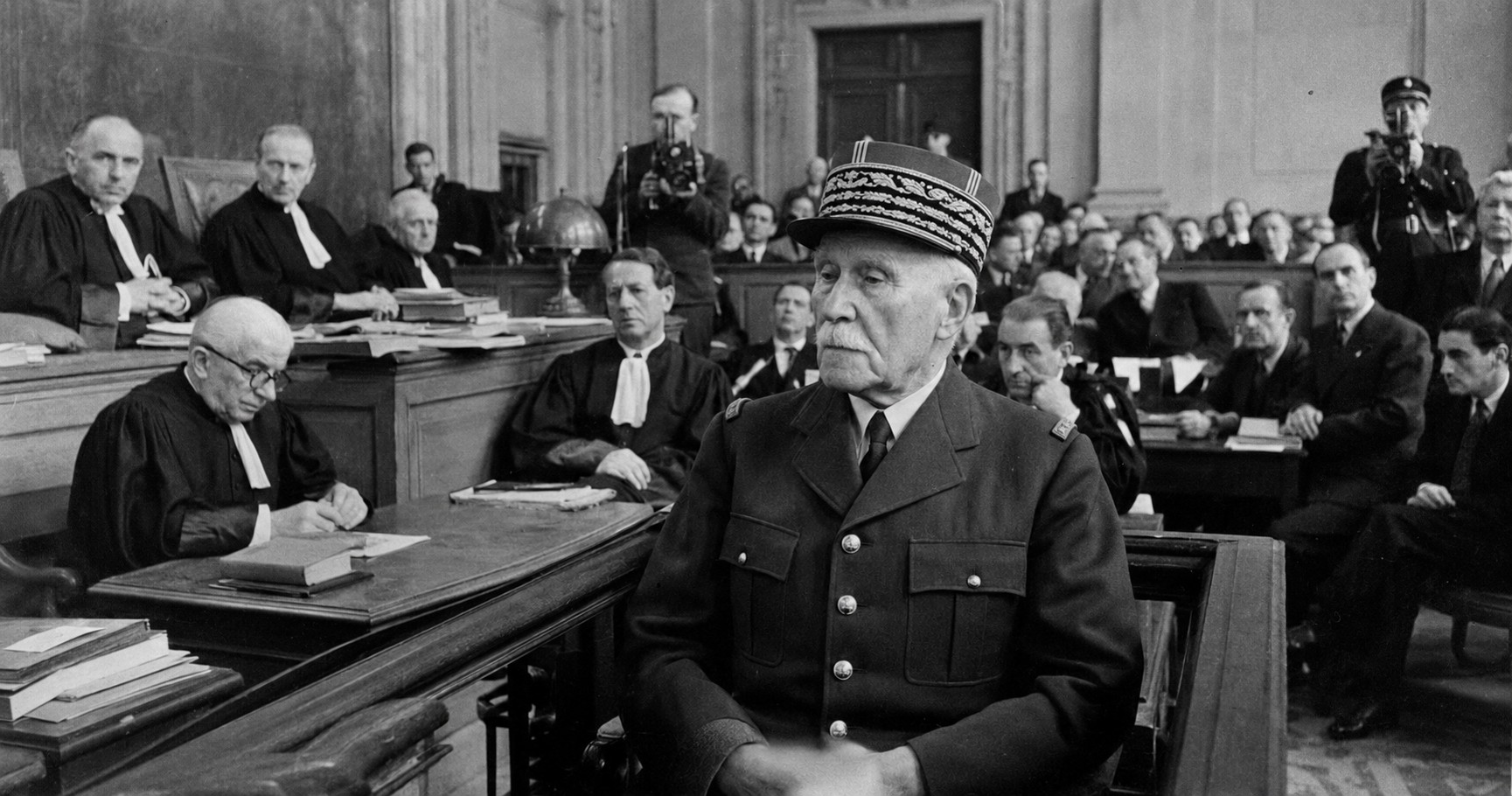
On 23 July 1945, Marshal Philippe Pétain, once celebrated as one of France’s greatest military heroes, went on trial in Paris accused of treason and collaboration with Nazi Germany. The proceedings forced a newly liberated nation to confront one of the most painful and divisive chapters in its modern history.
The hero of Verdun
Pétain had achieved national fame during the First World War, particularly for his role in the defence of Verdun in 1916. His reputation as a calm and disciplined commander made him a symbol of French endurance, and he was promoted to Marshal of France after the war.
By 1940, however, France faced a radically different military situation. German forces had broken through French defences, Paris had fallen and the government was in crisis. The 84-year-old Pétain became prime minister and supported seeking an armistice with Germany.

Following the French surrender, Pétain established his government in the spa town of Vichy. The new regime replaced the institutions of the French Republic with an authoritarian state built around the marshal’s leadership.
Collaboration under occupation
Although the Vichy government formally administered the unoccupied southern part of France until Germany occupied the entire country in 1942, it cooperated extensively with the Nazi authorities.
The regime introduced antisemitic legislation, excluded Jewish citizens from public life and participated in the arrest and deportation of Jews. It also pursued political opponents, members of the French Resistance and others considered hostile to the government.
Pétain’s defenders later argued that he had attempted to shield France from harsher German rule. This claim became known as the “shield” theory: Pétain supposedly protected the French population while Charles de Gaulle, leading the Free French from abroad, served as the “sword”.
Critics rejected this interpretation, arguing that Vichy had actively embraced collaboration and implemented repressive policies on its own initiative.
France puts its past on trial
After Germany’s defeat and the liberation of France, Pétain returned voluntarily from exile to face the French authorities. His trial opened before the High Court of Justice at the Palais de Justice in Paris.
The prosecution accused him of undermining the Republic, conspiring against the security of the state and cooperating with the enemy. The courtroom became a stage for conflicting accounts of France’s defeat, occupation and national responsibility.
Pétain delivered an opening statement challenging the authority of the court and then remained largely silent. Witnesses included former ministers, military officers and political figures whose testimony exposed the deep divisions that had existed within wartime France.
A death sentence commuted
On 15 August 1945, Pétain was convicted of treason and national indignity. He was sentenced to death, stripped of public honours and ordered to surrender his property.
However, the court recommended mercy because of his advanced age. General de Gaulle commuted the sentence to life imprisonment, also taking into account Pétain’s service during the First World War.
Pétain was eventually imprisoned on the Île d’Yeu, off France’s Atlantic coast, where he died in 1951 at the age of 95.
His trial remains one of the most symbolic legal proceedings in French history: the moment when the hero of Verdun was publicly judged for becoming the leader of Vichy France. The proceedings ran from 23 July to 15 August 1945, as documented in historian Julian Jackson’s study of the case.
Newshub Editorial in Europe – 23 July 2026

Ask NF GPT
If you have an account with ChatGPT you get deeper explanations,
background and context related to what you are reading.
Recent Comments