
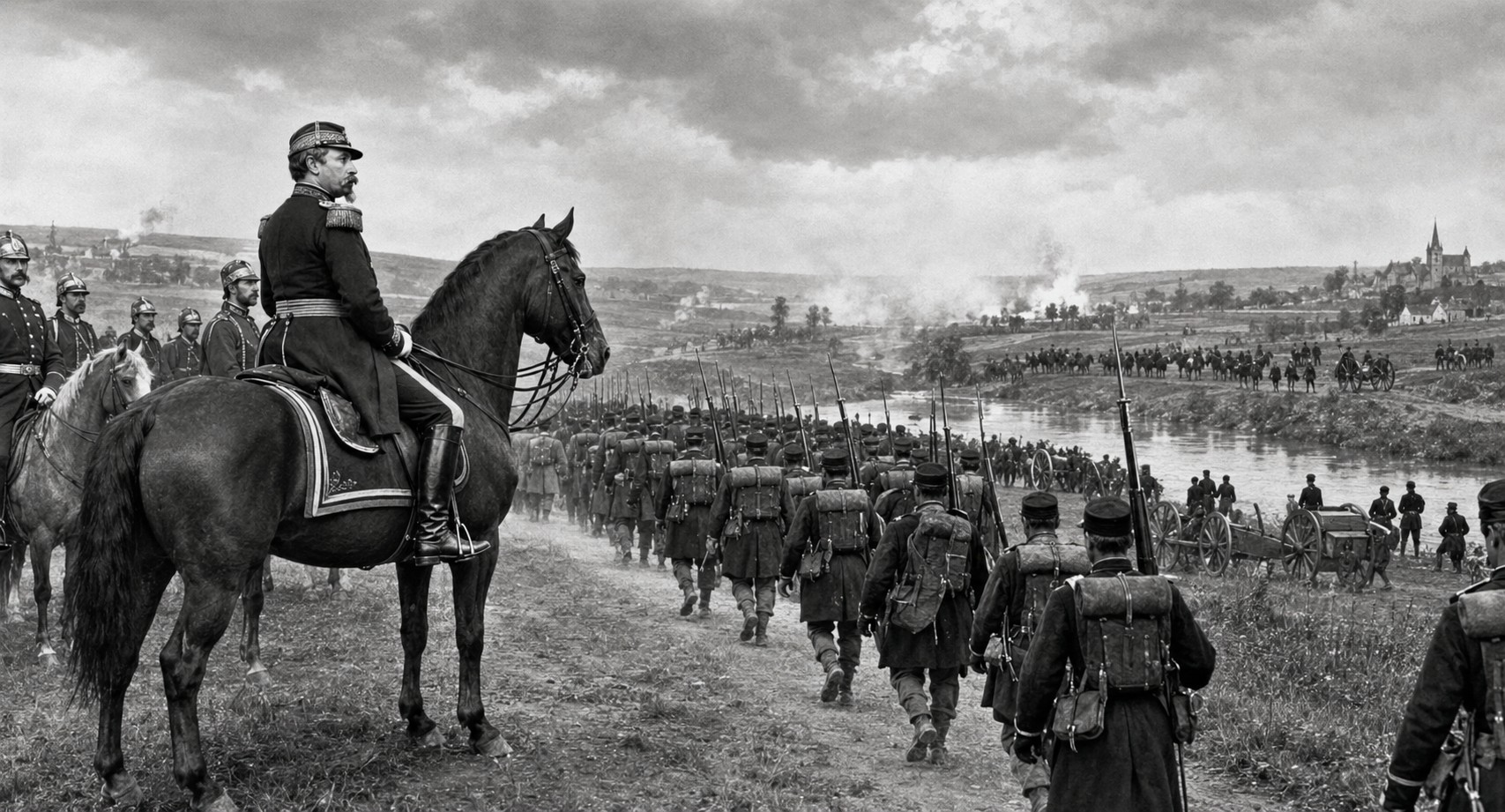
On 19 July 1870, French Emperor Napoleon III formally declared war on Prussia, beginning the conflict commonly known as the Franco-Prussian War or Franco-German War. What Paris expected to be a limited and victorious campaign instead became a national catastrophe for France, accelerated German unification and fundamentally altered the balance of power in Europe.
A crisis manufactured through diplomacy
The immediate cause of the war was a dispute over the vacant Spanish throne. Prince Leopold of Hohenzollern-Sigmaringen, a relative of Prussian King Wilhelm I, had been considered as a candidate. France feared that a Hohenzollern monarch in Spain would leave it strategically surrounded by Prussian influence.
Although Leopold withdrew his candidacy, the French government demanded additional assurances from Wilhelm that the matter would never be revived. The king politely rejected the request during a meeting with the French ambassador at the spa town of Ems.

Prussian Chancellor Otto von Bismarck then edited and published an account of the exchange. The resulting Ems Dispatch made the encounter appear more insulting to both sides than it had been. Public anger rose rapidly in France and the German states, helping Bismarck create the political conditions for war.
France enters the conflict unprepared
Napoleon III and his government faced intense pressure from nationalist politicians, newspapers and sections of the public. France declared war believing its professional army could defeat Prussia before the other German states fully mobilised.
The calculation proved disastrously wrong. Prussia possessed a sophisticated mobilisation system, an efficient railway network and a highly organised general staff. Bavaria, Württemberg, Baden and other southern German states joined Prussia, turning the conflict into a wider German national campaign.
French forces suffered from confused planning, inadequate logistics and divided leadership. German armies crossed into France and achieved a series of rapid victories during August 1870.
Defeat at Sedan ends an empire
The decisive moment came at the Battle of Sedan on 1 September. Napoleon III and more than 80,000 French troops were surrounded. The emperor surrendered the following day, destroying the authority of the Second French Empire.
News of the defeat reached Paris, where the empire collapsed and the Third Republic was proclaimed on 4 September. The new government continued fighting, but German forces surrounded Paris and subjected the capital to a prolonged siege.
France eventually accepted an armistice in January 1871. Under the Treaty of Frankfurt, it ceded most of Alsace and part of Lorraine to the newly created German Empire and agreed to pay a substantial indemnity.
A new European order emerges
The war achieved Bismarck’s central objective: the unification of Germany under Prussian leadership. On 18 January 1871, Wilhelm I was proclaimed German emperor in the Palace of Versailles, an event deliberately staged on French soil.
France’s defeat created lasting resentment, particularly over Alsace-Lorraine, while the emergence of a powerful united Germany transformed European diplomacy. The rivalry generated by the war became one of the forces shaping the alliances and tensions that ultimately contributed to the First World War.
Newshub Editorial in Europe – 19 July 2026

Ask NF GPT
If you have an account with ChatGPT you get deeper explanations,
background and context related to what you are reading.
Recent Comments