
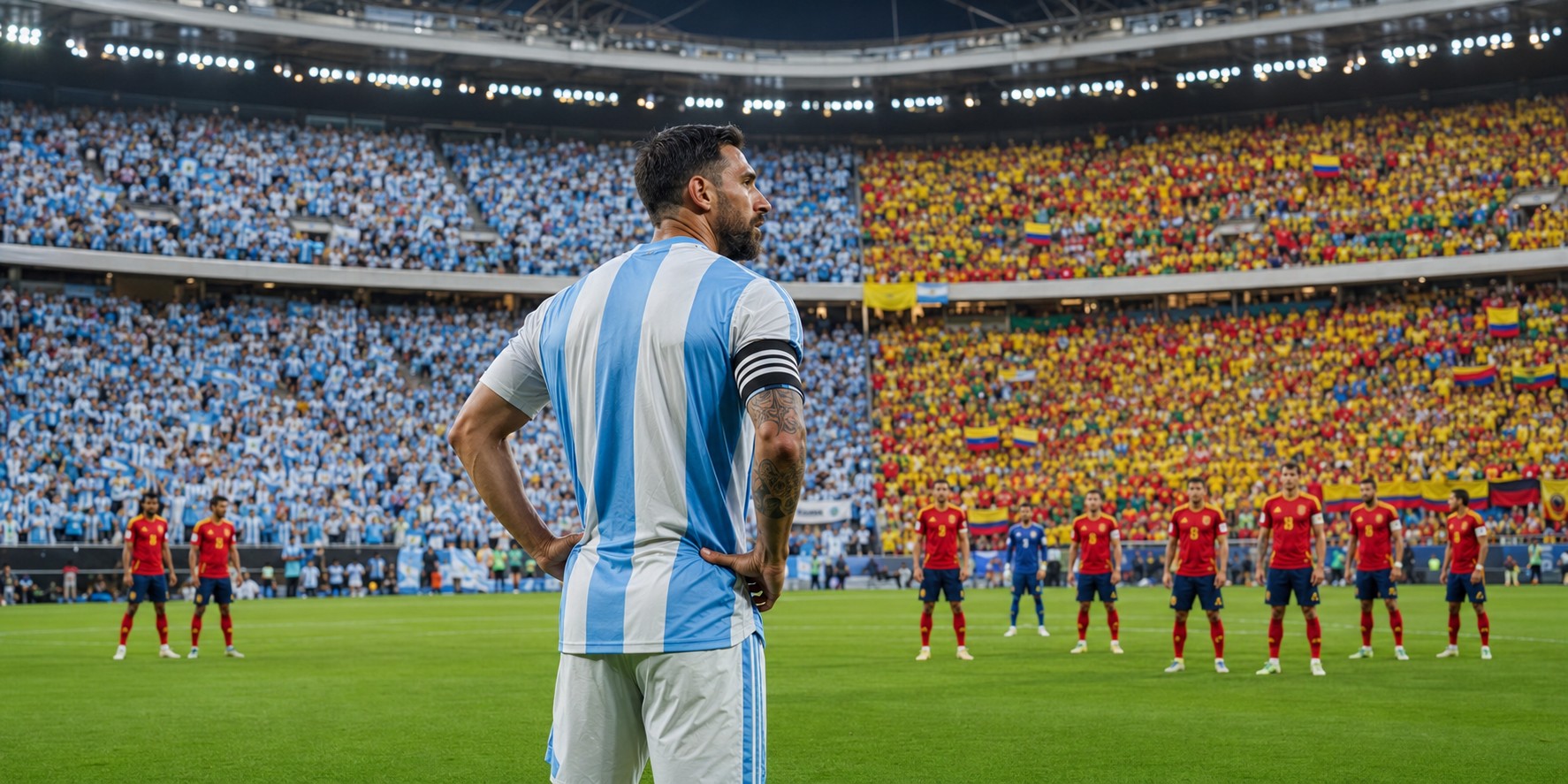
Argentina will attempt to defend their world title against Spain in the 2026 FIFA World Cup final, with Lionel Messi potentially preparing for the final international match of his extraordinary career. The occasion has captured attention across Latin America, but regional support is unusually divided as rivalry, resentment and controversy challenge the traditional expectation of continental solidarity.
Argentina seek consecutive titles
The reigning champions reached the final after defeating England 2-1 in a tense semi-final. An early English goal from Anthony Gordon was answered by Enzo Fernández before Lautaro Martínez secured Argentina’s victory.
Argentina entered the tournament as one of the favourites and progressed from Group J without defeat. They then eliminated Cape Verde, Egypt and Switzerland before overcoming England to earn the opportunity to defend the title won in Qatar four years ago.

Victory against Spain would make Argentina the first country to retain the men’s World Cup since Brazil achieved consecutive triumphs in 1958 and 1962. It would also deliver a fourth title after victories in 1978, 1986 and 2022.
For Messi, now 39, the final could represent the conclusion of a World Cup career extending across six tournaments. His presence has attracted enormous Argentine support to the New York and New Jersey area, with special flights from Buenos Aires selling out within hours.
Latin American support is divided
Historically, many Latin American supporters have backed the region’s remaining representative once their own country has been eliminated. That pattern has weakened during the 2026 tournament.
Large numbers of supporters in Brazil, Mexico and Colombia are expected to favour Spain. Argentina’s recent dominance, combined with established football rivalries and confrontations between supporters, has created growing resistance to another Argentine triumph.
Brazil’s rivalry with Argentina remains the most significant. Brazilian supporters have also criticised racist gestures and chants associated with sections of Argentina’s fan base during recent international tournaments.
Similar tensions have appeared in matches involving Mexican and Colombian clubs and national teams. Social media has amplified confrontations that were previously limited to stadiums, transforming sporting rivalry into wider arguments about identity, nationality and discrimination.
Messi continues to unite admirers
Support for Argentina nevertheless remains strong throughout the region. Messi continues to command admiration beyond national loyalties, particularly among supporters who view him as the defining footballer of his generation.
Argentina’s success has also carried symbolic importance for South American football. European countries have dominated much of the modern international game, and another Argentine title would reinforce the continent’s ability to challenge Europe’s wealthiest and most developed football systems.
Some Brazilian and other Latin American commentators have rejected support for Spain, pointing to the region’s colonial history and arguing that rivalry should not outweigh continental solidarity.
Spain stand between Argentina and history
Spain are appearing in their first World Cup final since winning the competition in South Africa in 2010. They reached the deciding match after overcoming Austria, Belgium and France during the knockout stages.
The final therefore presents a contest between Argentina’s experience and Spain’s technically gifted generation. It also places Messi’s pursuit of one final global triumph against a Spanish football culture that shaped much of his professional career.
Whatever the result, the match will carry significance far beyond the stadium. Argentina are not only defending their title but confronting a Latin American audience that is more emotionally and politically divided than at any point during their 2022 triumph.
Newshub Editorial in Latin America – 19 July 2026

Ask NF GPT
If you have an account with ChatGPT you get deeper explanations,
background and context related to what you are reading.
Recent Comments