
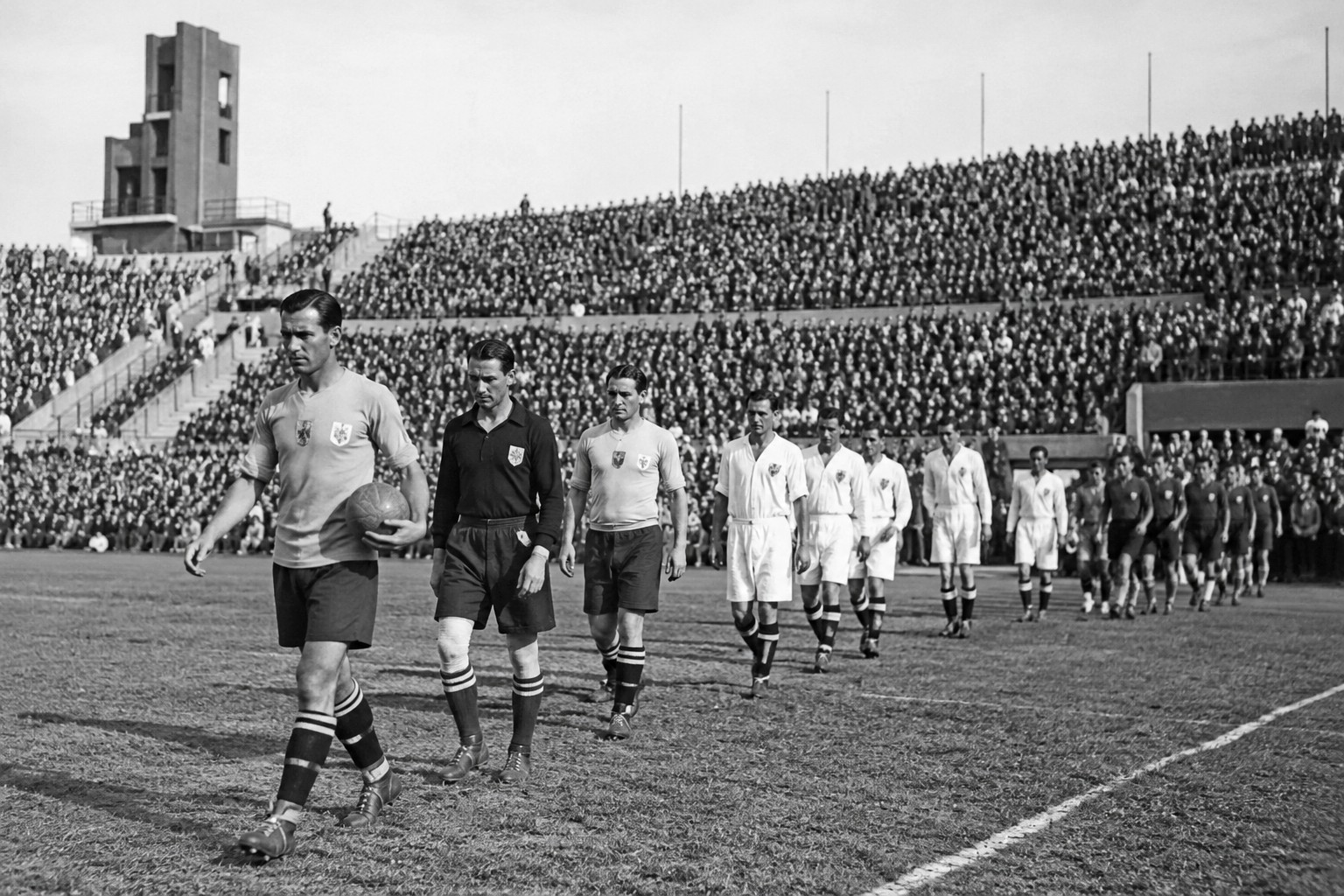
On this day, July 13, 1930, football entered a new era as the first-ever FIFA World Cup officially began in Montevideo, Uruguay. Thirteen national teams from Europe and the Americas gathered to compete in a tournament that would eventually grow into the world’s largest sporting event, watched by billions across the globe.
A bold vision becomes reality
The idea of a global football championship had been championed by FIFA President Jules Rimet, who believed the sport deserved its own international tournament independent of the Olympic Games. After years of planning, Uruguay was chosen as the inaugural host nation. The South American country had won Olympic football gold in both 1924 and 1928 and was celebrating the centenary of its constitution, making it a fitting venue for football’s greatest experiment.

Despite the excitement, organising the competition was far from straightforward. The Great Depression had made international travel expensive and uncertain, and crossing the Atlantic by ship required weeks rather than hours.
Only four European teams made the journey
Many European nations declined the invitation because of the cost and lengthy voyage. In the end, only France, Belgium, Romania and Yugoslavia sailed to Uruguay aboard the Italian liner Conte Verde, joined by FIFA officials, including Jules Rimet himself, who personally carried the World Cup trophy.
The remaining participants came from the Americas, with Argentina, Brazil, Chile, Bolivia, Mexico, Paraguay, Peru, the United States and the host nation completing the field.
A modest beginning to a global phenomenon
The opening day featured two matches. France defeated Mexico 4-1, with Lucien Laurent scoring what became the first goal in FIFA World Cup history. At the same time, the United States comfortably beat Belgium 3-0.
The tournament itself was a compact affair compared with today’s month-long spectacle. There were no qualification rounds, no television broadcasts and no billion-dollar commercial partnerships. Crowds relied on newspapers and radio for updates, while players travelled with little of the luxury or support now associated with elite international football.
The birth of football’s greatest stage
The tournament concluded on July 30, when Uruguay defeated fierce rivals Argentina 4-2 before a crowd of nearly 70,000 at the newly built Estadio Centenario. Uruguay became football’s first world champions, lifting a trophy that would later be renamed in honour of Jules Rimet.
What began with just 13 teams has since evolved into one of the world’s defining sporting events. The FIFA World Cup now brings together nations from every continent, generates enormous economic activity and remains one of the few occasions capable of capturing the attention of billions of people simultaneously.
From a handful of teams crossing oceans by ship to a truly global competition spanning continents, the first World Cup in Montevideo laid the foundation for nearly a century of football history.
Newshub Editorial – South America – July 13, 2026

Ask NF GPT
If you have an account with ChatGPT you get deeper explanations,
background and context related to what you are reading.
Recent Comments