
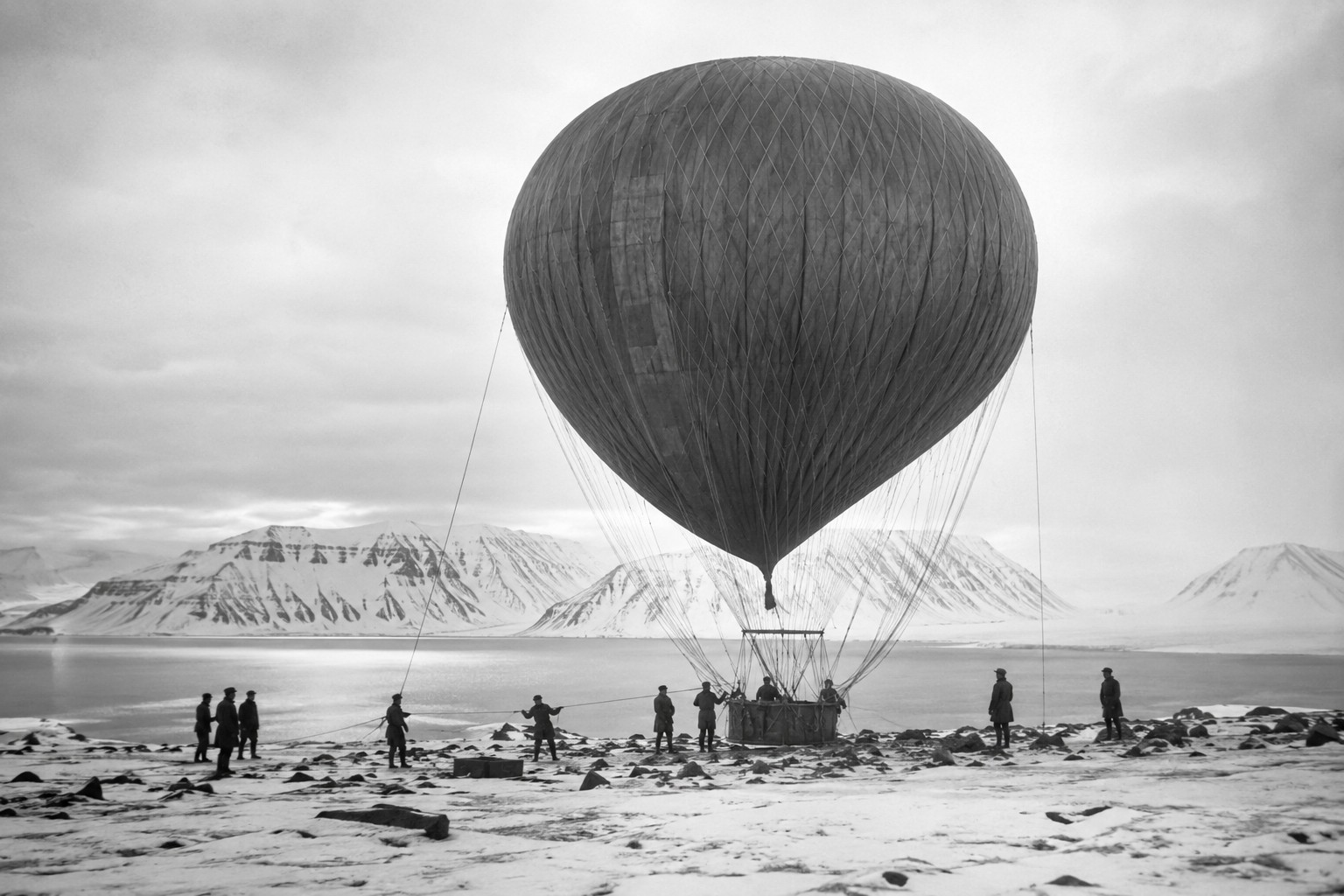
On 11 July 1897, one of history’s most ambitious polar expeditions lifted into the Arctic sky. Swedish engineer and explorer Salomon August Andrée, together with Knut Frænkel and photographer Nils Strindberg, departed from Danes Island in Svalbard aboard the hydrogen balloon Örnen (“The Eagle”), hoping to become the first people to reach the North Pole from the air. It was a bold experiment that captured the imagination of the world—but ultimately became one of exploration’s greatest tragedies.
A daring vision
At the end of the 19th century, the North Pole remained one of the last great geographical mysteries. While numerous expeditions had attempted to reach it by ship or sled, Andrée believed the future lay in aviation. His plan was revolutionary: use a hydrogen balloon equipped with drag ropes and sails to steer across the Arctic, carried by favourable winds over the Pole before descending somewhere in Russia, Alaska or Canada.
The expedition enjoyed significant public and financial support. It was backed by the Royal Swedish Academy of Sciences and received funding from prominent figures, including King Oscar II and Alfred Nobel. Expectations were immense, and Andrée became a national hero before the journey had even begun.

A promising start turns into disaster
The first launch attempt in 1896 was abandoned because of unfavourable winds. A year later, conditions appeared suitable, and on 11 July 1897 Örnen finally rose into the Arctic sky.
Almost immediately, however, the expedition encountered critical problems. Two of the three drag ropes designed to help steer the balloon broke shortly after take-off, leaving the crew with virtually no control over their direction. Hydrogen gradually leaked from the balloon while moisture and ice accumulated on its surface, making it increasingly difficult to stay airborne.
After approximately 65 hours in flight, Andrée and his companions were forced to land on drifting pack ice, still hundreds of kilometres from their intended destination.
The long march across the ice
Although the landing itself was successful, the real challenge had only begun. The three explorers salvaged supplies, sledges and kayaks before setting off on foot across the constantly shifting Arctic ice.
For nearly three months they struggled southwards through one of the harshest environments on Earth. Exhaustion, freezing temperatures, unstable ice and dwindling supplies steadily reduced their chances of survival.
Their final camp was established on Kvitøya (White Island), east of Svalbard, where all three men died in October 1897. The exact cause of death remains uncertain, with theories ranging from hypothermia and exhaustion to illness or poisoning.
A mystery solved decades later
For more than thirty years, the fate of the expedition remained unknown. In 1930, a Norwegian sealing vessel discovered the explorers’ remains, along with diaries, notebooks and photographic plates that had remarkably survived the Arctic climate.
The recovered journals provided a detailed account of their final journey, while Strindberg’s photographs offered haunting visual evidence of one of history’s most famous exploration disasters. The men were returned to Sweden, where they received a state funeral and were honoured as national heroes.
A legacy beyond failure
Although Andrée’s expedition failed to reach the North Pole, it became one of the defining stories of the Heroic Age of Polar Exploration. The mission highlighted both the extraordinary ambition and the significant technological limitations of the era, serving as a powerful reminder that innovation often advances through bold—but costly—experiments.
More than a century later, the story of Örnen continues to fascinate historians, scientists and explorers alike, standing as a testament to human curiosity and the enduring desire to venture into the unknown.
Newshub Editorial – Europe, 11 July 2026

Ask NF GPT
If you have an account with ChatGPT you get deeper explanations,
background and context related to what you are reading.
Recent Comments