
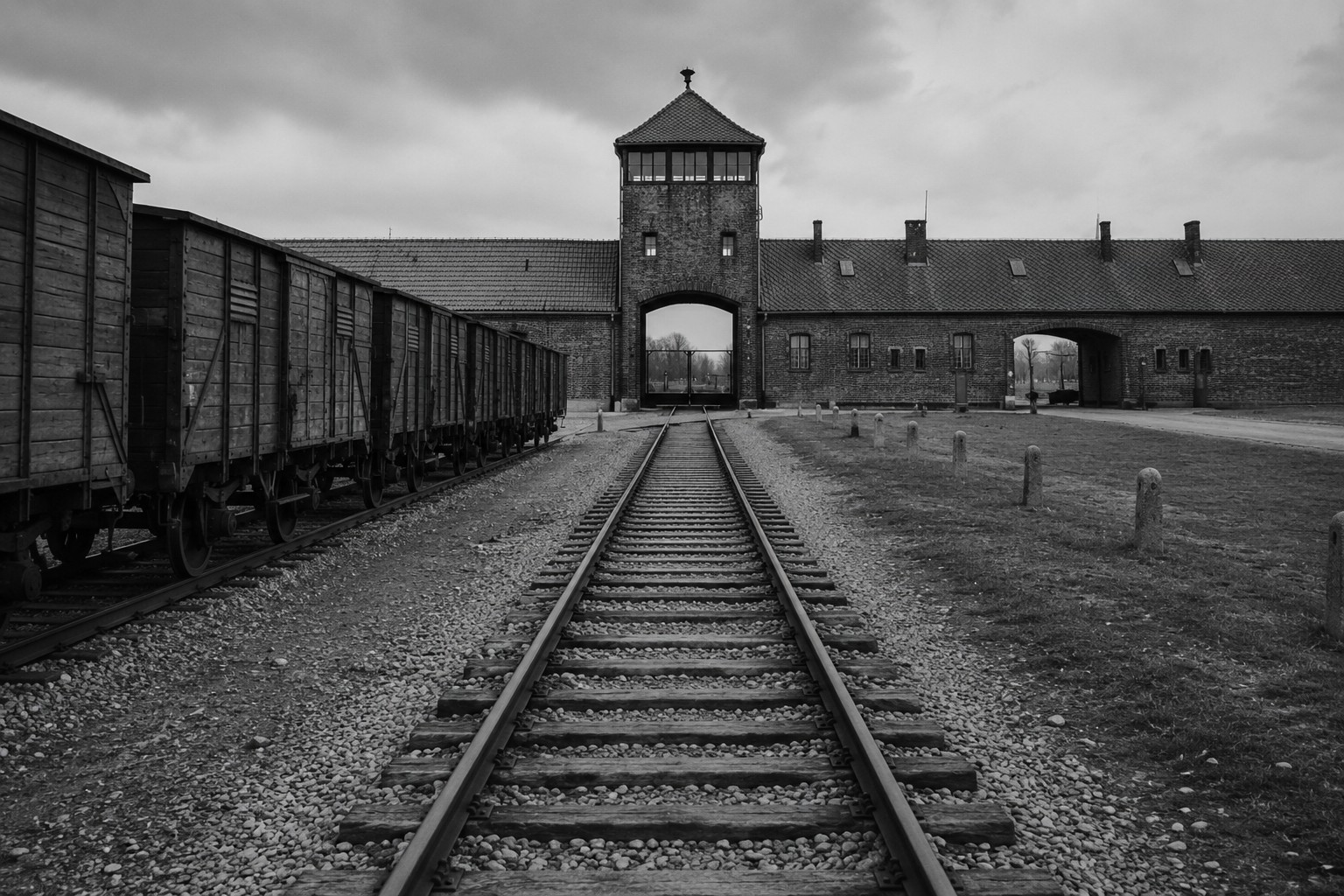
On 14 June 1940, the first organised transport of Polish political prisoners arrived at the newly established Auschwitz concentration camp, marking the beginning of what would become the largest Nazi German extermination and concentration camp complex during the Second World War. The arrival of 728 prisoners signalled the start of one of history’s darkest chapters, as Auschwitz evolved from a detention camp into the centrepiece of the Holocaust.
The first prisoners
The first transport departed from the prison in Tarnów in southern occupied Poland. The prisoners were primarily young Polish men, including students, teachers, lawyers, soldiers, priests and members of the resistance. Many had been arrested during Germany’s campaign to suppress Polish intellectuals and political opposition following the invasion of Poland in September 1939.
Upon arrival, the prisoners were assigned numbers from 31 to 758. The lower numbers had already been allocated to German criminal prisoners transferred earlier to serve as camp functionaries under SS supervision.

The newly established camp was located in former Polish military barracks near the town of Oświęcim, which the German occupiers renamed Auschwitz.
From concentration camp to extermination centre
Initially, Auschwitz was intended primarily as a detention centre for Polish political prisoners. However, as Nazi policies became increasingly focused on the systematic extermination of European Jews and other targeted groups, the camp expanded dramatically.
The Auschwitz complex eventually consisted of three main camps and dozens of satellite facilities. Auschwitz I served as the administrative centre, while Auschwitz II–Birkenau became the principal site of mass murder through gas chambers and crematoria. Auschwitz III–Monowitz supplied forced labour to nearby industrial facilities.
By the end of the war, more than 1.1 million people had been murdered at Auschwitz. The overwhelming majority were Jews, but the victims also included Poles, Roma, Soviet prisoners of war and others persecuted by the Nazi regime.
A symbol of the Holocaust
Although numerous concentration and extermination camps existed across occupied Europe, Auschwitz became the enduring symbol of the Holocaust because of both its scale and its industrialised methods of killing.
The camp combined forced labour, starvation, medical experimentation, torture and systematic mass murder. Families arriving by train were often separated immediately, with many victims sent directly to the gas chambers without registration.
When Soviet forces liberated Auschwitz on 27 January 1945, they found approximately 7,000 surviving prisoners. Tens of thousands had been forced on death marches during the final weeks of the war as German forces retreated.
Remembering the victims
Today, the former camp is preserved as the Auschwitz-Birkenau Memorial and Museum and is recognised as a UNESCO World Heritage Site. Millions of visitors from around the world come each year to learn about the atrocities committed there and to honour the victims.
The anniversary of the first transport serves as a reminder that the Holocaust did not begin with mass extermination but with persecution, imprisonment and the gradual erosion of human rights. Remembering these events remains essential to preserving historical truth and reinforcing the importance of democracy, tolerance and the protection of human dignity.
Newshub Editorial in Europe – 14 June 2026

If you have an account with ChatGPT you get deeper explanations,
background and context related to what you are reading.
Open an account:
Open an account
Recent Comments