
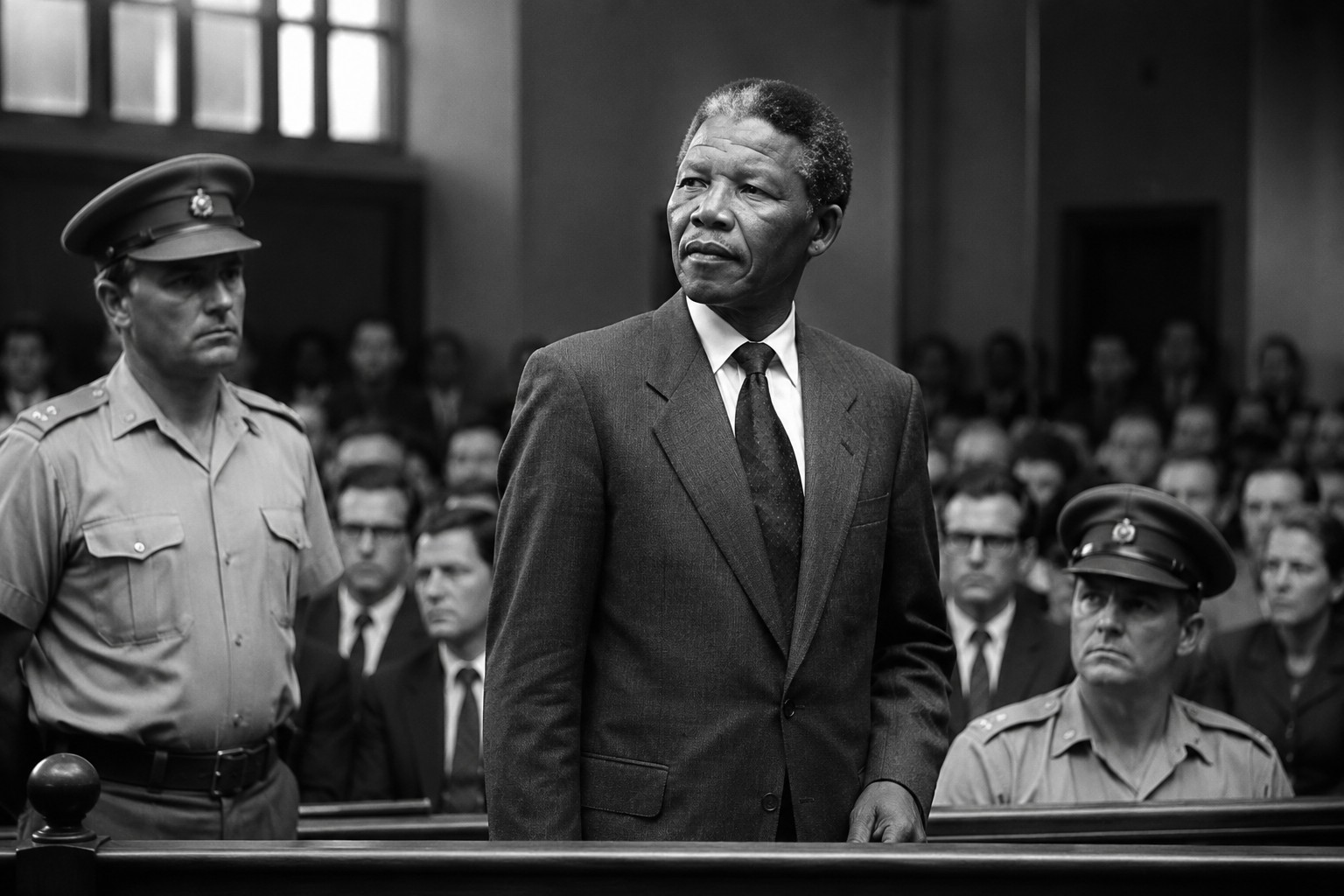
On 12 June 1964, South African anti-apartheid leader Nelson Mandela and seven of his co-accused were sentenced to life imprisonment following the Rivonia Trial, one of the most significant political trials of the twentieth century. The verdict marked a defining moment in South Africa’s struggle against apartheid and transformed Mandela into a global symbol of resistance, justice and reconciliation.
The Rivonia Trial
Mandela, together with senior members of the African National Congress (ANC), faced charges of sabotage and conspiracy to overthrow the apartheid government. Prosecutors argued that the group had organised acts of sabotage against government installations and sought assistance from foreign governments to support an armed campaign.

The trial, held in Pretoria between 1963 and 1964, attracted worldwide attention as many feared the defendants would receive the death penalty.
Mandela’s historic defence
During the proceedings, Mandela delivered what would become one of history’s most celebrated courtroom speeches. In his statement from the dock, he defended the fight against apartheid and declared that he had dedicated his life to the ideal of a democratic and free society.
He concluded with the words:
“It is an ideal for which I am prepared to die.”
The speech resonated around the world and remains one of the defining moments in the global struggle for human rights.
Life behind bars
Rather than imposing death sentences, the court sentenced Mandela and his fellow defendants to life imprisonment. Mandela spent the majority of his 27 years in prison on Robben Island before later being transferred to Pollsmoor Prison and Victor Verster Prison.
Despite his imprisonment, international campaigns calling for his release continued to grow throughout the following decades. Governments, civil society organisations and millions of ordinary citizens viewed Mandela as the face of the anti-apartheid movement.
From prisoner to president
Mandela was released on 11 February 1990 after negotiations between the South African government and the ANC.
Only four years later, South Africa held its first fully democratic elections. In May 1994, Mandela became the country’s first Black president, leading a peaceful transition away from apartheid while promoting reconciliation instead of revenge.
His leadership helped prevent widespread civil conflict and earned him worldwide admiration. Together with then-President F.W. de Klerk, Mandela was awarded the Nobel Peace Prize in 1993 for their efforts to peacefully end apartheid.
A legacy that endures
The life sentence handed down on 12 June 1964 was intended to silence one of apartheid’s most determined opponents. Instead, it elevated Nelson Mandela into one of the most influential figures of the twentieth century.
More than six decades later, the Rivonia Trial remains a powerful reminder of the cost of fighting oppression and the enduring importance of democracy, equality and human rights.
Newshub Editorial in Africa – 12 June 2026

If you have an account with ChatGPT you get deeper explanations,
background and context related to what you are reading.
Open an account:
Open an account
Recent Comments