
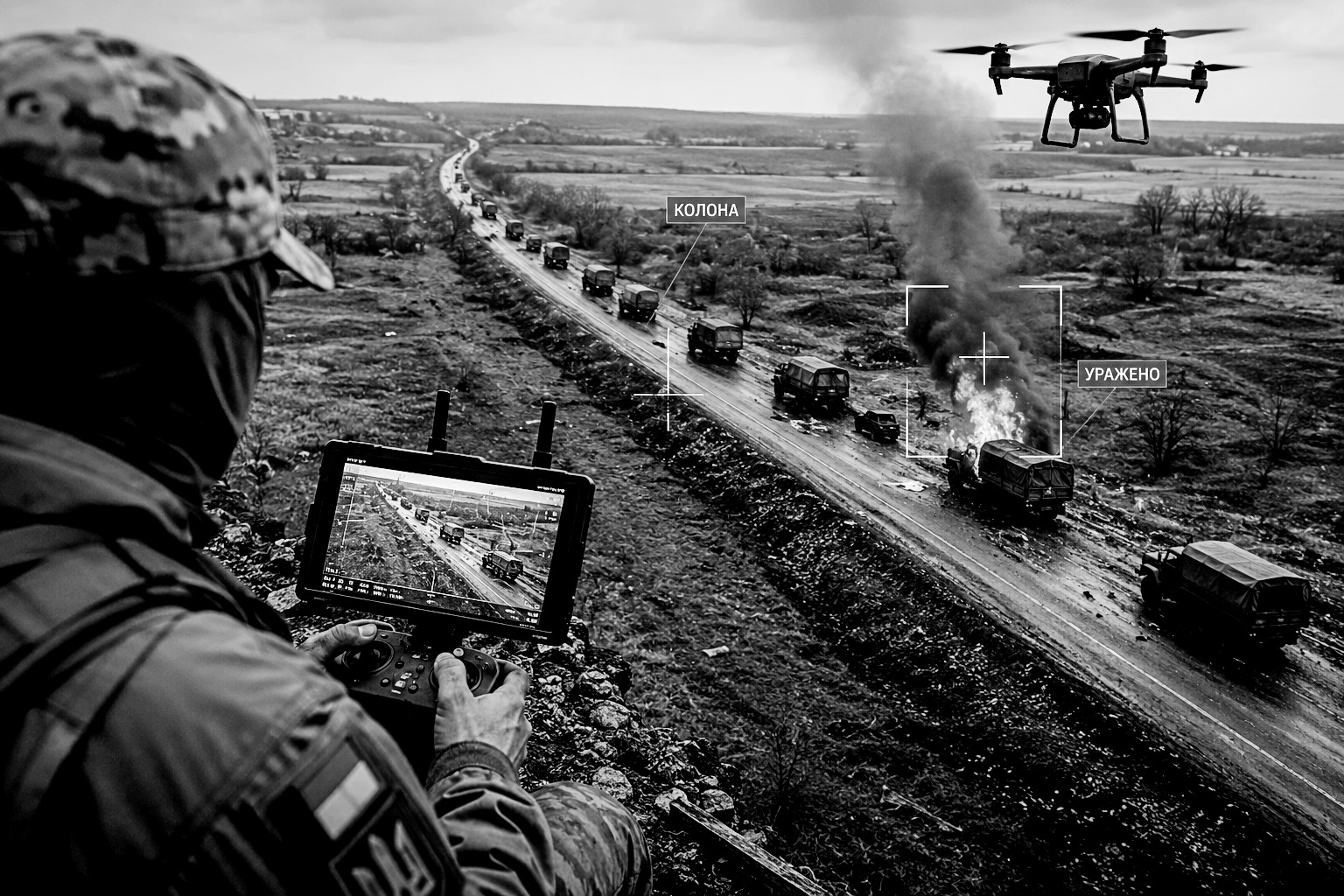
Ukraine has intensified its drone campaign against Russian military logistics, targeting supply traffic along a critical transport corridor connecting occupied territories in southern Ukraine with Russia. The route, increasingly referred to by soldiers and military observers as the “Highway of Death,” has become one of the most dangerous stretches of road for Russian military convoys as Kyiv expands its use of remotely piloted aircraft.
Drones reshape the battlefield
The campaign highlights how drones have transformed modern warfare. Ukrainian forces are deploying a combination of reconnaissance drones and armed first-person-view (FPV) systems to identify and strike vehicles transporting troops, ammunition, fuel, and equipment. The attacks are designed to disrupt Russian logistics and slow the movement of reinforcements to frontline positions.
Military analysts note that logistics networks are often as important as frontline combat units. By targeting supply routes rather than heavily defended positions, Ukraine aims to reduce Russia’s operational effectiveness while forcing Moscow to devote additional resources to protecting transport corridors.

Pressure on Russian supply lines
The affected route serves as a vital connection between Russian territory and occupied regions in southern Ukraine. Convoys travelling along the corridor reportedly face near-constant surveillance from Ukrainian drone operators, who can relay targeting information in real time and coordinate attacks across large areas.
Russian military units have responded by increasing electronic warfare measures, camouflage efforts, and air-defence coverage along key roads. However, the relatively low cost and flexibility of drone systems have made them difficult to counter completely.
Economic and military implications
The growing drone threat has broader implications beyond immediate battlefield losses. Supply disruptions can delay troop rotations, limit ammunition deliveries, and increase operational costs. The need to reroute convoys or provide additional security can also reduce the efficiency of military operations.
Defence experts believe the campaign demonstrates how relatively inexpensive drone technology can challenge traditional military advantages, particularly in conflicts where supply lines extend across large geographic areas.
A new phase of technological warfare
The conflict in Ukraine continues to serve as a testing ground for rapidly evolving military technologies. Drones now play a central role in reconnaissance, targeting, logistics monitoring, and direct attacks. Both Ukraine and Russia are investing heavily in new systems and countermeasures, creating a technological contest that is increasingly shaping developments on the battlefield.
As the war enters another critical phase, the battle for control of supply routes may prove just as significant as the fighting along the front lines themselves.
Newshub Editorial in Europe – 11 June 2026

If you have an account with ChatGPT you get deeper explanations,
background and context related to what you are reading.
Open an account:
Open an account
Recent Comments