
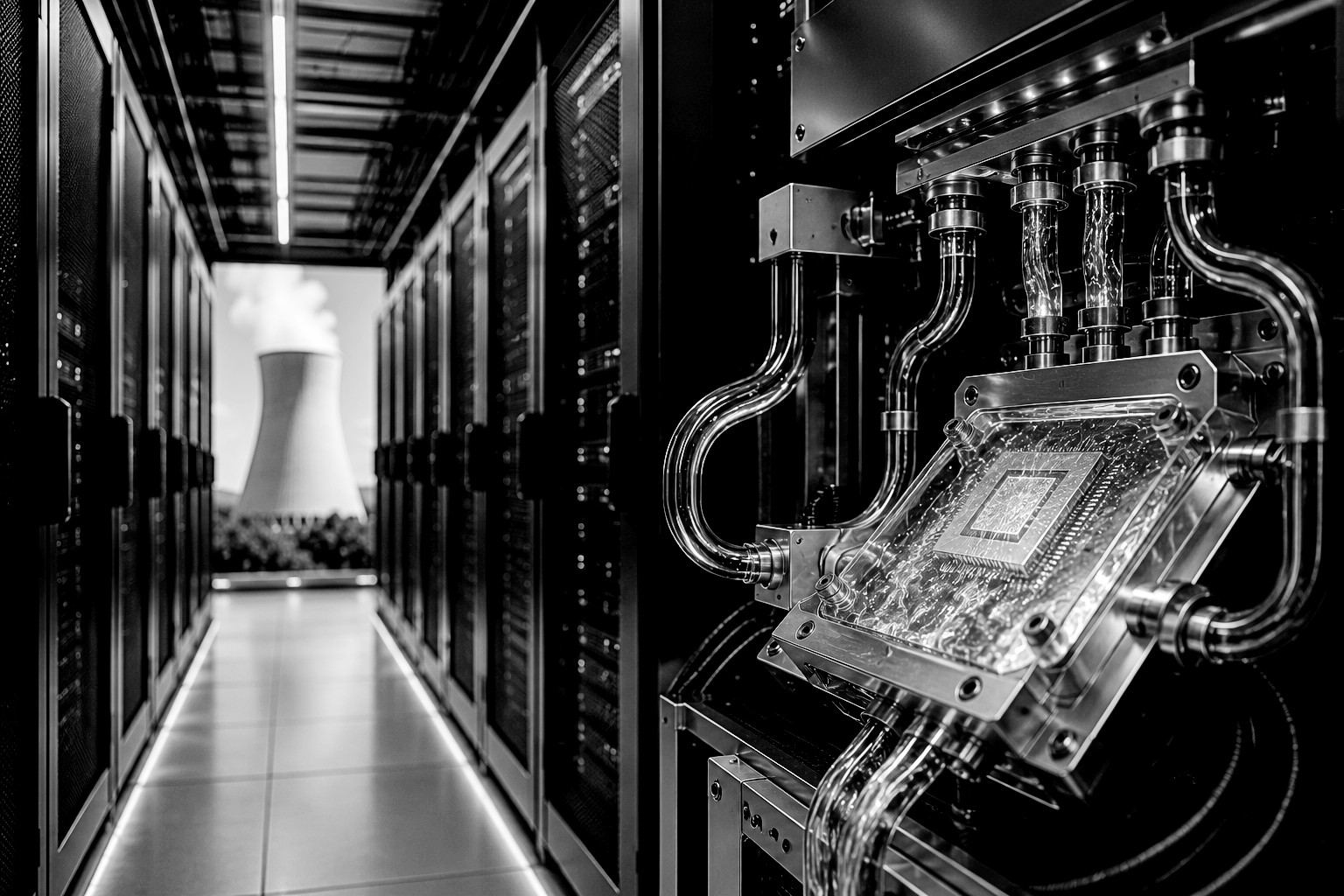
A startup founded by two researchers from the Massachusetts Institute of Technology (MIT) is developing a cooling technology inspired by nuclear reactor engineering that could significantly reduce the energy and water consumption of modern data centres. As artificial intelligence drives unprecedented demand for computing power, the innovation may offer a more sustainable path for the rapidly expanding digital infrastructure sector.
The company, Ferveret, has designed a cooling system that addresses one of the biggest challenges facing the AI industry: managing the enormous heat generated by advanced computer chips.
AI processors are becoming increasingly powerful, but they also consume large amounts of electricity and produce substantial heat. Traditional cooling methods often require significant energy inputs and millions of litres of water annually, creating growing environmental concerns as data centres expand worldwide.


Borrowing ideas from nuclear engineering
Ferveret’s founders turned to concepts commonly used in nuclear power systems, where efficient heat management is critical for safe and reliable operation. Their technology is designed to transfer heat away from processors more effectively, allowing computing systems to operate at higher performance levels while reducing overall cooling requirements.
The approach uses advanced thermal-management techniques that improve heat transfer efficiency and minimise the need for large-scale air conditioning systems typically found in conventional data centres.
According to the company, the result is lower electricity consumption and reduced dependence on water-intensive cooling infrastructure.
AI boom fuels demand for innovation
The timing of the technology is significant. Global investment in artificial intelligence continues to accelerate, driving a surge in demand for high-performance computing facilities.
Technology giants and cloud providers are investing billions of dollars in new data centres to support AI models that require vast amounts of processing power. However, concerns are growing over the environmental footprint associated with these facilities, particularly their electricity and water usage.
Industry analysts estimate that data-centre energy consumption could rise dramatically during the coming decade as AI adoption expands across sectors ranging from healthcare and finance to manufacturing and education.
Sustainability becomes a competitive advantage
Reducing operating costs and improving sustainability have become major priorities for data-centre operators. Cooling systems often account for a substantial share of total facility energy consumption, making them a key target for innovation.
If technologies such as Ferveret’s prove successful at commercial scale, operators could lower costs, improve efficiency and reduce environmental impacts simultaneously.
The potential benefits extend beyond AI infrastructure. Similar thermal-management systems could eventually find applications in supercomputing, telecommunications networks and industrial facilities where heat dissipation remains a significant challenge.
The future of data-centre cooling
As governments, investors and technology companies place greater emphasis on sustainability, innovations that improve energy efficiency are attracting increasing attention.
Ferveret’s nuclear-inspired approach highlights how ideas developed for one industry can help solve challenges in another. With AI expected to remain one of the fastest-growing sectors of the global economy, breakthroughs in cooling technology may become just as important as advances in computing power itself.
For data centres facing rising demand and increasing environmental scrutiny, the next major innovation may not be found inside the processor, but in the systems that keep it cool.
Newshub Editorial in North America – June 10, 2026

If you have an account with ChatGPT you get deeper explanations,
background and context related to what you are reading.
Open an account:
Open an accountA startup founded by two researchers from the Massachusetts Institute of Technology (MIT) is developing a cooling technology inspired by nuclear reactor engineering that could significantly reduce the energy and water consumption of modern data centres. As artificial intelligence drives unprecedented demand for computing power, the innovation may offer a more sustainable path for the rapidly expanding digital infrastructure sector.
Recent Comments