
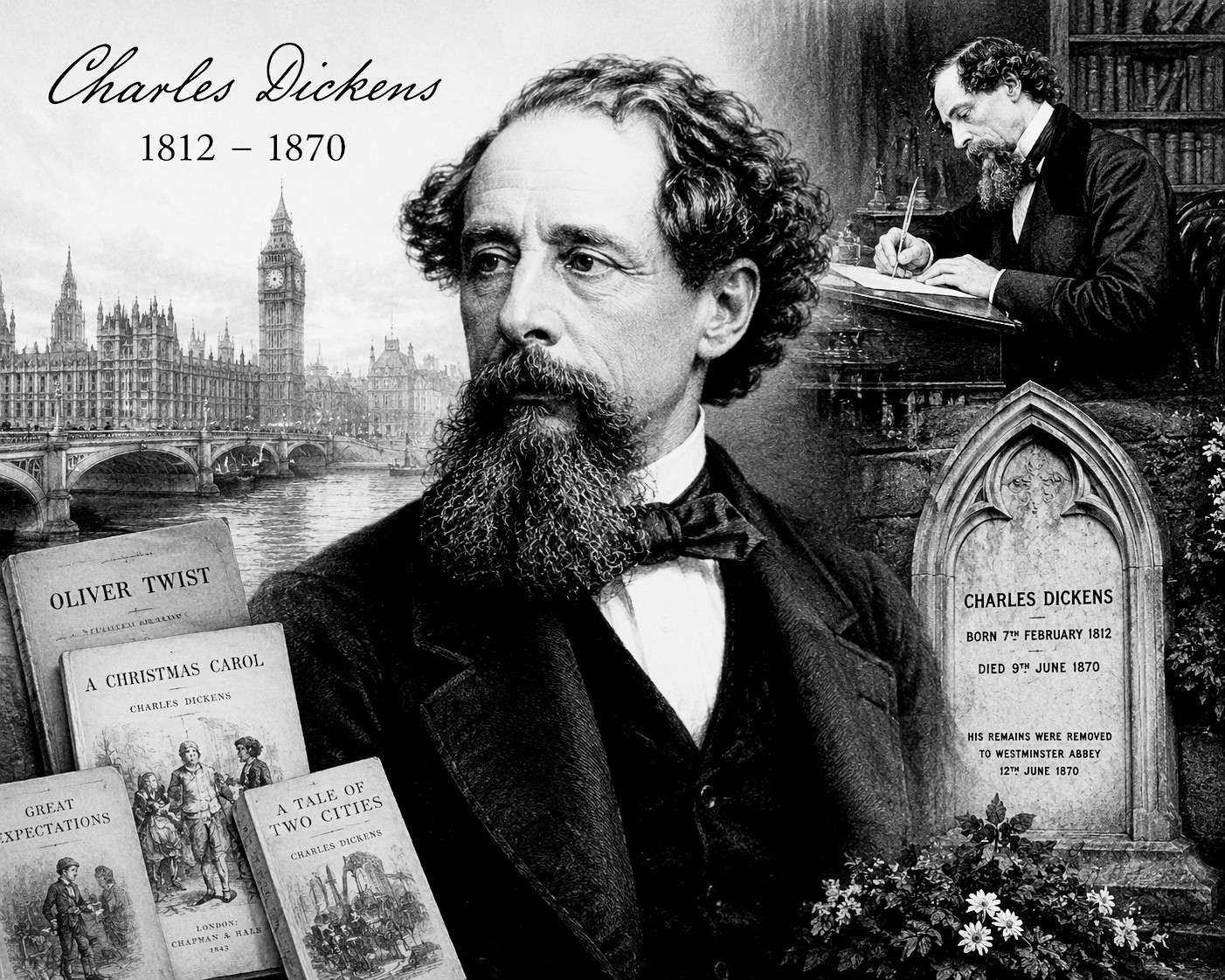
On 9 June 1870, English novelist Charles Dickens, widely regarded as the greatest writer of the Victorian era, died at the age of 58. His passing marked the end of one of the most influential literary careers in history, but his works continue to shape literature, culture, and social commentary more than 150 years later.
Born in Portsmouth, England, in 1812, Charles Dickens rose from a difficult childhood marked by poverty and hardship to become one of the most celebrated authors of the 19th century. His experiences of social inequality and economic struggle would later become central themes throughout his writing.
Dickens first gained widespread recognition with The Pickwick Papers in 1836. He quickly established himself as a literary phenomenon, captivating readers with vivid characters, compelling plots, and a unique ability to portray both the humour and hardships of everyday life.

A literary giant of the Victorian age
Throughout his career, Dickens produced a remarkable catalogue of novels that remain classics today. Works such as Oliver Twist, Nicholas Nickleby, A Christmas Carol, David Copperfield, Bleak House, Great Expectations, and A Tale of Two Cities have been translated into dozens of languages and adapted countless times for stage, film, and television.
His storytelling combined memorable characters with sharp observations of Victorian society. Dickens exposed child labour, debtors’ prisons, corruption, class inequality, and the harsh realities faced by the poor, helping to raise public awareness of social injustices during Britain’s rapid industrialisation.
More than an author
Beyond his novels, Dickens was a journalist, editor, public speaker, and social reform advocate. He used his growing influence to campaign for improvements in education, public health, and conditions for disadvantaged children.
His public readings became hugely popular across Britain and the United States, attracting large audiences eager to hear the author perform scenes from his own works. These appearances helped make Dickens one of the first truly international literary celebrities.
A sudden death
On 8 June 1870, Dickens suffered a stroke at his home, Gad’s Hill Place in Kent. He died the following day, leaving his final novel, The Mystery of Edwin Drood, unfinished.
Although he had wished for a modest burial, national admiration for the writer led to his interment in Poets’ Corner at Westminster Abbey. Thousands of mourners paid tribute to the man whose stories had become part of Britain’s cultural identity.
An enduring legacy
Today, Dickens remains one of the most widely read and studied authors in the English language. His works continue to resonate with modern audiences because many of the issues he explored—poverty, inequality, justice, and human dignity—remain relevant.
More than a century and a half after his death, Charles Dickens stands not only as the defining novelist of Victorian Britain but also as one of the greatest storytellers the world has ever known.
Newshub Editorial in Europe – 9 June 2026

If you have an account with ChatGPT you get deeper explanations,
background and context related to what you are reading.
Open an account:
Open an account
Recent Comments