
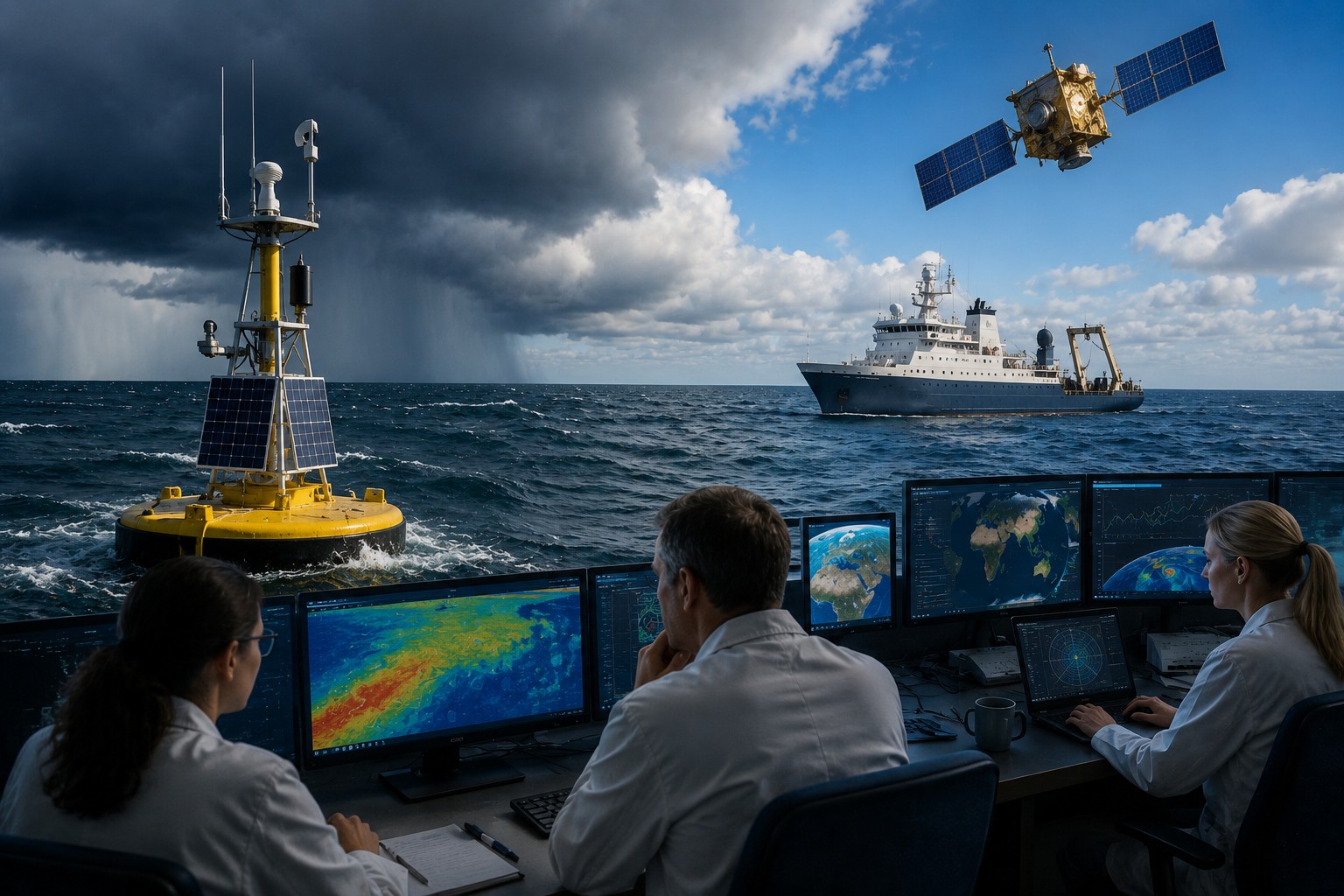
Scientists and climate experts have voiced strong concerns over proposals to significantly reduce or dismantle key elements of the United States’ ocean monitoring infrastructure, warning that such cuts could leave governments, businesses, and emergency services effectively “flying blind” when forecasting weather, tracking climate trends, and preparing for natural disasters.
Critical system under threat
The ocean observation network consists of thousands of instruments, satellites, buoys, sensors, and research platforms that continuously collect data on sea temperatures, ocean currents, atmospheric conditions, and marine ecosystems. This information is used by meteorologists and climate researchers around the world to improve forecasts and monitor environmental changes.

Experts argue that weakening the system would reduce the quality of weather prediction models that rely heavily on ocean data to forecast storms, rainfall, droughts, and temperature patterns.
Weather forecasting could suffer
Researchers warn that oceans play a central role in regulating global weather systems. Data collected from the world’s oceans helps forecast hurricanes, typhoons, floods, heatwaves, and other extreme weather events.
According to scientists, reducing access to this information would likely increase uncertainty in forecasting models and make it more difficult for authorities to issue accurate warnings ahead of dangerous weather events.
The concerns are particularly significant given the increasing frequency of climate-related disasters affecting communities worldwide.
Global consequences beyond the United States
Although the monitoring network is largely funded and operated by US agencies, the data generated is used internationally by weather services, universities, research institutions, shipping companies, airlines, and governments.
Experts note that the system functions as a global public resource, with information shared across borders to support forecasting and scientific research.
Any significant reduction in coverage could therefore affect weather prediction capabilities far beyond the United States, impacting both developed and developing nations.
Climate research at risk
Scientists also caution that long-term climate studies could be affected by interruptions in data collection. Ocean observations are essential for understanding rising sea levels, marine heatwaves, carbon absorption, and broader climate trends.
Researchers argue that maintaining continuous datasets is critical for accurately tracking environmental change and informing future policy decisions.
As debate continues over funding priorities and government spending, many in the scientific community are urging policymakers to preserve the monitoring network, warning that the cost of losing accurate ocean data could far exceed any short-term budget savings.
Newshub Editorial in North America – 6 June 2026

If you have an account with ChatGPT you get deeper explanations,
background and context related to what you are reading.
Open an account:
Open an account
Recent Comments