
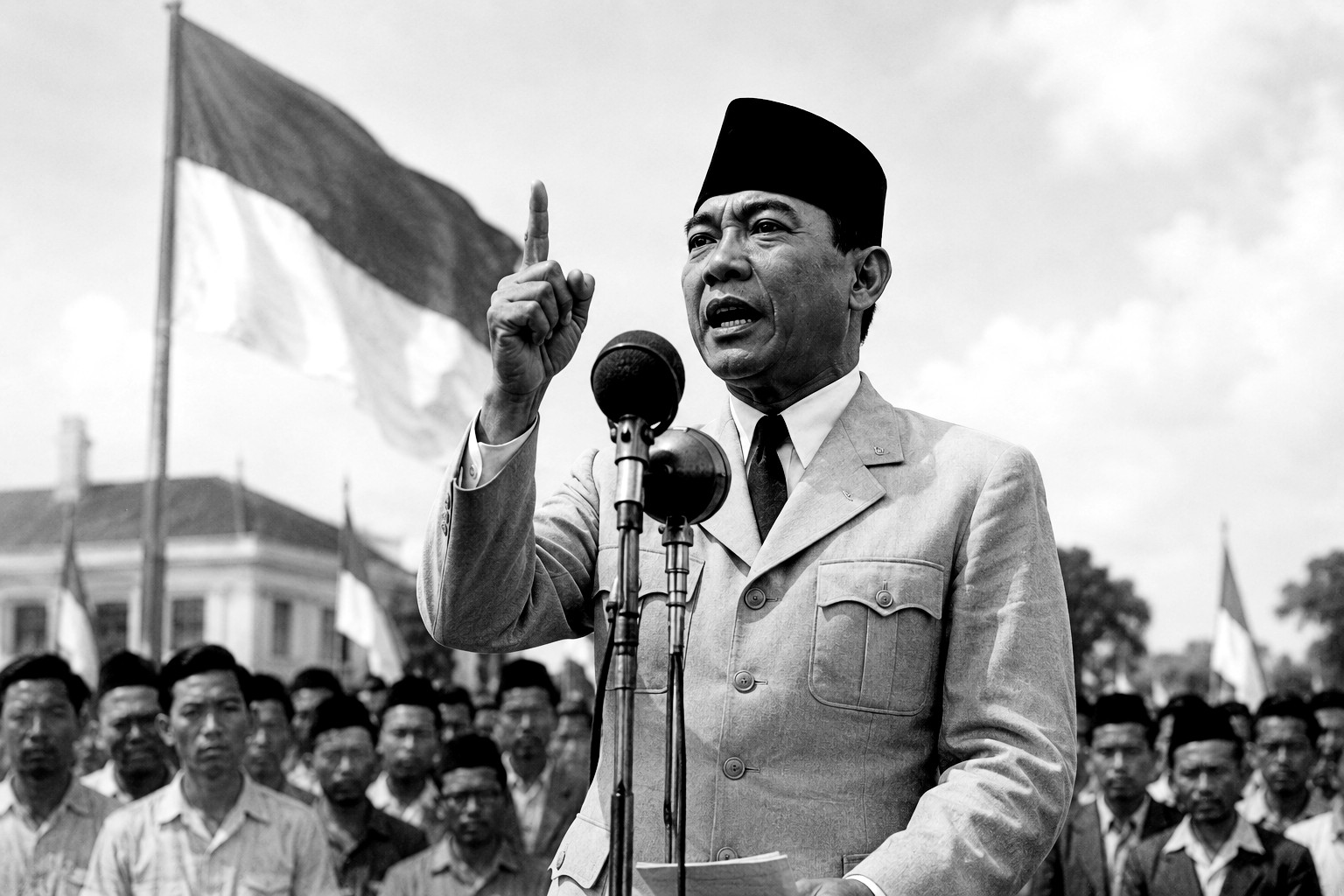
On 1 June 1945, Indonesian nationalist leader Sukarno delivered a landmark speech that introduced the Pancasila, a set of five guiding principles that would become the philosophical foundation of the modern Indonesian state. More than eight decades later, Pancasila remains central to Indonesia’s national identity, political system and social cohesion.
Sukarno, who would later become Indonesia’s first president, presented the concept during a meeting of the committee tasked with preparing for Indonesian independence from colonial rule. At the time, Indonesia was still under Japanese occupation during the final stages of the Second World War, but nationalist leaders were already planning for a future independent nation.
The term “Pancasila” is derived from Sanskrit, meaning “Five Principles”. Sukarno proposed the framework as a unifying ideology for a country characterised by immense ethnic, linguistic and religious diversity. Rather than favouring one group over another, the principles were designed to provide a common foundation for all Indonesians.

A blueprint for unity
The five principles outlined by Sukarno were:
- Belief in one supreme God.
- Just and civilised humanity.
- The unity of Indonesia.
- Democracy guided by wisdom through consultation and representation.
- Social justice for all Indonesians.
Together, these principles sought to balance religious faith, national unity, democratic governance and social welfare. The framework was intended to prevent sectarian divisions and create a state capable of accommodating Indonesia’s diverse population.
At a time when many newly emerging nations struggled with competing political ideologies, Pancasila offered a uniquely Indonesian approach that drew from local traditions, religious values and modern political thought.
From vision to state philosophy
Indonesia formally declared independence on 17 August 1945, just months after Sukarno’s speech. The following day, the country’s constitution incorporated Pancasila as the guiding philosophy of the new republic.
Over the decades, Pancasila has served as a cornerstone of Indonesian governance. Successive governments have interpreted and applied the principles in different ways, but their status as the state’s foundational ideology has remained unchanged.
The philosophy has also played a significant role in maintaining stability across the world’s fourth most populous nation, which consists of thousands of islands and hundreds of ethnic groups. Supporters argue that Pancasila has helped Indonesia avoid the ideological fragmentation experienced by some other post-colonial states.
Enduring relevance in modern Indonesia
Today, Pancasila continues to be taught in schools, referenced by political leaders and celebrated annually on 1 June as Pancasila Day. It remains a symbol of national unity and a reminder of the values that guided Indonesia’s path to independence.
As Indonesia strengthens its position as one of Asia’s largest economies and a key player in regional affairs, the principles first articulated by Sukarno in 1945 continue to influence debates about democracy, development, religious tolerance and social justice.
The speech stands as one of the most important moments in Indonesian history, providing a philosophical framework that has endured through political change, economic transformation and rapid modernisation.
Newshub Editorial in Asia – 1 June 2026

If you have an account with ChatGPT you get deeper explanations,
background and context related to what you are reading.
Open an account:
Open an account
Recent Comments