
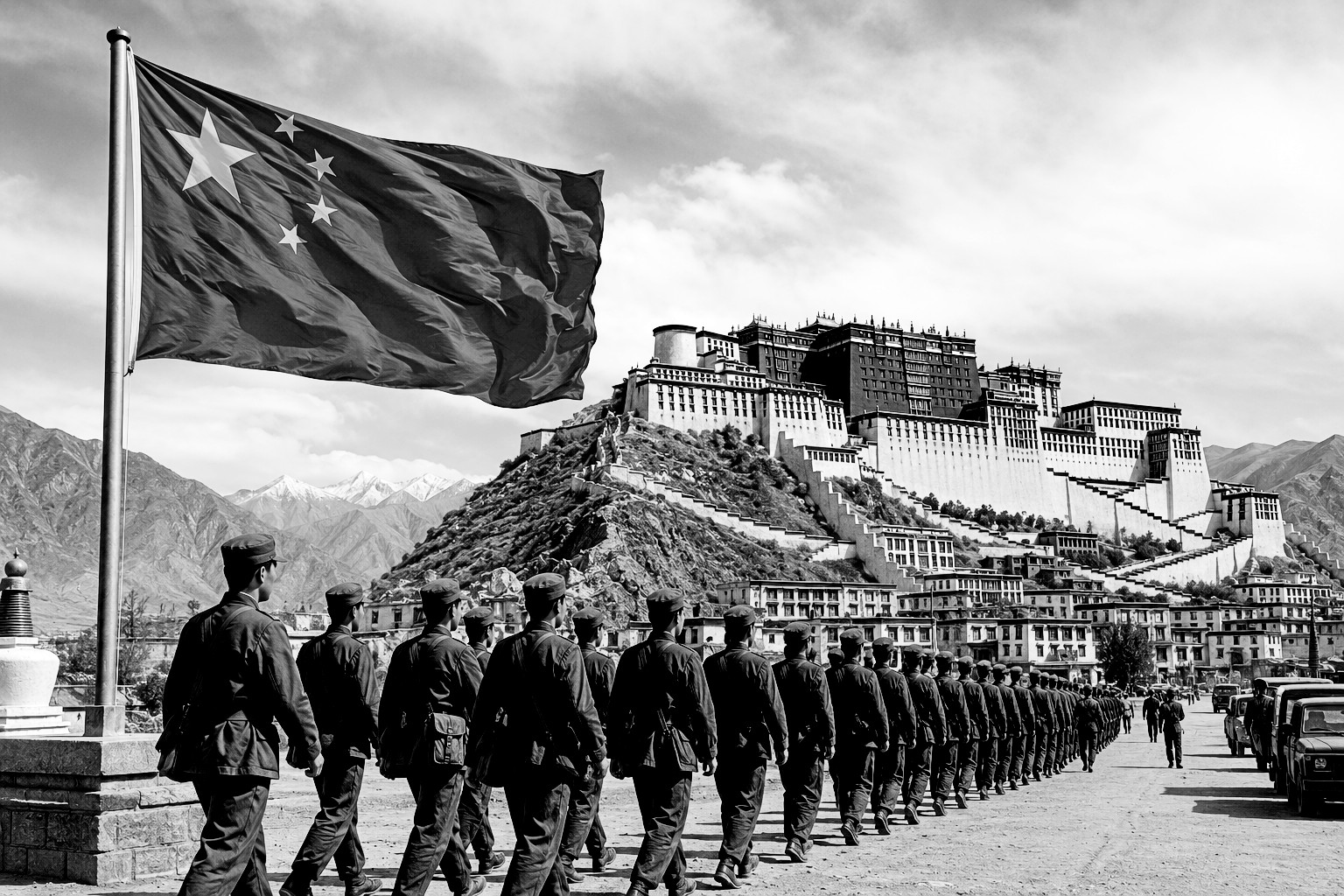
China’s formal incorporation of Tibet into the People’s Republic remains one of the most contested moments in modern Asian history. After Chinese forces entered Tibet in 1950, Beijing consolidated control through the 1951 Seventeen Point Agreement, while Tibetan leaders and many exile groups later argued that the agreement was signed under pressure. In 1965, Tibet was formally designated the Tibet Autonomous Region, turning the plateau into a provincial-level unit within China’s state structure.
From de facto independence to Chinese control
Before 1950, Tibet had functioned for decades with substantial de facto independence after the fall of the Qing dynasty. Lhasa maintained its own government, religious hierarchy and external contacts, although China continued to claim historical sovereignty. The arrival of the People’s Liberation Army changed that balance and brought Tibet under direct Chinese administration.
The 1959 uprising
Tensions escalated sharply in 1959, when an uprising broke out in Lhasa. The revolt was suppressed, and the 14th Dalai Lama fled to India, where the Tibetan government-in-exile later developed its political base. For Beijing, the events confirmed the need to tighten administrative control. For Tibetans in exile, they became the central symbol of occupation and lost self-rule.

Autonomy in name and practice
The creation of the Tibet Autonomous Region in 1965 was presented by China as a framework for ethnic autonomy, development and integration. In practice, however, critics argue that political authority has remained firmly controlled by the Chinese Communist Party. Religion, language, education and cultural identity have remained deeply sensitive areas, particularly because Tibetan Buddhism is closely tied to national identity.
A lasting geopolitical dispute
Tibet’s status continues to affect China’s relations with India, the United States and human rights organisations. Beijing rejects foreign criticism as interference in domestic affairs, while Tibetan advocates argue that genuine autonomy has never been delivered. The issue also carries strategic weight because Tibet borders India, Nepal, Bhutan and Myanmar and controls major water sources feeding Asia’s great rivers.
A question still unresolved
More than six decades after Tibet became an autonomous region, the dispute remains unresolved. China has built roads, railways and infrastructure across the plateau, but political control and cultural pressure remain central concerns for Tibetans and international observers. The formal annexation of Tibet did not close the question of sovereignty; it turned it into one of Asia’s most enduring political and human rights disputes.
Newshub Editorial in Asia – 23 May 2026

If you have an account with ChatGPT you get deeper explanations,
background and context related to what you are reading.
Open an account:
Open an account
Recent Comments