
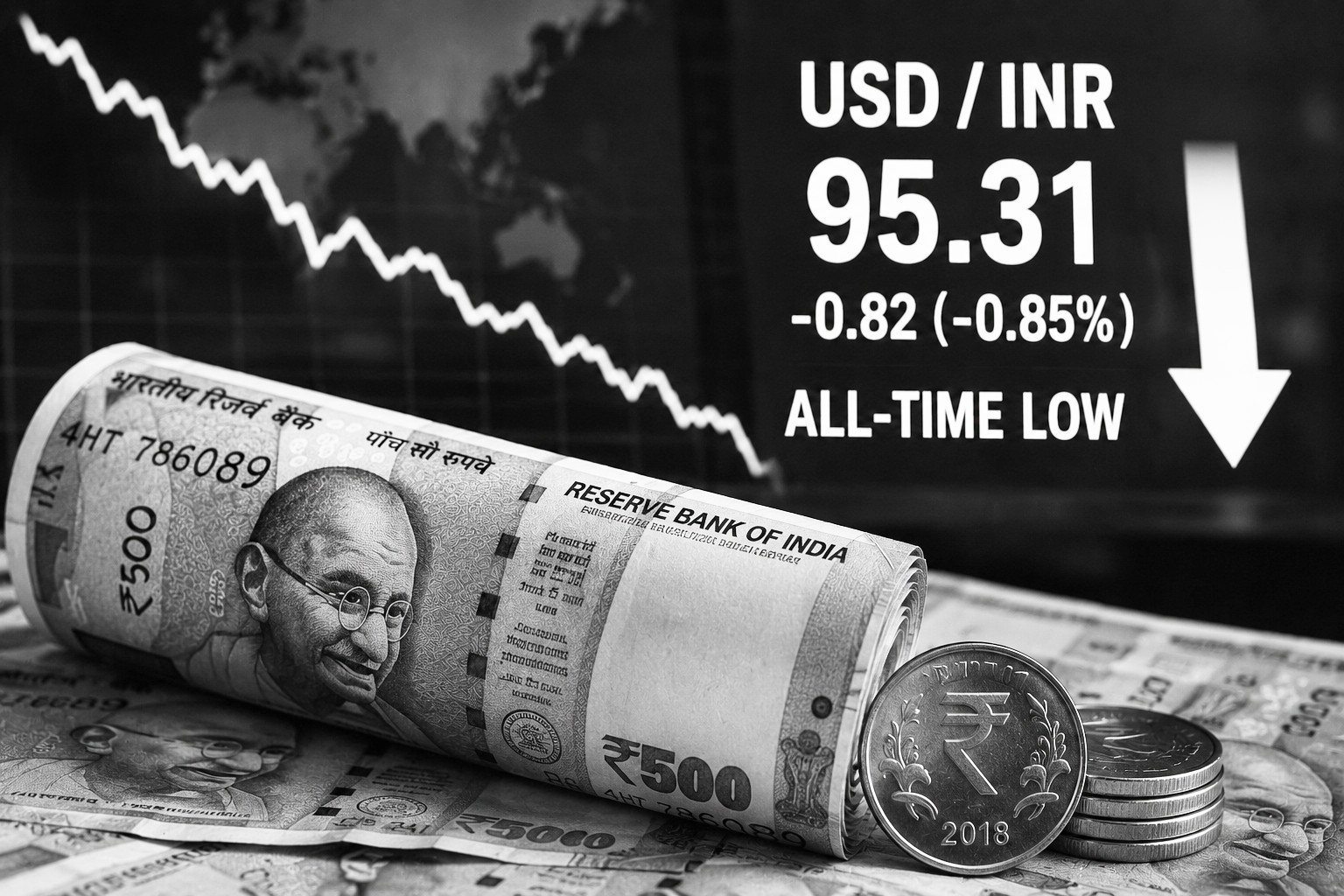
India’s rupee suffered its sharpest decline in months on Monday, crashing 82 paise to close at a historic low of 95.31 against the U.S. dollar as rising global uncertainty, foreign portfolio investor outflows and a strengthening American currency intensified pressure on the local unit. The sharp depreciation renewed concerns about imported inflation, energy costs and broader financial stability within one of Asia’s largest economies.
Forex traders said the rupee came under heavy pressure throughout the trading session as investors moved capital towards dollar-denominated assets amid escalating geopolitical tensions and stronger demand for safe-haven currencies.
The U.S. dollar has strengthened significantly in recent weeks as global markets reassessed inflation risks linked to rising oil prices and instability in the Middle East. Higher American bond yields and expectations surrounding future Federal Reserve policy have also supported dollar demand across international currency markets.

For India, which remains heavily dependent on imported crude oil, the timing of the rupee’s decline presents additional economic challenges.
Oil prices deepen currency pressure
India imports the majority of its energy requirements, meaning a weaker rupee combined with rising oil prices can rapidly increase import costs and inflationary pressure. Analysts noted that higher fuel prices may affect transportation, manufacturing and consumer spending throughout the economy.
Energy-importing Asian economies have faced renewed market volatility as oil traders continue monitoring geopolitical risks linked to shipping routes and regional supply concerns.
The rupee’s decline also reflects growing caution among foreign portfolio investors, many of whom have reduced exposure to emerging markets amid uncertainty surrounding global growth and monetary policy.
Foreign institutional investors reportedly continued withdrawing funds from Indian equities during recent sessions, placing further downward pressure on the currency.
Reserve Bank of India faces growing scrutiny
Attention is now increasingly turning towards the Reserve Bank of India and whether policymakers may intervene more aggressively to stabilise the currency market.
India’s central bank has historically used foreign exchange reserves strategically to reduce excessive volatility in the rupee. However, analysts note that sustained global dollar strength can limit the effectiveness of direct intervention efforts.
Market participants are also closely monitoring inflation expectations and potential implications for future interest-rate decisions. A weaker rupee may complicate efforts to manage inflation, particularly if elevated energy prices persist.
Despite the sharp currency decline, Indian equity markets showed relatively mixed performance as investors attempted to balance near-term currency concerns against the country’s broader long-term growth outlook.
India’s economic fundamentals remain under focus
Economists continue highlighting that India retains several structural strengths, including relatively strong domestic consumption, ongoing infrastructure investment and a rapidly expanding digital economy. However, external vulnerabilities linked to energy imports and global capital flows remain important risk factors.
The rupee’s record low also underscores how closely emerging markets remain tied to broader international financial conditions, particularly movements in U.S. interest rates and investor sentiment.
Corporate sectors reliant on imported materials and foreign debt exposure may face additional pressure if currency weakness continues over a prolonged period. Conversely, some export-oriented industries could benefit from improved international competitiveness.
For now, traders expect volatility within Indian currency markets to remain elevated as global investors continue reacting to geopolitical developments, oil price movements and international monetary policy expectations.
The coming weeks may prove critical in determining whether the rupee stabilises or faces further downward pressure amid an increasingly uncertain global financial environment.
Newshub Editorial in Asia – May 12, 2026

If you have an account with ChatGPT you get deeper explanations,
background and context related to what you are reading.
Open an account:
Open an accountIndia’s rupee suffered its sharpest decline in months on Monday, crashing 82 paise to close at a historic low of 95.31 against the U.S. dollar as rising global uncertainty, foreign portfolio investor outflows and a strengthening American currency intensified pressure on the local unit. The sharp depreciation renewed concerns about imported inflation, energy costs and broader financial stability within one of Asia’s largest economies.
Recent Comments