
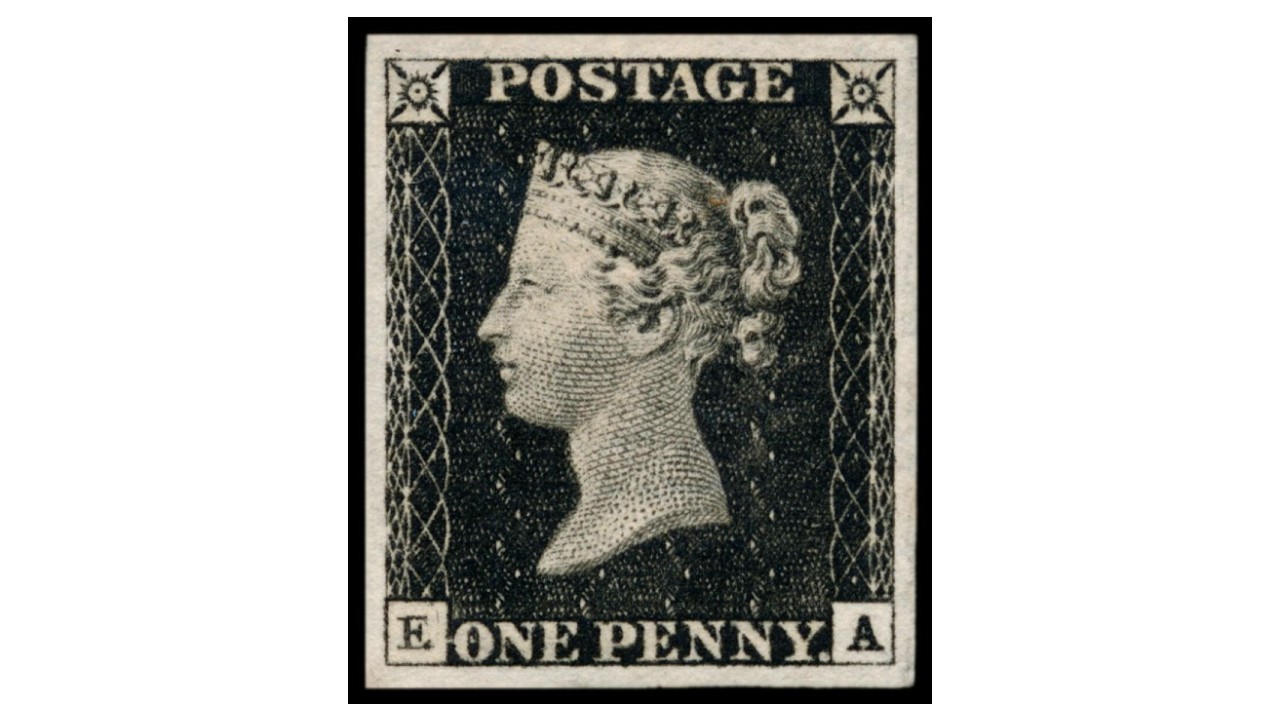
On 1 May 1840, the world’s first adhesive postage stamp, the Penny Black, was officially issued in England, marking the beginning of a revolution in global communication and postal systems. The small black stamp featuring the profile of Queen Victoria fundamentally transformed how people, businesses and governments exchanged information, laying the groundwork for the modern postal network still in use today.
The introduction of the Penny Black by the British postal authorities represented one of the most important administrative and commercial innovations of the 19th century. Before its release, postal costs were often expensive, inconsistent and typically paid by the recipient rather than the sender. Rates varied depending on distance and the number of pages being delivered, making communication difficult and costly for ordinary citizens.
The British reformer Sir Rowland Hill proposed a radically simpler system based on pre-paid postage. Under his model, anyone could send a standard letter anywhere within the United Kingdom for the uniform price of one penny. The Penny Black became the practical implementation of this idea and rapidly changed public access to communication.


A symbol of industrial Britain
The stamp itself carried a detailed engraving of the young Queen Victoria based on a portrait created by William Wyon. Printed entirely in black ink, the stamp quickly became known as the Penny Black. Despite its modest appearance, it symbolised a broader transformation taking place in industrial Britain, where railways, newspapers, banking and commerce were becoming increasingly interconnected.
The success of the stamp was immediate. Millions were printed and sold within the first year, dramatically increasing the volume of letters sent throughout the country. For the first time, affordable written communication became available to broad sections of society, helping families, businesses and institutions maintain regular contact over long distances.
The system also improved efficiency for postal workers, standardised procedures and reduced administrative complexity. Other countries quickly observed the British experiment and began adopting similar systems during the following decades.
Global influence on trade and society
The release of the Penny Black had implications far beyond personal correspondence. The new postal model accelerated trade, finance and international business by making communication more predictable and affordable. Contracts, invoices, market information and legal documents could move faster and more reliably between cities and regions.
Historians frequently describe the postage stamp as one of the foundational tools of globalisation during the industrial era. The rapid spread of postal systems supported expanding economies, growing empires and increasingly international financial markets.
By the late 19th century, postage stamps had become universal, and international agreements eventually led to the establishment of coordinated global postal standards. The influence of the British postal reform could therefore be seen across Europe, the Americas, Asia and Africa.
A lasting cultural and collector legacy
Today, the Penny Black remains one of the most famous stamps ever produced and holds legendary status among collectors and historians. Surviving examples are highly sought after and are displayed in museums and private collections around the world.
Beyond philately, the stamp continues to represent a milestone in administrative innovation and mass communication. Its release in 1840 demonstrated how a relatively simple idea could reshape economies, societies and human interaction on a global scale.
The Penny Black not only changed the postal service — it changed the speed at which the world could connect.
Newshub Editorial in Europe – May 1, 2026

If you have an account with ChatGPT you get deeper explanations,
background and context related to what you are reading.
Open an account:
Open an accountOn 1 May 1840, the world’s first adhesive postage stamp, the Penny Black, was officially issued in England, marking the beginning of a revolution in global communication and postal systems. The small black stamp featuring the profile of Queen Victoria fundamentally transformed how people, businesses and governments exchanged information, laying the groundwork for the modern postal network still in use today.
Recent Comments