
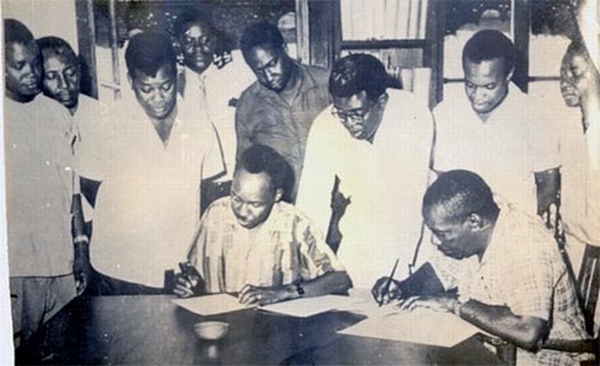
On 26 April 1964, the independent states of Tanganyika and Zanzibar formally united to create the United Republic of Tanzania, marking one of the most significant political mergers in post-colonial Africa.
A strategic union in a turbulent era
The union was forged in the aftermath of the Zanzibar Revolution, which had overthrown the Arab-led sultanate and established a new republican government on the islands. Just months earlier, Tanganyika had gained independence from British colonial rule in 1961, followed by Zanzibar in December 1963.
Leaders from both territories—most notably Julius Nyerere of Tanganyika and Abeid Karume—saw union as a means to stabilise the region, prevent external interference during the Cold War, and strengthen political and economic resilience.

Formation of the United Republic
The Articles of Union were signed on 22 April 1964, and within days the new state was proclaimed. Initially named the United Republic of Tanganyika and Zanzibar, it was soon renamed Tanzania—a blend of the two territories’ names.
The structure of the union was unique: while mainland Tanganyika and Zanzibar merged under a single sovereign state, Zanzibar retained a semi-autonomous status with its own president, legislature, and internal governance over non-union matters. This dual system remains a defining feature of Tanzania’s political framework today.
Political vision and long-term stability
Nyerere’s vision of African unity and self-reliance played a central role in the merger. He viewed the union as a practical step toward broader pan-African integration, reducing fragmentation across the continent.
Over the decades, Tanzania has largely maintained political stability compared to many of its regional peers, avoiding civil war and large-scale internal conflict. The union itself, however, has periodically faced tensions—particularly regarding Zanzibar’s autonomy and calls for greater independence—but it has endured for more than six decades.
Economic and regional implications
The merger created a geographically and economically diverse nation, combining the mainland’s agricultural base with Zanzibar’s historical role as a trading hub in the Indian Ocean. Today, Tanzania is a key member of the East African Community, leveraging its strategic position to expand trade and infrastructure links across the region.
The union also contributed to the country’s identity as a cohesive state, supporting nation-building efforts through shared language—Swahili—and centralised political institutions.
A defining moment in African history
The creation of Tanzania stands as one of the few successful political unions between sovereign states in modern history. While many post-colonial borders remained fixed, this merger demonstrated an alternative path—one based on voluntary integration and shared governance.
More than 60 years later, the union continues to shape Tanzania’s political identity, offering a case study in both the opportunities and complexities of state-building in Africa.
Newshub Editorial in Africa – April 27, 2026

If you have an account with ChatGPT you get deeper explanations,
background and context related to what you are reading.
Open an account:
Open an accountOn 26 April 1964, the independent states of Tanganyika and Zanzibar formally united to create the United Republic of Tanzania, marking one of the most significant political mergers in post-colonial Africa.
Recent Comments