
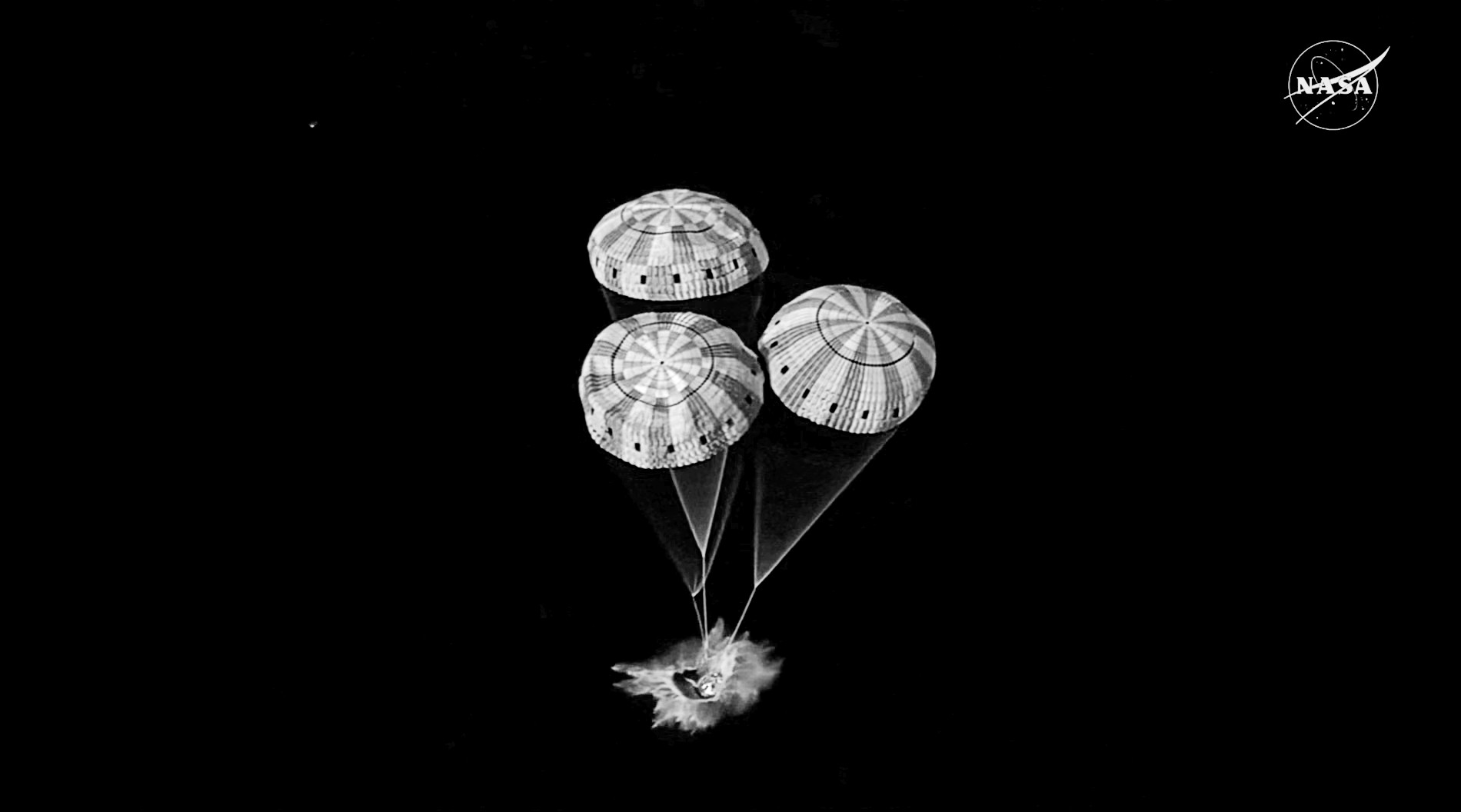
The crew of Artemis II splashed down safely off the coast of California after a record-breaking 10-day journey around the Moon, marking a major milestone in humanity’s return to deep space exploration.
A mission that pushes boundaries
The four astronauts aboard Artemis II completed the first crewed lunar flyby mission in more than five decades, travelling farther from Earth than any humans before them. The mission, led by NASA, is widely seen as a critical step toward establishing a sustained human presence on the Moon.
During the flight, the crew conducted a series of system tests, navigation exercises and communications trials designed to validate spacecraft performance under deep space conditions. The mission also demonstrated the capabilities of the Orion spacecraft, which is intended to carry astronauts to lunar orbit and beyond in future missions.

A safe return to Earth
The capsule re-entered Earth’s atmosphere at high speed before deploying parachutes and splashing down in the Pacific Ocean. Recovery teams quickly secured the spacecraft and assisted the astronauts, who were reported to be in good condition following the mission.
The successful return concluded a technically demanding journey that required precise navigation and coordination across multiple mission phases, including launch, lunar flyby and Earth re-entry.
‘Just the beginning’ of a new era
Mission officials described Artemis II as a foundational moment in the broader Artemis programme, which aims to return humans to the Moon and eventually establish long-term exploration infrastructure. The phrase “just the beginning” has been widely used to frame the mission’s significance, highlighting its role as a precursor to future landings.
The next phase, expected to involve a crewed lunar landing, will build on the data and experience gathered during Artemis II. These missions are designed not only for exploration but also for testing technologies that could support future journeys to Mars.
Global and strategic implications
The success of Artemis II reinforces the United States’ position in the renewed global space race, where multiple nations and private entities are investing heavily in lunar exploration. The mission also underscores growing international collaboration, with partners contributing technology, research and operational support.
At the same time, the programme carries strategic importance, as space agencies increasingly view the Moon as a platform for scientific discovery, resource utilisation and long-term human expansion beyond Earth.
A defining moment for modern spaceflight
Artemis II represents a turning point in modern space exploration, bridging the gap between historic missions of the past and ambitious plans for the future. By successfully completing a crewed lunar flyby, the mission demonstrates both technological readiness and political commitment to sustained space exploration.
As the astronauts return to Earth, the focus now shifts to what comes next — a new chapter that could redefine humanity’s relationship with space and lay the groundwork for exploration far beyond the Moon.
Newshub Editorial in North America – April 11, 2026

If you have an account with ChatGPT you get deeper explanations,
background and context related to what you are reading.
Open an account:
Open an account
Recent Comments