

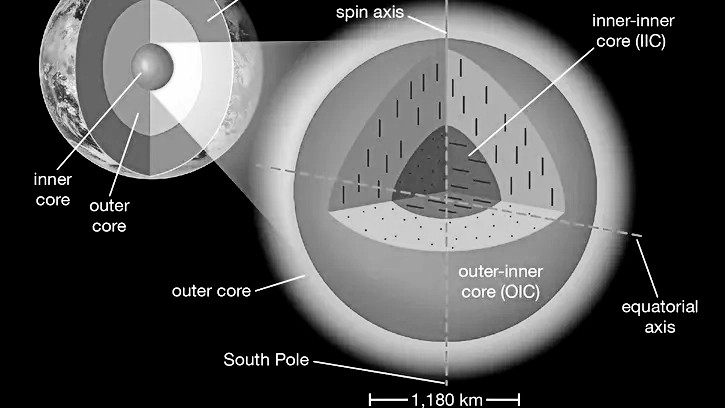
In 1936, Danish seismologist Inge Lehmann made a breakthrough that fundamentally changed scientific understanding of the Earth’s interior, revealing that the planet’s core was not uniform but composed of distinct layers. Her discovery of the solid inner core remains one of the most important contributions in the field of geophysics.
A puzzle beneath the surface
At the time Lehmann conducted her research, scientists believed the Earth’s core was entirely liquid. This assumption was based on how seismic waves — generated by earthquakes — travelled through the planet. Certain waves appeared to disappear when reaching the core, reinforcing the idea of a molten centre.
Lehmann, working at the Danish Geodetic Institute, closely analysed seismic data from earthquakes occurring across the globe. She noticed anomalies: faint signals appearing in regions where no seismic waves were expected. These observations suggested that waves were being deflected or reflected in ways that existing models could not explain.

The discovery of the inner core
Lehmann proposed a bold revision to the accepted model. She argued that the Earth’s core must contain a solid inner sphere surrounded by a liquid outer layer. This structure would explain why some seismic waves reappeared after passing through the core — they were being refracted by a solid inner boundary.
Her findings, published in 1936, introduced the concept of what is now known as the “Lehmann discontinuity,” marking the boundary between the Earth’s liquid outer core and solid inner core. The proposal was initially met with caution but gradually gained acceptance as further seismic evidence confirmed her conclusions.
Scientific impact and validation
Lehmann’s model provided a framework that remains central to modern geophysics. Today, it is well established that the Earth consists of a solid inner core primarily composed of iron and nickel, surrounded by a liquid outer core responsible for generating the planet’s magnetic field.
Advances in seismic technology throughout the 20th century repeatedly validated Lehmann’s insight. Her work not only refined understanding of Earth’s structure but also improved the interpretation of seismic activity, contributing to fields ranging from earthquake prediction to planetary science.
A lasting legacy in geophysics
Inge Lehmann’s achievement stands out not only for its scientific significance but also for the context in which it was made. Working in a male-dominated field during the early 20th century, she established herself as one of the leading seismologists of her time through meticulous analysis and intellectual rigour.
Her legacy endures in both scientific terminology and ongoing research into Earth’s deep interior. The inner core remains a subject of active study, with researchers continuing to explore its composition, behaviour, and role in shaping the planet’s evolution.
Lehmann’s discovery serves as a reminder that even the most established scientific assumptions can be overturned through careful observation and critical thinking — a principle that continues to drive progress in modern science.
Newshub Editorial in Europe – March 29, 2026

If you have an account with ChatGPT you get deeper explanations,
background and context related to what you are reading.
Open an account:
Open an account
Recent Comments