

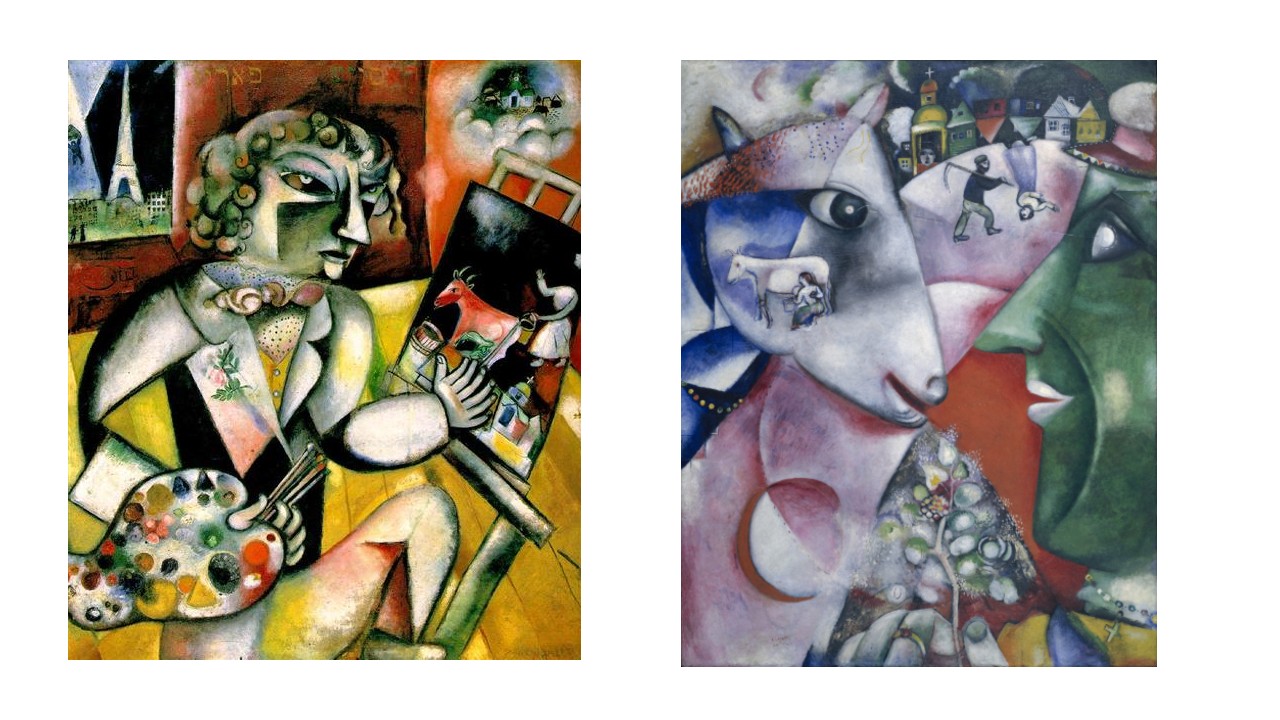
Marc Chagall remains one of the most distinctive voices in 20th-century art, blending folklore, memory and modernism into a visual language that defied categorisation. Born in Belarus and later naturalised as a French citizen, his work continues to influence artists, collectors and institutions worldwide.
Origins and early influences
Born in 1887 in Vitebsk, then part of the Russian Empire (now Belarus), Marc Chagall grew up in a Jewish family within a tight-knit community. His upbringing deeply shaped his artistic vision, with recurring motifs drawn from village life, religious traditions and personal memory. Early exposure to icon painting and folk art gave his work a symbolic and narrative quality that would remain central throughout his career.
Paris and the birth of a modern style
Chagall moved to Paris in 1910, immersing himself in the avant-garde scene alongside artists experimenting with Cubism and Fauvism. While influenced by these movements, he resisted full alignment, instead developing a unique style characterised by floating figures, vivid colours and dreamlike compositions. Works such as I and the Village exemplify his ability to merge personal storytelling with modernist techniques, creating art that felt both intimate and universal.

War, exile and resilience
The turbulence of the 20th century profoundly affected Chagall’s life and work. Returning to Russia during the First World War, he later fled the Soviet Union as artistic freedoms narrowed. During the Second World War, he escaped Nazi-occupied France and found refuge in the United States. These periods of displacement introduced darker tones into his work, yet his core themes—love, identity and spirituality—remained intact.
A master across mediums
Beyond painting, Chagall achieved global recognition for his work in stained glass, theatre design and large-scale public commissions. His stained-glass windows, notably those installed in Jerusalem and European cathedrals, demonstrate his mastery of colour and light. These works expanded his influence beyond galleries into public and sacred spaces, reinforcing his reputation as a versatile and innovative artist.
Legacy and market relevance
Chagall’s works are held in major museums worldwide and continue to command strong prices at auction, reflecting sustained demand among collectors. His art occupies a unique position at the intersection of modernism and narrative symbolism, appealing to both institutional buyers and private investors. In an art market increasingly driven by recognisable names and emotional resonance, Chagall’s oeuvre remains both culturally significant and commercially resilient.
A timeless visual language
What distinguishes Marc Chagall is his refusal to conform to a single artistic doctrine. Instead, he constructed a visual universe rooted in memory, emotion and imagination. His floating lovers, upside-down animals and luminous villages are not merely stylistic choices but expressions of a deeply personal worldview. Decades after his death in 1985, Chagall’s work continues to resonate, offering a poetic counterpoint to the often rigid narratives of modern art.
Newshub Editorial in Europe – March 28, 2026

If you have an account with ChatGPT you get deeper explanations,
background and context related to what you are reading.
Open an account:
Open an account
Recent Comments