

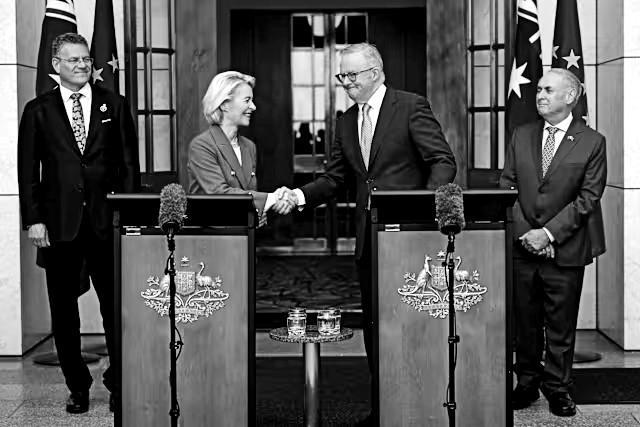
A long-awaited breakthrough in bilateral relations
The European Union and Australia have formally signed a comprehensive agreement aimed at strengthening trade, investment, and strategic cooperation, marking a significant milestone after years of negotiations. The deal reflects a shared ambition to diversify economic partnerships and reinforce rules-based international trade amid rising geopolitical uncertainty.
Trade liberalisation at the core
At the centre of the agreement is a broad reduction in tariffs and non-tariff barriers across key sectors. European exporters are expected to gain improved access to Australian markets in areas such as automotive, pharmaceuticals, and industrial goods, while Australian producers will benefit from expanded entry into the EU for agricultural exports, including beef, wine, and dairy.
The agreement also addresses regulatory alignment, aiming to simplify standards and certification processes that have historically limited cross-border trade efficiency. This is expected to reduce operational friction for businesses operating between the two markets.

Strategic and geopolitical alignment
Beyond trade, the agreement carries a strong geopolitical dimension. Both parties have emphasised the importance of secure supply chains, particularly in critical minerals, energy, and advanced technologies. Australia’s role as a key supplier of rare earth materials positions it as a strategic partner for the EU’s industrial and green transition ambitions.
The deal also signals closer coordination on Indo-Pacific engagement, with the EU seeking to expand its presence in the region while aligning with like-minded partners on security and economic resilience.
Sustainability and regulatory standards
Sustainability provisions form a central pillar of the agreement. Both sides have committed to maintaining high environmental and labour standards, including adherence to international climate targets. This reflects the EU’s broader policy approach of embedding sustainability into its external trade agreements.
Mechanisms for dispute resolution and compliance monitoring have been included to ensure that commitments are upheld over time, reinforcing predictability for investors and stakeholders.
Economic impact and outlook
The agreement is expected to generate long-term economic benefits by increasing trade volumes and facilitating investment flows between the two economies. For the EU, it strengthens diversification away from traditional partners, while for Australia, it provides enhanced access to one of the world’s largest single markets.
However, implementation will be closely watched, particularly in sensitive sectors such as agriculture, where domestic stakeholders have previously expressed concerns about competition and quotas.
A signal in a shifting global order
The signing of the agreement comes at a time of increasing fragmentation in global trade. By advancing a comprehensive bilateral framework, the EU and Australia are positioning themselves as advocates of open markets and multilateral cooperation.
As geopolitical tensions continue to shape economic policy, the agreement represents both a commercial opportunity and a strategic statement about the future direction of international trade.
Newshub Editorial in Europe – March 24, 2026

If you have an account with ChatGPT you get deeper explanations,
background and context related to what you are reading.
Open an account:
Open an account
Recent Comments