

The Iraq war began on 20 March 2003, when a United States-led coalition launched a large-scale military invasion aimed at toppling Saddam Hussein and dismantling what it claimed were Iraq’s weapons of mass destruction programmes.
A rapid military campaign
The initial phase of the war, branded “Operation Iraqi Freedom,” was characterised by overwhelming force and speed. The United States, supported primarily by the United Kingdom and a smaller coalition of allies, initiated the invasion with a campaign of aerial bombardment known as “shock and awe.” The objective was to cripple Iraq’s command and control infrastructure, degrade military capability, and psychologically overwhelm the regime.
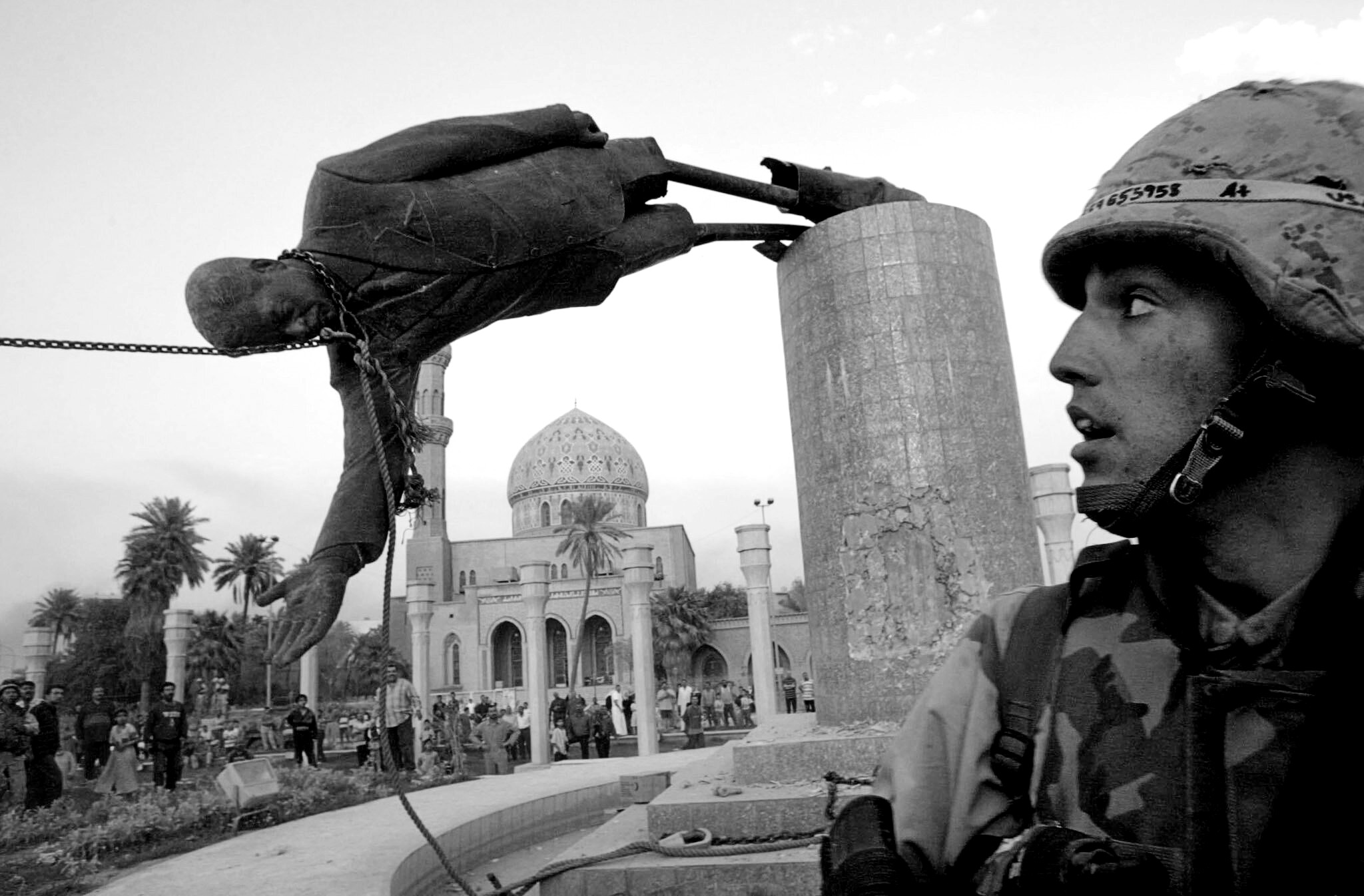
Ground forces advanced quickly from Kuwait into southern Iraq, encountering sporadic resistance from Iraqi forces. Within weeks, coalition troops reached Baghdad. On 9 April 2003, the Iraqi capital effectively fell, symbolised by the widely broadcast toppling of Saddam Hussein’s statue in Firdos Square. By early May, then US President George W. Bush declared the end of major combat operations.

The case for war
The justification for the invasion rested heavily on claims that Iraq possessed weapons of mass destruction (WMDs) and posed an imminent threat to international security. The US and its allies also argued that Saddam Hussein’s regime had links to terrorist organisations and that regime change would promote democracy in the Middle East.
However, the war was highly controversial from the outset. Key allies, including France and Germany, opposed military action without explicit authorisation from the United Nations Security Council. Large-scale protests took place globally in early 2003, reflecting widespread public scepticism about the evidence presented.
In the months and years following the invasion, no stockpiles of WMDs were found. This significantly undermined the credibility of the initial rationale and fuelled ongoing political and legal debates in the US, UK, and internationally.
From invasion to insurgency
While the initial military campaign was swift, the aftermath proved far more complex and destabilising. The dissolution of Iraq’s army and state institutions created a power vacuum, contributing to widespread looting, lawlessness, and the emergence of insurgent groups.
By late 2003, Iraq had entered a prolonged period of insurgency and sectarian violence. Various factions—including former regime loyalists, Islamist militants, and later groups such as al-Qaeda in Iraq—began targeting coalition forces and civilians. The conflict evolved into a multifaceted war involving ethnic, religious, and political divisions.
Efforts to rebuild Iraq’s political system led to elections and the formation of a new government, but instability persisted for years. The long-term consequences included significant loss of life, displacement of millions, and enduring regional instability.
Global implications and legacy
The Iraq war reshaped global geopolitics and had lasting implications for international relations. It strained transatlantic alliances, raised questions about the use of pre-emptive military force, and influenced subsequent foreign policy decisions in the Middle East.
Economically, the war imposed substantial costs on the United States and its allies, while contributing to volatility in global oil markets. Politically, it eroded trust in government intelligence in several countries and intensified debates over interventionism.
More than two decades later, the Iraq war remains a defining event of the early 21st century—one that continues to inform discussions on military intervention, state-building, and the limits of external power in complex regional conflicts.
Newshub Editorial in Europe – March 19, 2026

If you have an account with ChatGPT you get deeper explanations,
background and context related to what you are reading.
Open an account:
Open an account
Recent Comments