
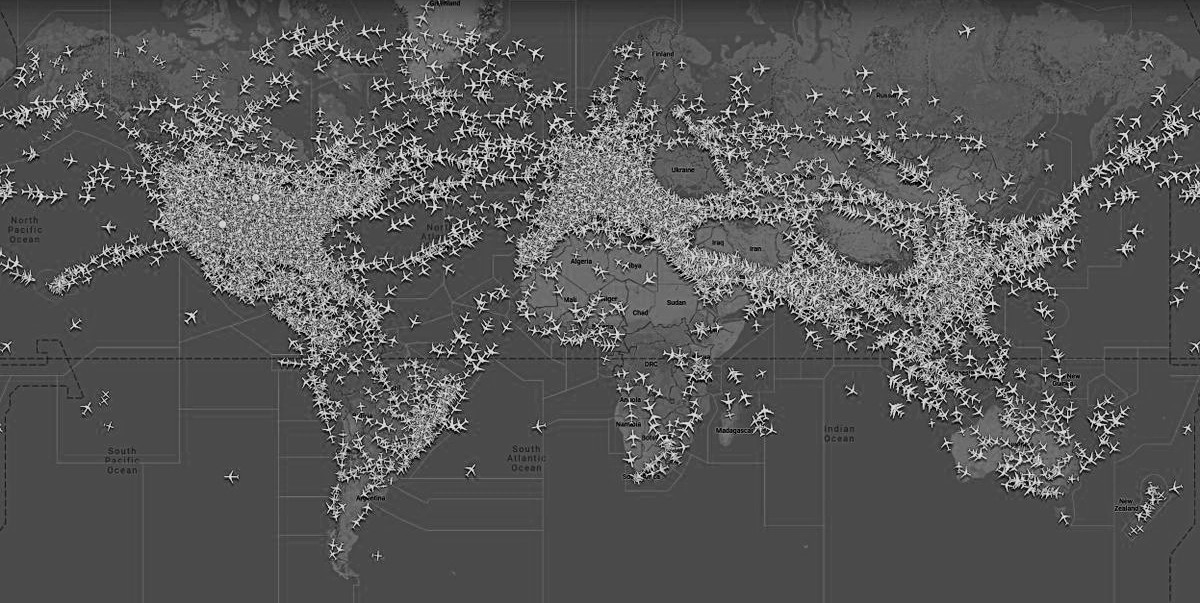
When geopolitical crises disrupt global aviation, millions of people now turn to a Swedish digital platform to watch events unfold in real time. Flightradar24, once a small feature inside a flight price comparison website, has become the world’s most widely used live air-traffic tracker, offering an unprecedented view of the skies during moments of global tension.
From a Swedish side project to global platform
The service Flightradar24 was created by Swedish aviation enthusiasts Mikael Robertsson and Olov Lindberg. Initially developed as an additional feature on a flight price comparison portal, the live map of aircraft positions quickly became more popular than the original travel service itself.
Founded in 2006 and based in Stockholm, the platform now tracks aircraft movements worldwide and provides detailed data including flight numbers, routes, altitude, speed and aircraft type.


Over time, it evolved from a niche aviation tool into a global digital infrastructure used by journalists, analysts, aviation professionals and ordinary travellers alike.
How the technology tracks the world’s aircraft
Flightradar24 works by collecting signals from aircraft transponders using a technology known as ADS-B (Automatic Dependent Surveillance-Broadcast). These signals transmit information such as position, speed and altitude, which are then received by ground-based receivers and forwarded to the platform’s global network.
The system relies heavily on crowdsourcing. Thousands of aviation enthusiasts around the world host receivers that feed real-time data into the network. Today the platform operates tens of thousands of receivers globally, allowing it to track hundreds of thousands of flights each day.
The result is a live map showing aircraft moving across the planet in near real time.
Crisis moments drive massive global attention
Flightradar24’s global popularity often spikes during major aviation or geopolitical events. Its first major surge came during the 2010 eruption of Iceland’s Eyjafjallajökull volcano, when millions of people used the site to watch Europe’s airspace empty as flights were grounded.
Since then, the platform has become the public’s real-time window into events such as the disappearance of Malaysia Airlines Flight 370, the collapse of global aviation during the Covid-19 pandemic and major political tensions affecting air travel.
The latest surge in traffic has come amid the escalating conflict between the United States, Israel and Iran. As countries across the Middle East closed their airspace, the platform revealed dramatic shifts in global aviation routes, with aircraft rerouting through narrow corridors north of Iran via the Caucasus or south through Egypt, Saudi Arabia and Oman.
These patterns, visible instantly on the map, show how geopolitical tensions reshape international travel in real time.
A new form of global transparency
Today Flightradar24 attracts tens of millions of monthly users and more than a million paying subscribers, while airlines and aviation professionals also rely on its data services.
Beyond aviation enthusiasts, the platform has become a powerful transparency tool. During conflicts, disasters or major state visits, the movement of aircraft—once largely invisible to the public—can now be tracked by anyone with an internet connection.
In an increasingly uncertain geopolitical environment, the Swedish platform has effectively turned global airspace into a live data map, allowing the world to witness the immediate impact of crises as they unfold above the clouds.
Newshub Editorial in Europe – March 6, 2026

If you have an account with ChatGPT you get deeper explanations,
background and context related to what you are reading.
Open an account:
Open an account
Recent Comments