
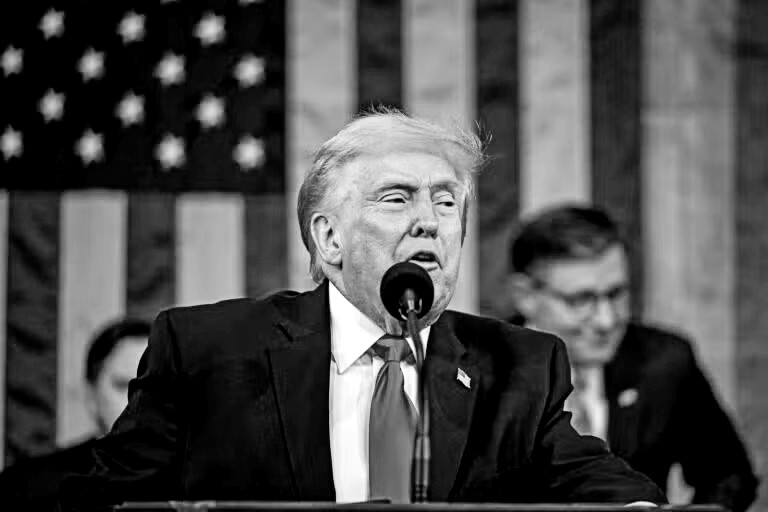
A notable minority of Republican voters now say Donald Trump appears increasingly erratic, according to a new poll conducted just ahead of his highly polarising State of the Union address, adding fresh complexity to the debate over age and leadership in US politics.
Polling reveals internal unease
The survey, released days before the address to Congress, found that a surprising proportion of Republican respondents believe Donald Trump is becoming “erratic with age”. While the majority of Republican voters continue to express support for the president, the findings suggest a measurable shift in perception within his own political base.
The polling results come at a sensitive moment. Trump’s State of the Union speech — delivered against a backdrop of legal battles, policy disputes and global tensions — intensified partisan divides. Supporters praised his combative tone and policy pledges, while critics described the address as unusually confrontational.


The emergence of age-related concerns among Republicans mirrors a broader national conversation about the cognitive stamina and health of ageing political leaders. At 79, Trump is among the oldest individuals to serve in the Oval Office, a factor that has become an increasingly prominent campaign issue.
Health and acuity under scrutiny
Questions surrounding presidential health are not new in American politics. However, scrutiny has intensified in recent years as both major parties have fielded older candidates. In Trump’s case, detractors have pointed to off-script remarks, rhetorical tangents and late-night social media posts as evidence of unpredictability. Allies counter that his unscripted style has long been a defining political asset rather than a liability.
The White House has dismissed speculation about cognitive decline, describing the president as energetic and fully capable of executing his duties. Medical summaries released during previous campaigns characterised Trump as being in good overall health, though critics argue that greater transparency would help calm speculation.
Implications for 2026 and beyond
Within the Republican Party, the poll’s findings could have strategic implications. Even a modest erosion of confidence among core voters may influence fundraising, turnout dynamics and intra-party positioning ahead of midterm and future presidential contests.
Party leaders face a delicate balancing act: reaffirming support for a dominant political figure while addressing emerging voter concerns about stability and electability. Republican strategists privately acknowledge that perceptions of erratic behaviour — whether grounded in policy disagreements or personal style — can affect swing voters in tightly contested states.
For now, Trump maintains strong approval among the Republican base, and no significant primary challenge has materialised. Yet the polling underscores a subtle but noteworthy development: scepticism is no longer confined to political opponents. As debates over age and capacity intensify across the political spectrum, the issue may become a defining theme of the current electoral cycle.
Whether the concerns represent a fleeting reaction to a divisive speech or the beginning of a deeper shift within Republican ranks remains to be seen. What is clear is that questions about leadership, temperament and longevity are increasingly central to American political discourse.
Newshub Editorial in North America – 26 February 2026

If you have an account with ChatGPT you get deeper explanations,
background and context related to what you are reading.
Open an account:
Open an account
Recent Comments