
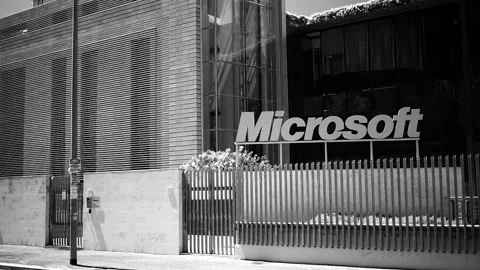
Microsoft shares suffered a steep decline on Thursday’s trading session on the New York Stock Exchange, erasing approximately $357bn in market capitalisation in a single day as investors reassessed growth expectations, rising investment costs, and the near-term returns from the company’s aggressive artificial intelligence strategy. The move marked one of the most severe one-day value losses ever recorded by a US-listed company and sent a clear signal that market tolerance for uncertainty around future earnings is tightening.
A sell-off of unusual magnitude
The scale of Thursday’s decline stood out not only for its size, but for the stature of the company involved. Microsoft has long been considered one of the market’s most stable technology leaders, supported by diversified revenues, recurring enterprise contracts, and strong cash generation. The selling pressure built steadily through the session, indicating large institutional repositioning rather than short-term volatility or retail-driven moves.
Earnings delivery versus expectations
The immediate catalyst for the drop was the company’s latest earnings release. While headline revenue and profit figures remained strong and broadly in line with expectations, markets reacted to what the results implied about the pace and quality of future growth. Investors had priced Microsoft for near-perfect execution, leaving little room for ambiguity. When forward indicators failed to decisively exceed expectations, confidence at elevated valuation levels weakened rapidly.

Cloud growth under scrutiny
Particular attention focused on Microsoft’s cloud operations, which form the core of its long-term investment thesis. Although cloud revenues continued to grow at a healthy pace, the rate of expansion showed signs of moderation compared with previous quarters. Given the cloud segment’s importance to margin expansion and long-term earnings power, even modest deceleration was enough to prompt a sharp reassessment of future cash-flow assumptions.
AI investment costs reshape the narrative
Another key driver behind the sell-off was concern over the scale and intensity of Microsoft’s investment in artificial intelligence infrastructure. The company has committed substantial capital to data centres, advanced chips, and AI-related capacity. While strategically rational, these investments materially increase near-term costs. Investors questioned how quickly these outlays would translate into sustainable, high-margin revenue, particularly as competition in AI services accelerates across the technology sector.
Valuation sensitivity in a changing market
Thursday’s move highlighted a broader shift in market psychology. Over the past year, optimism around AI has supported premium valuations for large technology companies. The reaction to Microsoft’s update suggested that investors are now demanding clearer evidence of monetisation and operating leverage. At current valuation levels, the market appears less willing to fund long-dated growth stories without visible near-term payoff.
Wider implications for technology stocks
Microsoft’s loss reverberated across the broader technology sector, weighing on peer stocks and major US indices. The episode reinforced a growing theme: scale and ambition alone are no longer sufficient to justify expanding valuations. Markets are increasingly differentiating between revenue growth, profitability, and capital discipline, even among industry leaders.
A reset, not a rejection
Despite the severity of the decline, the sell-off does not fundamentally undermine Microsoft’s long-term strategic position. The company remains deeply embedded in global enterprise infrastructure and financially robust. However, Thursday’s $357bn loss represented a decisive reset in expectations. Investors sent a clear message that future growth, particularly in AI, must now be accompanied by clearer timelines, cost control, and demonstrable returns.
Newshub Editorial in North America – 30 January 2026

If you have an account with ChatGPT you get deeper explanations,
background and context related to what you are reading.
Open an account:
Open an account
Recent Comments