
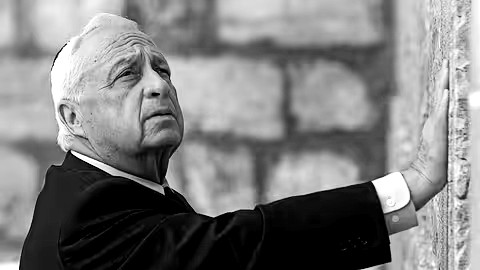
Ariel Sharon was one of the most consequential and divisive figures in Israel’s modern history, a man whose life mirrored the turbulence of the Middle East itself. Rising from a battlefield commander to prime minister, Sharon’s legacy is defined by dramatic shifts in policy, fierce debate and decisions that reshaped Israel’s political landscape.
From farm boy to battlefield commander
Ariel Sharon was born in 1928 in what was then British Mandate Palestine. He joined Jewish paramilitary forces as a teenager and quickly gained a reputation for boldness and operational daring. During Israel’s early wars, Sharon distinguished himself as an aggressive field commander, most notably in the 1956 Suez Crisis and later in the 1967 Six-Day War. His battlefield style—decisive, improvisational and often controversial—earned both admiration and criticism within Israel’s military establishment.
The general who shaped modern warfare
As a senior officer, Sharon was instrumental in developing Israel’s armoured warfare doctrine. In the 1973 Yom Kippur War, he played a key role in the counteroffensive that crossed the Suez Canal, a manoeuvre that shifted the strategic balance and is still studied in military academies. For supporters, this cemented his status as a national hero; for critics, it reinforced concerns about his willingness to act independently of political oversight.

Political rise and deep controversy
Transitioning into politics, Sharon served in several ministerial roles before becoming defence minister in the early 1980s. His tenure was overshadowed by the 1982 Lebanon War and the Sabra and Shatila massacre, carried out by allied militias while Israeli forces controlled the area. An Israeli commission found Sharon indirectly responsible for failing to prevent the killings, forcing his resignation as defence minister. The episode permanently marked his reputation, both domestically and internationally.
Prime minister in an era of crisis
Sharon became prime minister in 2001 amid the Second Intifada, a period of intense violence. Initially seen as a hardliner, he authorised tough security measures while also making an unexpected strategic turn. In 2005, he launched the unilateral disengagement from Gaza, withdrawing Israeli settlers and troops from the territory. The move shocked allies and opponents alike, fracturing his own party and redefining Israel’s political map.
A complex and lasting legacy
Supporters argue that Sharon evolved with circumstances, placing long-term state interests above ideology. Critics contend that his policies deepened conflict and instability. His sudden stroke in early 2006 ended his political career, leaving many questions unanswered about where his leadership might have led.
Understanding Ariel Sharon today
Ariel Sharon remains a symbol of Israel’s contradictions: strength and vulnerability, pragmatism and force, continuity and rupture. To some, he was a guardian of national security; to others, a cautionary figure whose decisions carried profound human costs. What is beyond dispute is that few individuals have left a deeper imprint on Israel’s military doctrine, political direction and national debate.
Newshub Editorial in Asia – 11 January 2026

If you have an account with ChatGPT you get deeper explanations,
background and context related to what you are reading.
Open an account:
Open an account
Recent Comments