
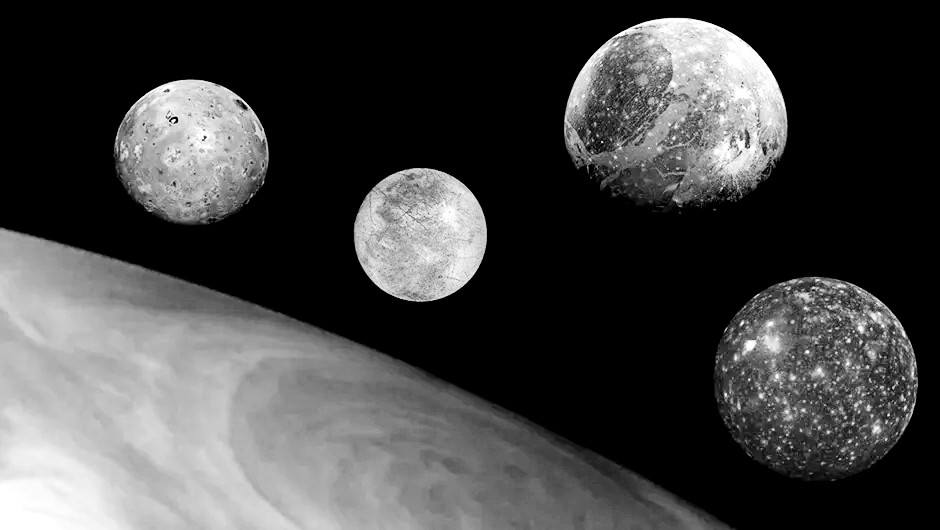
In January 1610, an Italian astronomer peering through a crude telescope made a discovery that would permanently alter humanity’s understanding of the cosmos. By identifying four moons orbiting Jupiter, Galileo provided direct evidence that not everything in the heavens revolved around Earth, striking at the very foundation of centuries-old astronomical belief.
A telescope pointed at the unknown
When Galileo Galilei first turned his improved telescope toward the night sky in late 1609, his intention was not to overthrow accepted cosmology. His instrument, magnifying objects around 20 times, was rudimentary by modern standards but revolutionary for its era. While observing Jupiter, Galileo noticed three small points of light arranged in a straight line near the planet. At first, he assumed they were fixed stars.
Over successive nights, however, their positions changed in a way that could not be explained by Earth’s rotation or Jupiter’s own motion across the sky. A fourth object soon appeared. The pattern became undeniable: these small bodies were orbiting Jupiter itself.
Four moons and a radical implication
The objects Galileo observed are today known as Io, Europa, Ganymede, and Callisto. At the time, he referred to them as the “Medicean stars,” honouring his patrons, the powerful Medici family of Florence. Their significance went far beyond courtly flattery.
The dominant astronomical model of the early seventeenth century, based on Aristotle and Ptolemy, held that Earth was the immovable centre of the universe. All celestial bodies were believed to circle it. Galileo’s observation of moons orbiting another planet provided a clear counterexample: there were centres of motion other than Earth.
This did not, on its own, prove that the Sun lay at the centre of the planetary system, but it made the heliocentric model proposed by Nicolaus Copernicus far more plausible. If moons could orbit Jupiter, there was no fundamental reason planets could not orbit the Sun.
Publication and immediate impact
Galileo published his findings in March 1610 in a short but explosive book, Sidereus Nuncius (The Starry Messenger). The work caused a sensation across Europe. Some astronomers quickly confirmed the observations using their own telescopes, while others refused to look at all, dismissing the instrument as deceptive or unreliable.
The discovery elevated Galileo to international fame and secured him a prestigious position as court mathematician in Florence. At the same time, it placed him on a collision course with religious authorities who viewed heliocentrism as incompatible with prevailing interpretations of Scripture.
A turning point in scientific history
The moons of Jupiter became a symbol of the emerging scientific method: careful observation, repeated measurement, and conclusions drawn from empirical evidence rather than inherited authority. Galileo’s insistence on trusting what he could see, even when it contradicted accepted doctrine, marked a decisive break with medieval natural philosophy.
Today, the four Galilean moons remain central to planetary science. Ganymede is the largest moon in the Solar System, Europa is a prime candidate in the search for extraterrestrial life, and Io is the most volcanically active body known. Yet their greatest legacy lies not in their physical properties, but in what they revealed four centuries ago: the universe is more complex, more dynamic, and far less Earth-centred than once believed.
Newshub Editorial in Europe – 7 January 2026

If you have an account with ChatGPT you get deeper explanations,
background and context related to what you are reading.
Open an account:
Open an account
Recent Comments