
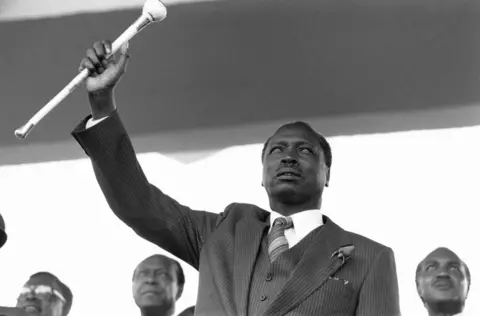
When Daniel arap Moi was sworn in for his fifth consecutive term as president of Kenya, the ceremony marked a defining moment in the country’s post-independence political history, underscoring both the durability of his rule and the deepening debate over democracy, power and succession in East Africa.
A presidency shaped by continuity and control
Daniel arap Moi had first assumed the presidency in 1978 following the death of Jomo Kenyatta, positioning himself as a unifying figure in a young nation navigating ethnic complexity and regional pressures. By the time of his fifth inauguration, Moi had become one of Africa’s longest-serving leaders. His extended tenure reflected a political system that prioritised stability and continuity, but it also revealed the limits placed on political pluralism during much of his rule.
The political context of the fifth inauguration
Moi’s fifth swearing-in took place against a backdrop of intense political consolidation. Kenya remained a de facto one-party state for much of his presidency, with the ruling party maintaining firm control over political life. Elections were held, but opposition movements faced legal and institutional constraints that curtailed their ability to challenge the incumbent effectively. Supporters argued that Moi’s leadership provided predictability in a volatile region, while critics viewed the system as increasingly disconnected from democratic accountability.
Economic management and state authority
During Moi’s long presidency, Kenya experienced periods of both growth and stagnation. His government invested in infrastructure, education and public administration, helping to expand the reach of the state across rural areas. At the same time, the economy struggled with debt, inefficiencies and allegations of corruption that became more pronounced in the later years of his rule. By the time of his fifth term, international donors and financial institutions were applying growing pressure for economic reform and better governance.
Domestic dissent and international scrutiny
The fifth inauguration did not silence opposition voices. Civil society groups, churches and emerging political activists increasingly called for constitutional reform and the restoration of multiparty democracy. Internationally, Kenya faced heightened scrutiny over human rights and political freedoms. Western governments and aid partners linked assistance to political liberalisation, signalling that Moi’s grip on power was becoming harder to sustain in a changing global environment.
A turning point rather than an endpoint
While the swearing-in for a fifth term symbolised the peak of Moi’s authority, it also foreshadowed a period of transition. Within a few years, sustained domestic pressure and international engagement led to the reintroduction of multiparty politics. Moi would remain in office until 2002, but the political landscape that followed his fifth inauguration was already shifting, laying the groundwork for a new generation of leadership and a more competitive democratic system.
Legacy and historical significance
Moi’s fifth consecutive term stands as a powerful illustration of how post-independence African states balanced stability against democratic evolution. For Kenya, the moment captured both the strengths and weaknesses of long-term rule: institutional continuity on one hand, and suppressed political choice on the other. Decades later, the event remains a reference point in debates about presidential power, constitutional limits and the path Kenya has taken toward a more open political order.
Newshub Editorial in Africa – 6 January 2026

If you have an account with ChatGPT you get deeper explanations,
background and context related to what you are reading.
Open an account:
Open an account
Recent Comments