
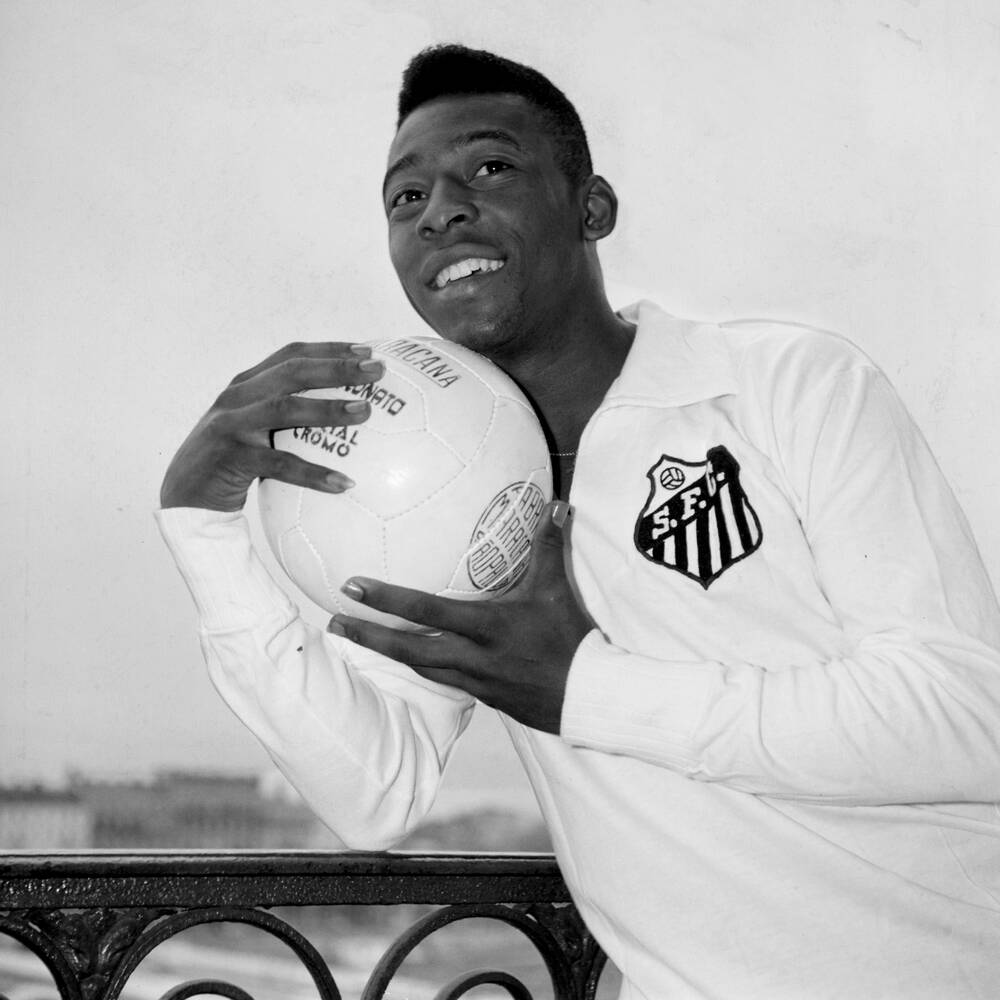
Pelé is widely regarded as the greatest footballer in history, a player whose influence transcended sport and reshaped how football was played, watched, and understood around the world. From his emergence as a teenage prodigy in Brazil to his status as a global icon, Pelé set benchmarks of excellence that remain unmatched decades later.
A prodigy from Brazil’s heartland
Born Edson Arantes do Nascimento in 1940 in Três Corações, Brazil, Pelé grew up in modest circumstances, honing his skills on the streets with improvised balls. His extraordinary talent was evident early. By the age of 15, he had signed for Santos FC; by 16, he was playing for the Brazilian national team. His pace, balance, finishing, and football intelligence distinguished him from peers, even in an era rich with technical brilliance.
World Cup dominance like no other
Pelé’s defining stage was the FIFA World Cup. He remains the only player to win the tournament three times, lifting the trophy in 1958, 1962, and 1970. At just 17, he scored twice in the 1958 final, announcing himself to the world. Twelve years later, he orchestrated Brazil’s 1970 team—often cited as the greatest international side ever assembled—combining creativity, precision, and joy in a way that redefined attacking football.

Club career and relentless scoring
At club level, Pelé spent the majority of his career with Santos FC, transforming the club into a global attraction. Santos toured internationally, drawing unprecedented crowds eager to witness Pelé’s artistry. He scored over 1,000 career goals across official matches and exhibitions, a testament not only to his finishing but to his durability and consistency across two decades of elite competition.
Reinventing the role of the forward
Pelé was not simply a goalscorer. He functioned as a complete forward before the term became fashionable—capable of playmaking, aerial dominance, long-range shooting, and defensive contribution. His vision and passing were as lethal as his finishing, enabling teammates to flourish. Many tactical concepts associated with the modern attacking player can be traced back to Pelé’s all-round influence.
Global ambassador and cultural force
Beyond the pitch, Pelé became football’s first true global superstar. In the 1970s, his move to the New York Cosmos helped popularise the sport in the United States, expanding football’s commercial and cultural footprint. He later served as a goodwill ambassador, advocate for sport’s unifying power, and a symbol of Brazil’s soft power worldwide.
An enduring legacy
Pelé’s death in December 2022 prompted tributes from heads of state, athletes, and institutions across the globe, reflecting a legacy that extended far beyond statistics. He represented excellence, creativity, and optimism—values that continue to define football at its best. While debates over greatness will always persist, Pelé remains the reference point, the player against whom all others are measured.
Newshub Editorial in South America – 29 December 2025
Recent Comments