

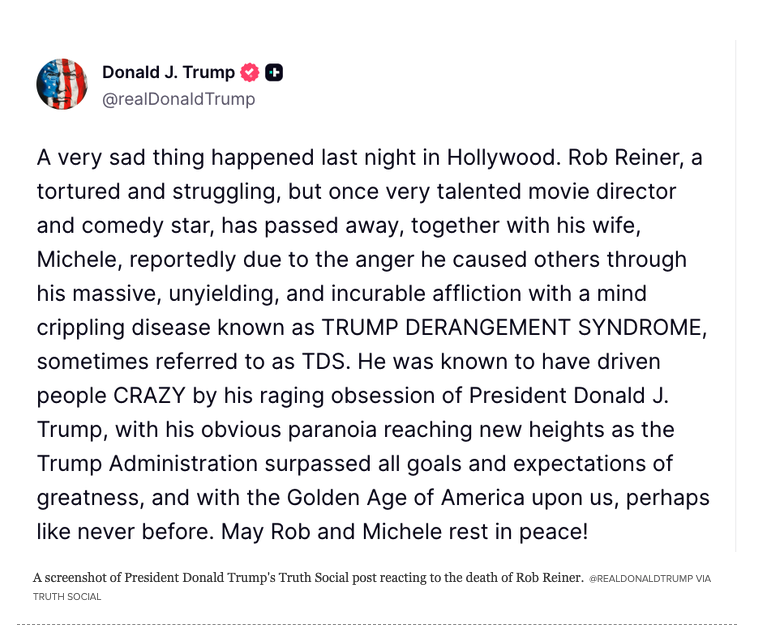
Donald Trump has sparked widespread controversy after posting on Truth Social that filmmaker and actor Rob Reiner would be “to blame” for his death, a remark that critics have described as inflammatory, disturbing and reckless.
A post that shocked supporters and critics alike
The message, published on Trump’s Truth Social account, did not claim that any immediate threat existed but framed Reiner as responsible should harm ever come to him. The post appeared to link Trump’s long-running grievances against liberal critics and Hollywood figures with broader claims that his opponents have fostered an atmosphere of hostility and danger.
While Trump did not provide specific evidence or outline a direct causal link, the phrasing was widely interpreted as accusatory and provocative, prompting swift backlash across political and media circles.

Who is Rob Reiner?
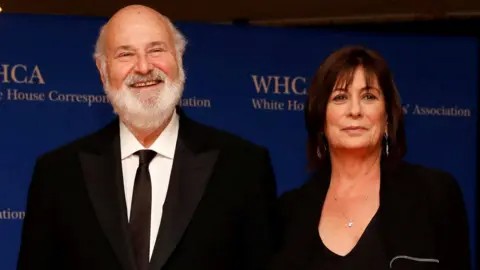
Rob Reiner, best known for directing films such as When Harry Met Sally, A Few Good Men and The Princess Bride, has become an outspoken critic of Trump in recent years. He has used social media to warn about what he sees as threats to US democracy and has repeatedly condemned Trump’s rhetoric and actions, particularly surrounding the 2020 election and the events of January 6.
Reiner has not responded directly to the Truth Social post, though figures close to him described the accusation as “absurd” and “dangerous”.
Escalating rhetoric and political tension
The episode highlights the increasingly personalised and confrontational tone of Trump’s political communication. Analysts note that framing critics as responsible for potential violence risks normalising extreme language at a time of already heightened political polarisation in the United States.
Civil society groups and media commentators warned that such statements can contribute to a climate of intimidation, particularly when aimed at named individuals. Some drew parallels to previous episodes in which public figures reported receiving threats following online attacks by high-profile politicians.
Free speech versus responsibility
Supporters of Trump defended the post as an expression of free speech, arguing that he was criticising what he views as sustained political demonisation. They contend that Trump himself has been the target of hostile rhetoric for years and that his remarks should be read in that context.
Critics counter that the issue is not legality but responsibility, arguing that public figures with large followings have a duty to avoid language that could be interpreted as incitement or personal blame for violence.
Another flashpoint in a volatile campaign climate
As the US political environment grows more heated, incidents like this underline how social media remains a central battleground. Trump’s latest post adds to a series of episodes in which provocative language has overshadowed substantive policy debate, reinforcing concerns about the tone and direction of public discourse in the run-up to a pivotal period for American democracy.
Newshub Editorial in North America – 16 December 2025
Recent Comments