

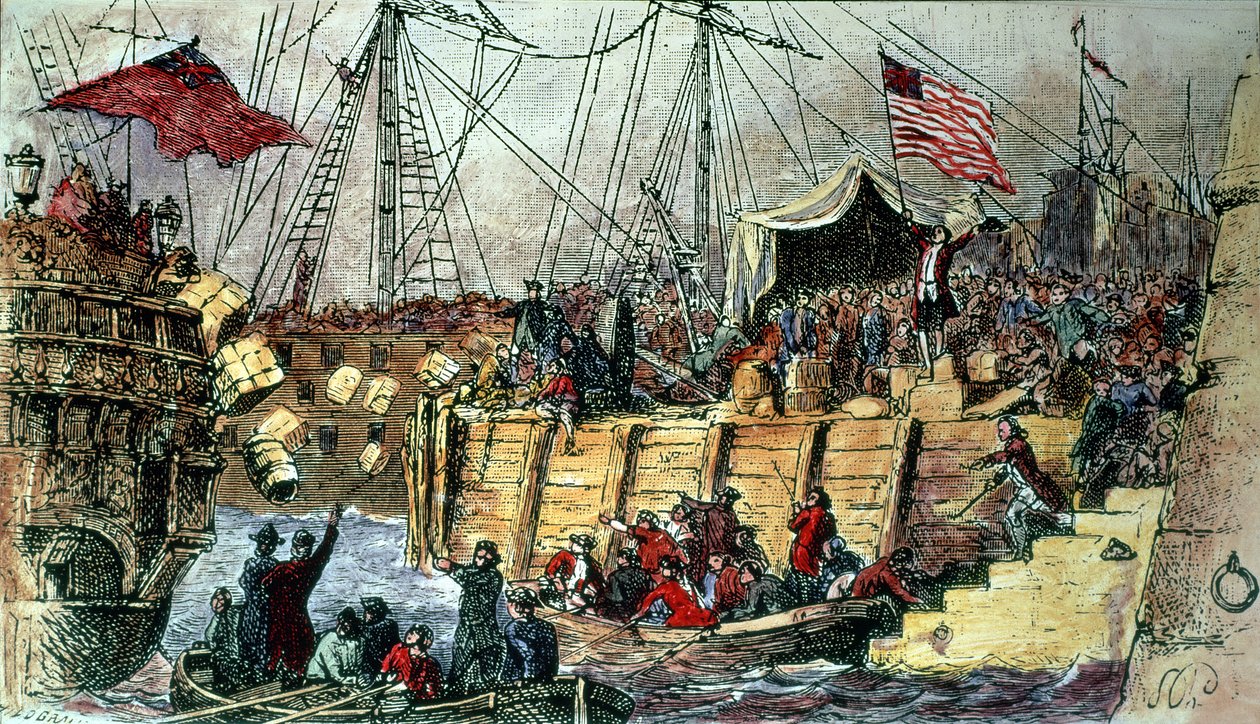
The Boston Tea Party stands as one of the most decisive acts of political defiance in modern history, transforming a dispute over taxation into a catalyst for revolution and reshaping the future of a continent.
A protest rooted in taxation and power
By the early 1770s, tensions between Britain and its American colonies had been simmering for more than a decade. Following the costly Seven Years’ War, London sought to recoup expenses by imposing new taxes on the colonies, including the Stamp Act and later the Townshend Duties. Although many of these levies were repealed, the underlying principle remained: Parliament claimed the right to tax the colonies, despite colonists having no elected representation in Westminster. This grievance was encapsulated in the rallying cry “no taxation without representation”.
The Tea Act and colonial outrage
In 1773, Parliament passed the Tea Act, designed to rescue the financially struggling British East India Company. The act allowed the company to sell tea directly to the colonies at reduced prices, undercutting colonial merchants and smugglers. While the tea itself became cheaper, it retained a small tax, which many colonists viewed as a dangerous precedent. Accepting the tea, critics argued, meant accepting Parliament’s right to tax them without consent.

The night of defiance in Boston Harbour
On the evening of 16 December 1773, resistance in Boston reached a dramatic climax. A group of colonists, many associated with the Sons of Liberty and some disguising themselves as Mohawk Indians, boarded three British ships — the Dartmouth, the Eleanor, and the Beaver. Over several hours, they systematically broke open 342 chests of tea and dumped their contents into Boston Harbour. Remarkably, no other cargo was damaged, and efforts were reportedly made to avoid personal injury or theft.
British retaliation and colonial unity
The British government reacted swiftly and harshly. In 1774, Parliament enacted the Coercive Acts — known in the colonies as the Intolerable Acts — which closed Boston’s port, curtailed Massachusetts’ self-government, and allowed British officials accused of crimes to be tried elsewhere. Rather than isolating Massachusetts, these measures galvanised colonial solidarity. Colonies that had previously been divided by regional interests now rallied in support of Boston.
From protest to revolution
The Boston Tea Party did not immediately trigger war, but it marked a decisive shift. It demonstrated that colonial resistance had moved beyond petitions and boycotts to direct action. In response to British repression, colonial leaders convened the First Continental Congress in 1774, laying the groundwork for coordinated resistance. Less than two years later, fighting erupted at Lexington and Concord, and the American Revolutionary War began in earnest.
A lasting symbol of resistance
Today, the Boston Tea Party endures as a powerful symbol of civic protest against perceived injustice. It is frequently invoked in political discourse, both in the United States and beyond, as an example of how organised civil resistance can challenge entrenched authority. More than an act of destruction, it was a calculated political statement — one that helped set the stage for the birth of a new nation.
Newshub Editorial in North America – 16 December 2025
Recent Comments