

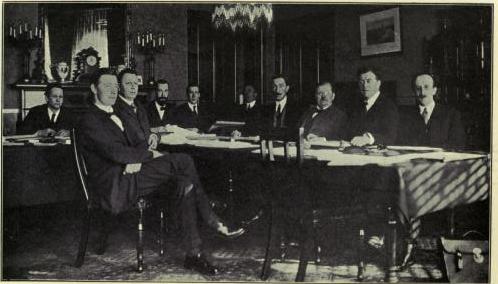
The establishment of the Irish Free State on 6 December 1922 marked one of the most consequential constitutional shifts in modern European history, formally ending centuries of direct British rule and reshaping political identities across Ireland and the United Kingdom. Emerging from war, negotiation and deep internal division, the new state represented both an achievement of national aspiration and the beginning of a complex period of adjustment.
A new constitutional order
The Irish Free State came into being following the ratification of the Anglo-Irish Treaty, which granted Dominion status similar to Canada and Australia. Under this arrangement, Ireland obtained considerable autonomy, including control over domestic governance and taxation, while remaining within the British Commonwealth. The creation of a provisional government earlier in 1922 set the stage for the formal transition, as institutions were built rapidly to assume legislative and administrative responsibility.

A divided nation at independence
The treaty that enabled statehood also fractured the Irish revolutionary movement. Supporters viewed Dominion status as a pragmatic route to self-government and future sovereignty, while opponents rejected the continued role of the British Crown and the requirement for elected representatives to take an oath of allegiance. These divisions escalated into the Irish Civil War, which was at its height when the Free State was inaugurated. As a result, the birth of the new state was overshadowed by violence, political resentment and uncertainty about its long-term stability.
Implications for Northern Ireland
The new constitutional settlement also formalised the position of Northern Ireland, which had been created under the 1920 Government of Ireland Act. Upon the establishment of the Free State, Northern Ireland exercised its right to opt out of the arrangement, thereby remaining within the United Kingdom. This decision entrenched a partition that would shape political dynamics for decades, influencing identity, governance and security across the island.
Building a functioning state
Despite the immediate challenges, the Free State government moved quickly to consolidate its authority. It developed a national civil service, established financial mechanisms, reformed policing and sought to stabilise a society emerging from conflict. International recognition, particularly from Commonwealth partners, helped solidify its position, while domestic leaders focused on pragmatic state-building rather than symbolic gestures. Over the following years, constitutional amendments and political evolution gradually expanded Ireland’s autonomy, culminating in the 1937 constitution and later the declaration of the Republic in 1949.
A legacy that shaped modern Ireland
The establishment of the Irish Free State remains a defining moment in Ireland’s political development. It laid the structural foundations for an independent nation-state, set in motion the processes that would lead to republicanism, and permanently altered relations with Britain. Although born amid conflict, the Free State served as the pivotal bridge between colonial rule and full sovereignty, and its legacy continues to inform contemporary debates on identity, governance and the future of the island.
Newshub Editorial in Europe – 6 December 2025
Recent Comments