

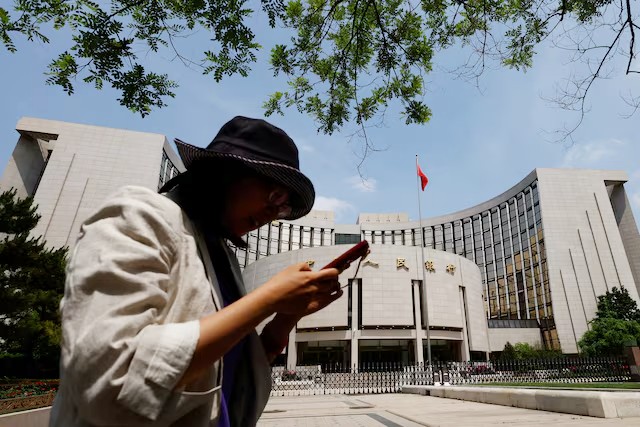
China’s central bank has maintained its key lending rates, a widely anticipated move as policymakers continue to assess the impact of recent support measures on the nation’s patchy economic recovery. The decision leaves the benchmark loan prime rates (LPR) unchanged for the ninth consecutive month.
The one-year LPR, which serves as the benchmark for most corporate and household loans, was held at 3.45%. The five-year LPR, a reference rate for mortgages and a key influencer of the property market, was kept at 4.20%. The People’s Bank of China (PBOC) sets the LPR each month, with major commercial banks submitting their proposed rates based on the cost of the central bank’s medium-term lending facility (MLF).
A decision in line with market expectations
The hold was unanimously forecast by economists, coming on the heels of the PBOC’s decision last week to leave the interest rate on its one-year MLF unchanged. The LPRs are loosely pegged to the MLF rate, making a change highly unlikely without a prior adjustment to this key policy tool. This consistency provides a clear signal that the central bank is prioritising currency stability and a measured approach to monetary easing.

Recent economic data has presented a mixed picture. While industrial output and retail sales for the first two months of the year surpassed expectations, the property sector remains a significant drag on growth, with real estate investment and home sales continuing to decline. This has created a complex environment for policymakers, who must balance the need for stimulus with concerns over growing debt and financial risk.
Focus remains on targeted support measures
With broad-based rate cuts withheld for the moment, analysts suggest that authorities are relying on a suite of more targeted measures to bolster specific sectors of the economy. The central bank has recently cut the reserve requirement ratio (RRR), freeing up more capital for banks to lend. Furthermore, there is a strong emphasis on fiscal policy, including the issuance of special sovereign bonds, to drive investment and stimulate demand.
The stability of the yuan is also a critical factor. Significant interest rate cuts would widen the yield differential with the United States, where rates remain elevated, potentially leading to capital outflows and putting downward pressure on the Chinese currency. By holding rates steady, the PBOC is providing a stable environment for the yuan amidst global financial volatility.
Implications for mortgages and the property market
The unchanged five-year LPR means that existing and new mortgage rates will remain at their current levels, offering little immediate relief to the beleaguered property sector. The government has instead been focusing on other methods to support the housing market, including easing purchase restrictions in major cities and encouraging banks to provide development loans to ensure the completion of pre-sold homes.
The overall implication is one of cautious stability. The central bank appears to be in a holding pattern, carefully monitoring the effectiveness of its previous actions before committing to more aggressive, broad-based monetary easing. The decision underscores a preference for a calibrated, long-term approach to navigating China’s economic challenges rather than deploying sudden, shock-and-awe stimulus.
REFH – Newshub, 20 August 2025
Recent Comments