

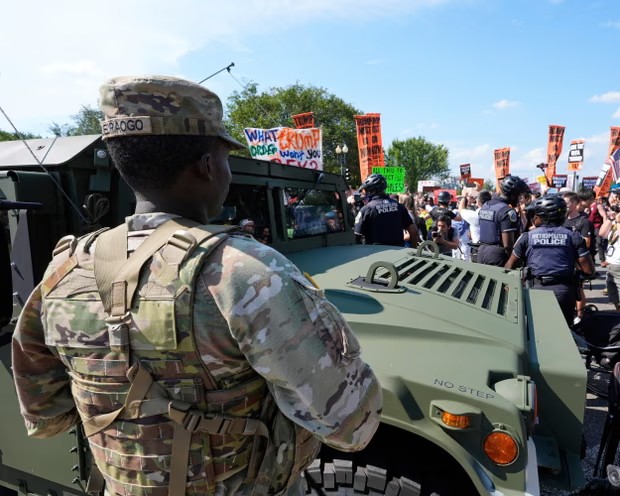
West Virginia, South Carolina and Ohio have announced they will deploy hundreds of National Guard troops to Washington, D.C., joining a federal security initiative that critics say amounts to political policing. The decision has triggered protests in the capital and renewed debate over the appropriate role of the Guard in domestic affairs.
Troops pledged from three states
West Virginia Governor Patrick Morrisey confirmed the largest deployment, sending between 300 and 400 troops. South Carolina’s Governor Henry McMaster committed 200 personnel, while Ohio’s Governor Mike DeWine pledged around 150 military police. Combined, the reinforcements will add as many as 750 National Guard members to the capital, supplementing the 800 already activated under federal orders.
Officials from the participating states framed the deployments as support for federal efforts to maintain order and secure government facilities. South Carolina, however, made clear its troops could be recalled immediately if needed to respond to local emergencies such as the approaching hurricane season.

Protests and political blowback
The announcement provoked demonstrations across Washington, with protesters gathering outside the White House and on major streets carrying signs rejecting what they describe as the “militarisation of civic space.” Chants warning of “military occupation” echoed through the capital, reflecting public unease over troops patrolling political centres.
Local leaders, including Mayor Muriel Bowser, denounced the deployments. Bowser argued that Washington residents were being subjected to a federal occupation without local consent. The District’s attorney general, Brian Schwalb, has launched legal challenges against the move, calling it an unconstitutional abuse of executive power.
Legal questions and security concerns
The arrival of National Guard troops at a time when violent crime in the District has reached record lows has further fuelled criticism that the operation is more political than protective. Critics argue that the Guard is being used as a tool to enforce partisan objectives rather than to address genuine security threats.
Official statements insist that the Guard’s mission will be limited to protecting federal property and supporting law enforcement, yet reports suggest that the deployment could soon include armed patrols. That possibility has heightened concern that tensions could escalate if protests continue to grow.
A debate over precedent
The use of National Guard forces in Washington has long been controversial, given the city’s lack of statehood and limited autonomy over its own security. Past deployments have usually followed major unrest or national emergencies, but opponents note that no such crisis currently exists.
For supporters, the Guard represents a necessary show of force to ensure stability in the capital during a volatile political climate. For opponents, however, the move is a dangerous precedent that risks blurring the line between civilian policing and military power.
Uncertain road ahead
With further deployments under consideration, the standoff over Washington’s security could intensify. For now, residents face the prospect of an expanded National Guard presence in the heart of the capital, while political leaders and courts wrestle with whether this deployment is a matter of public safety—or of politics.
REFH – Newshub, 17 August 2025
Recent Comments