

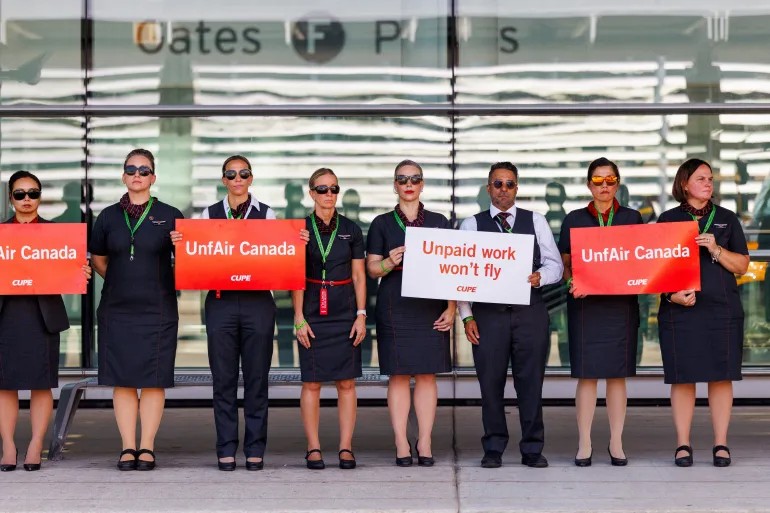
Air Canada has begun cancelling flights ahead of a potential strike by thousands of its flight attendants, sparking fears of widespread disruption for passengers. The airline confirmed that a lockout is scheduled, which could affect as many as 130,000 travellers each day if labour talks fail to reach a resolution.
Labour talks at a standstill
Negotiations between Air Canada and the Canadian Union of Public Employees (CUPE), which represents around 9,500 flight attendants, have stalled over pay, scheduling and working conditions. The union has warned that its members are prepared to strike if no deal is reached, while the airline has responded with lockout preparations. Both sides continue to trade blame, each accusing the other of refusing to compromise.
Impact on passengers
The looming strike has already forced the airline to begin cancelling flights in anticipation of reduced staffing levels. Passengers have reported receiving last-minute notifications of cancellations or rescheduled services, adding to the uncertainty. Industry experts estimate that up to 130,000 passengers could be stranded or delayed each day should the strike proceed. Key domestic and transatlantic routes are expected to be the most heavily affected.

Government response
The Canadian government has urged both parties to return to the negotiating table, highlighting the potential economic and social impact of such large-scale disruption. While Ottawa has not ruled out intervention, ministers have so far refrained from imposing back-to-work legislation, instead encouraging a voluntary settlement. Analysts warn that any government step-in could draw criticism from unions while offering temporary relief for travellers.
Financial implications
For Air Canada, the potential strike comes at a critical moment, as the airline continues to rebuild from pandemic-era losses and rising operating costs. Analysts estimate that prolonged disruption could cost the company tens of millions of dollars in lost revenue each week. Shares in Air Canada have already shown signs of volatility as investors weigh the risks of a protracted dispute.
Broader context
The dispute reflects broader tensions in the global aviation industry, where workers have increasingly pressed for higher wages and better working conditions amid rising demand for air travel. Recent strikes across Europe and the United States have highlighted the fragility of the aviation recovery and the growing leverage of unions in negotiations.
What comes next
Unless a breakthrough is achieved in talks, Air Canada faces the prospect of the first large-scale flight attendant strike in over a decade. For passengers, the advice remains to monitor flight status closely and consider contingency plans. The coming days will be decisive in determining whether travel chaos can be averted or if Canada’s largest airline will face one of its most disruptive labour disputes in recent memory.
REFH – Newshub, 16 August 2025
Recent Comments