
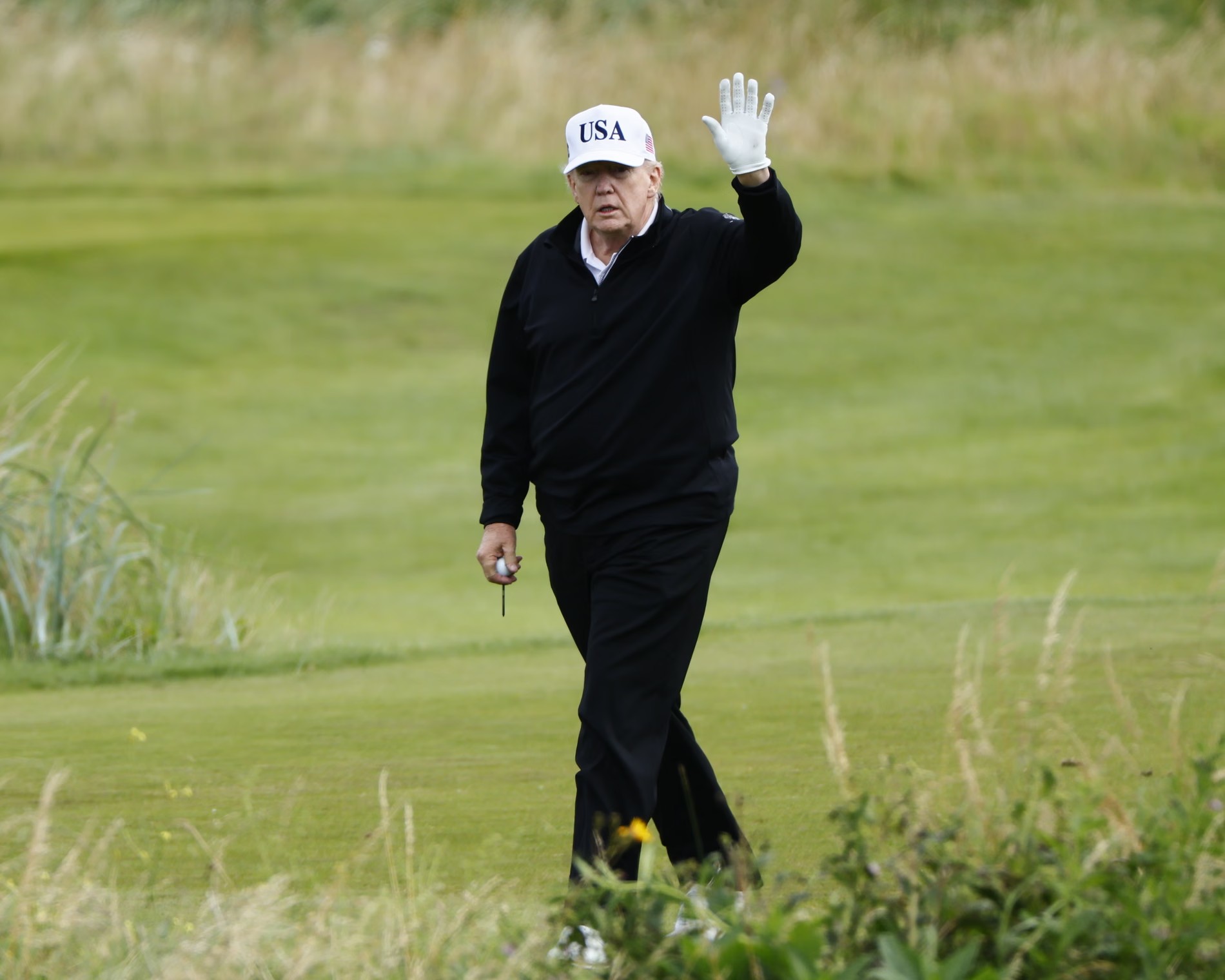
Donald Trump has reignited his transatlantic rhetoric during a brief and controversial visit to Scotland, taking direct aim at European energy policy and calling on the continent to “stop the windmills” ahead of pivotal trade discussions with the UK and EU. The remarks, delivered during a private event at one of his golf properties, quickly made waves across political and diplomatic circles.
Scotland’s visit is steeped in symbolism
The former US president arrived in Scotland for what aides described as a “private business and political engagement”. His Trump Turnberry resort in Ayrshire was the focal point of the visit, with the press limited to brief appearances. Despite his status as a former head of state and current presidential candidate, no formal meetings were held with Scottish or UK officials.
Local protesters gathered outside the Turnberry gates, citing environmental concerns and Trump’s inflammatory political record. His presence remains divisive in Scotland, where previous visits have sparked similar demonstrations. Trump, for his part, appeared undeterred, using the setting to deliver pointed remarks on European energy policy.
‘Stop the windmills’ – energy policy takes centre stage
During his speech, Trump criticised the EU’s and UK’s increasing reliance on renewable energy, particularly offshore wind. “They’ve destroyed the countryside,” he declared. “Europe needs to stop the windmills and get back to reliable energy.”
The comments echo his previous criticisms of green energy, often delivered with sharp rhetoric aimed at bolstering fossil fuels. While his remarks play well among segments of his US base, they risk alienating European leaders preparing for renewed trade discussions with Washington.
Officials in Brussels and London are expected to approach Trump’s comments cautiously, aware that his potential return to the White House could reshape trade, tariffs, and climate cooperation. His statement could be interpreted as a signal that a future Trump administration may resist any provisions linked to renewable energy or carbon reduction.
Mixed reactions in Europe and the UK
Reaction among British and European politicians ranged from concern to dismissal. A spokesperson for the Scottish Greens said Trump’s visit was “a reminder of everything wrong with climate denial and outdated thinking.” Others in the Conservative Party signalled that, while Trump’s influence can’t be ignored, the UK would not reverse course on renewable targets that underpin its net zero strategy.
In Brussels, EU trade officials acknowledged the remarks but emphasised that energy and climate commitments remain “non-negotiable” pillars in future cooperation. European diplomats privately expressed worry that Trump’s approach, if elected again, could stall existing agreements or unravel progress on cross-border carbon policies.
Looking ahead to trade talks
The next round of UK–US and EU–US trade talks is scheduled for early autumn. Trump’s visit and statements are likely to hang over preparations, adding a layer of unpredictability. With his campaign gaining momentum in the US, European officials are quietly reviewing their contingencies in case Trump retakes the Oval Office in 2025.
While the current Biden administration has taken a collaborative approach to transatlantic energy and trade, Trump’s rhetoric points to a starkly different vision—one more confrontational and less aligned on climate goals.
REFH – Newshub, 27 July 2025

Recent Comments