
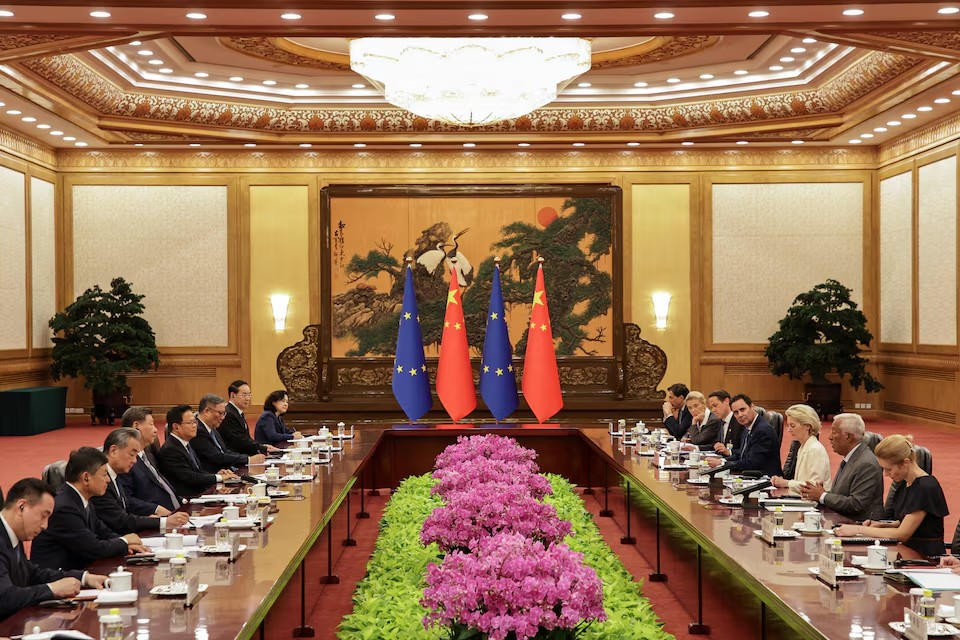
European Commission President Ursula von der Leyen has warned that the European Union’s relationship with China stands at an “inflection point”, as she joined top EU leaders in Beijing for a one-day summit marked by trade tensions and geopolitical unease. The talks, intended to mark 50 years of diplomatic ties, were shortened at China’s request and reflected a shift in tone between the two powers.
Trade imbalance at centre of EU demands
Von der Leyen expressed concern over the EU’s widening trade deficit with China, which reached a record €305.8 billion last year. She described the imbalance as “unsustainable” and urged Chinese leaders to propose credible solutions. The EU delegation pressed Beijing on several issues including market access restrictions, overcapacity in industrial sectors like electric vehicles, and export controls on critical raw materials such as rare earths.
Xi Jinping calls for strategic alignment
Chinese President Xi Jinping responded by urging the EU to make “correct strategic choices,” framing the relationship as one of mutual benefit despite growing frictions. While calling for continued cooperation on global issues such as climate change and financial stability, Xi signalled Beijing’s resistance to structural changes that would curtail its industrial policy or restrict state subsidies.

Ukraine war and geopolitical divergence
The conflict in Ukraine loomed large over the summit. EU leaders called on China to leverage its influence over Russia and take a more active role in pursuing a negotiated peace. However, Beijing maintained its position of neutrality and avoided any public criticism of Moscow. The EU also raised concerns over China’s human rights record, cyber activity, and regional assertiveness—particularly in the South China Sea and Taiwan Strait.
Tone tempered but no breakthrough
Despite the underlying tensions, von der Leyen adopted a cautious optimism, noting that the meeting offered an opportunity to “advance and rebalance” EU–China relations. A joint statement was expected on limited areas of cooperation such as climate and energy, but no major agreements were reached. The summit did not produce any changes to existing trade policy or new frameworks for future dialogue.
Looking ahead: competition or recalibration?
The summit has reinforced the EU’s view of China as both a partner and a competitor. Von der Leyen signalled that Brussels would continue to defend its economic interests while remaining open to engagement. As the EU builds closer ties with the US and other Indo-Pacific nations, pressure is likely to grow on Beijing to address European concerns or risk strategic decoupling in key sectors.
REFH – Newshub, 24 July 2025
Recent Comments