
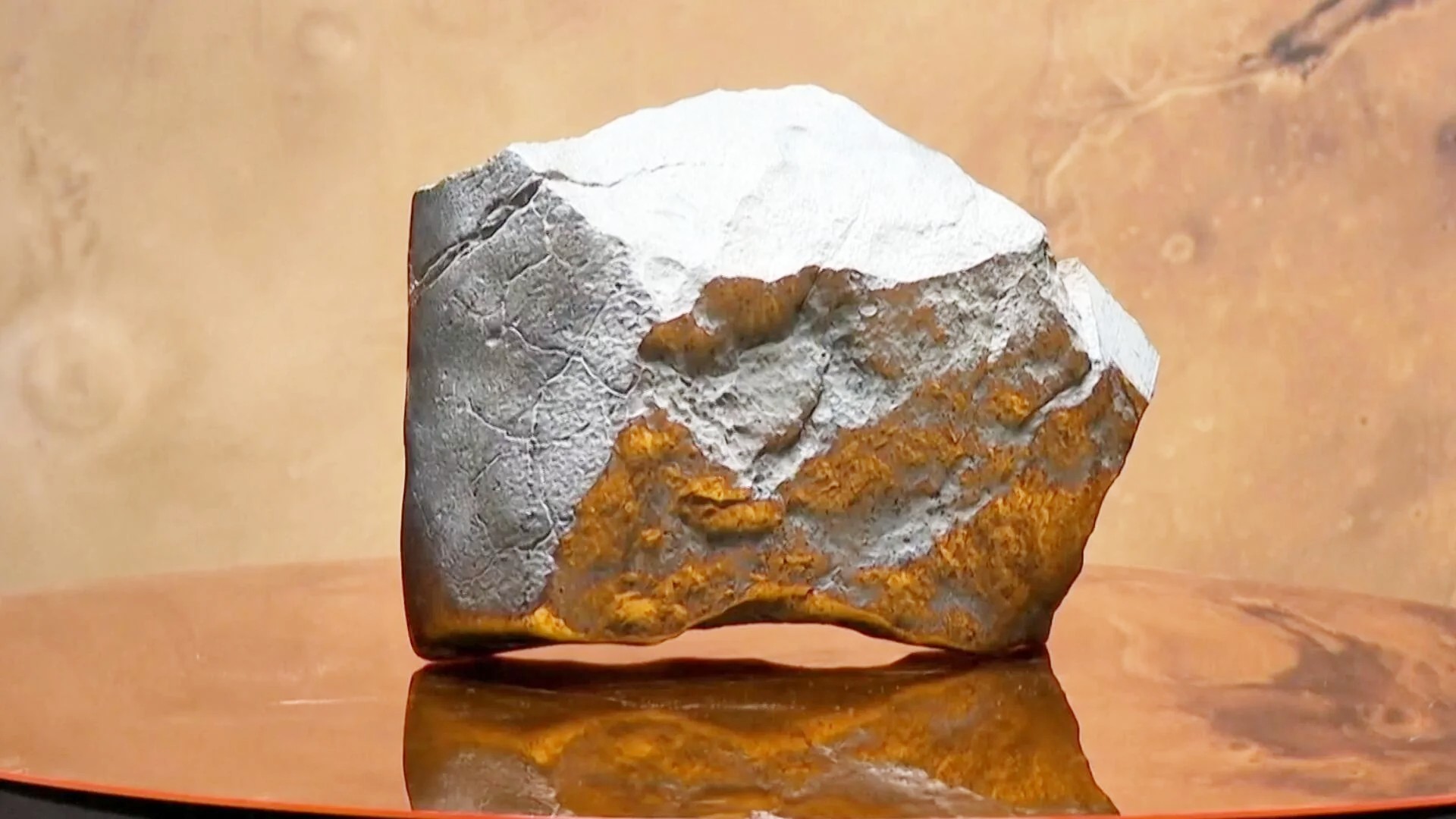
A rare meteorite originating from Mars has been sold for €4.4 million in a high-profile auction, setting a new record for Martian material sold to a private buyer. The transaction marks a growing fascination with space collectables and underscores the surging value of extraterrestrial artefacts.
Martian rock draws global attention
The meteorite, known as NWA 14565, was discovered in the Sahara Desert and has been confirmed by scientists as Martian in origin, ejected from the Red Planet’s surface millions of years ago before landing on Earth. It weighs just under 9 kilograms and is composed of igneous rock formed through ancient volcanic activity. Bidders from Europe, the Middle East and the United States competed fiercely for the piece, but the final sale was made to an anonymous European collector.
Auctioneer Samuel Renaud, who led the sale in Paris, described the winning bid as “a landmark moment for planetary science and private collecting,” adding that interest in space relics has never been higher.

Meteorites gain momentum as investment assets
Space rocks, once confined to museum vaults and academic study, have rapidly gained popularity in recent years as luxury items and alternative investments. Martian meteorites are among the rarest on Earth, with fewer than 300 verified specimens ever found. The scarcity, combined with their scientific and symbolic value, has fuelled intense demand from collectors, universities and even technology firms.
Experts say prices for Martian meteorites have more than doubled in the past five years, with certain specimens now commanding higher prices per gram than gold or diamonds. The latest sale is expected to boost the entire segment of the collectibles market, reinforcing space rocks as assets of both scientific and financial significance.
Scientific institutions express concern
While the sale has been celebrated in collecting circles, it has also reignited debate over the private ownership of scientifically valuable materials. Researchers have raised concerns that increased commercial interest may restrict access to important specimens needed for study.
Dr Maria Lopez, a planetary geologist at the European Space Agency, noted that “each Martian meteorite carries unique data about the geology, atmosphere and potential habitability of Mars. When these objects go into private hands, that knowledge may be lost to science.”
Broader fascination with the cosmos grows
The record-breaking sale comes amid a wave of public interest in space, fuelled by renewed lunar exploration, private spaceflight and ongoing missions to Mars. NASA’s continued analysis of Martian soil, along with future plans for sample return missions, has further intensified fascination with tangible pieces of other worlds.
Collectors and enthusiasts see such acquisitions as a way of owning part of humanity’s cosmic story. For now, the €4.4 million meteorite remains both a scientific wonder and a symbol of Earth’s growing appetite for the universe beyond.
REFH – Newshub, 17 July 2025
Recent Comments