
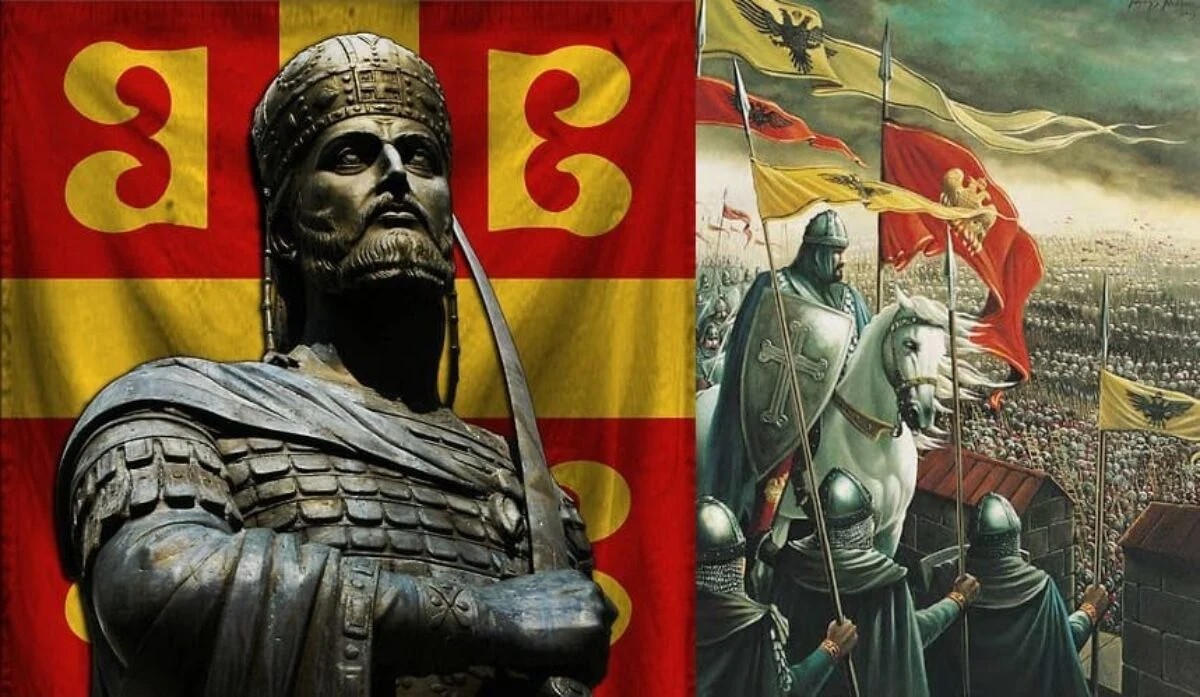
The day the last Byzantine emperor died fighting on the walls of Constantinople
On this day in 1453, the thunderous roar of Ottoman cannons finally breached the legendary walls of Constantinople, bringing an end to over a thousand years of Byzantine rule and forever changing the course of European history.
Sultan Mehmed II, just 21 years old but already bearing the epithet “the Conqueror,” had positioned his massive army of nearly 100,000 men outside the ancient city’s walls on 6th April. What followed was a siege that would become one of history’s most decisive military campaigns, pitting the might of the Ottoman Empire against the final remnants of what had once been the Eastern Roman Empire.
Emperor Constantine XI Palaiologos knew the odds were against him. With fewer than 10,000 defenders manning the walls, including Genoese mercenaries and loyal Byzantine soldiers, the city faced an almost impossible task. Yet the emperor refused to flee, choosing instead to make his final stand alongside his men.

The Ottomans brought revolutionary warfare to the siege. Hungarian engineer Orban had designed massive cannons for Mehmed, including the legendary “Basilica” that could hurl 600-pound stone balls against the city’s fortifications. These weapons, though cumbersome and prone to overheating, represented a new age of warfare that would render traditional castle defences obsolete.
For weeks, the thunderous bombardment continued. The Theodosian Walls, which had protected Constantinople since the 5th century and had successfully repelled countless sieges throughout the centuries, began to crumble under the relentless artillery fire. These double fortifications had been considered virtually impregnable, but gunpowder had changed the rules of siege warfare forever.
The final assault began before dawn on 29th May. Wave after wave of Ottoman troops threw themselves against the walls—first the irregular bashi-bazouks, then the regular infantry, and finally the elite Janissary corps. According to contemporary accounts, Emperor Constantine discarded his imperial regalia and fought as an ordinary soldier, declaring that it was “better to die than to live.”
When the walls were finally breached, the emperor’s body was found among the fallen defenders, identifiable only by the purple boots that marked his imperial rank. With his death, the last direct link to the Roman Empire vanished forever.
The fall of Constantinople sent shockwaves throughout Christian Europe. The great city, which would soon be renamed Istanbul, became the Ottoman capital and the centre of a growing empire that would dominate the eastern Mediterranean for centuries. The Hagia Sophia, the magnificent cathedral that had been the heart of Eastern Orthodox Christianity for nearly a millennium, was transformed into a mosque.
The conquest also triggered an unexpected consequence that would reshape the Western world. Greek scholars fled westward carrying precious classical texts, contributing to the intellectual flowering of the Renaissance. Meanwhile, Ottoman control of traditional trade routes to Asia prompted European powers to seek alternative paths, ultimately leading to the voyages of discovery that would bring Europeans to the Americas.
The cannon fire that breached Constantinople’s walls on 29th May 1453 echoed far beyond that single day, announcing the end of the medieval world and the dawn of the modern age.
newshub finance
Recent Comments