
• Global
    • Africa
      • Burundi
      • Ghana
      • Gambia
      • Senegal
    • Asia
      • Indonesia
      • Laos
      • Malaysia
      • South Korea
    • Caribbean
      • Central America
    • Climate & energy
      • Climate
      • Carbon
      • Coal
      • Disruptive
      • Gas
      • Nuclear
      • Oil
      • Solar
      • Water
      • Waves
      • Wind
      • Renewable
      • South America
    • Lifestyle
      • Best chefs
      • Cocktail of the week
      • History
      • Influential women
      • Newshub long-read
  • Finance
    • Africa finance
    • Australia
    • Asia finance
    • Banking
    • Business of the week
    • Central Banks
    • China
    • Commodities
    • Corporate
    • Europe
    • Investment
    • Japan
    • MSTRpay
    • Neobanking
    • South East Asia
    • UK
    • US
  • Fintech
    • Tech
    • AI
    • Blockchain
  • Press releases
  • NF GPT
Friday, February 13, 2026
  • Login
No Result
View All Result
Newshub Finance
  • Global
    • Africa
      • Burundi
      • Ghana
      • Gambia
      • Senegal
    • Asia
      • Indonesia
      • Laos
      • Malaysia
      • South Korea
    • Caribbean
      • Central America
    • Climate & energy
      • Climate
      • Carbon
      • Coal
      • Disruptive
      • Gas
      • Nuclear
      • Oil
      • Solar
      • Water
      • Waves
      • Wind
      • Renewable
      • South America
    • Lifestyle
      • Best chefs
      • Cocktail of the week
      • History
      • Influential women
      • Newshub long-read
  • Finance
    • Africa finance
    • Australia
    • Asia finance
    • Banking
    • Business of the week
    • Central Banks
    • China
    • Commodities
    • Corporate
    • Europe
    • Investment
    • Japan
    • MSTRpay
    • Neobanking
    • South East Asia
    • UK
    • US
  • Fintech
    • Tech
    • AI
    • Blockchain
  • Press releases
  • NF GPT
  • Global
    • Africa
      • Burundi
      • Ghana
      • Gambia
      • Senegal
    • Asia
      • Indonesia
      • Laos
      • Malaysia
      • South Korea
    • Caribbean
      • Central America
    • Climate & energy
      • Climate
      • Carbon
      • Coal
      • Disruptive
      • Gas
      • Nuclear
      • Oil
      • Solar
      • Water
      • Waves
      • Wind
      • Renewable
      • South America
    • Lifestyle
      • Best chefs
      • Cocktail of the week
      • History
      • Influential women
      • Newshub long-read
  • Finance
    • Africa finance
    • Australia
    • Asia finance
    • Banking
    • Business of the week
    • Central Banks
    • China
    • Commodities
    • Corporate
    • Europe
    • Investment
    • Japan
    • MSTRpay
    • Neobanking
    • South East Asia
    • UK
    • US
  • Fintech
    • Tech
    • AI
    • Blockchain
  • Press releases
  • NF GPT
No Result
View All Result
Newshub Finance
No Result
View All Result
Download MSTRpay app Download MSTRpay app Download MSTRpay app
ADVERTISEMENT

Emerging economies are pushing to end the dollar’s dominance. But what’s the alternative?

Emerging economies are pushing to end the dollar’s dominance. But what’s the alternative?

Across the developing world, many countries are fed up with America’s dominance of the global financial system — and especially the power of the dollar

Business has vanished at Kingsley Odafe’s clothing shop in Nigeria’s capital, forcing him to lay off three employees.

One culprit for his troubles stands out: The U.S. dollar’s strength against the Nigerian currency, the naira, has pushed the price of garments and other foreign goods beyond the reach of local consumers. A bag of imported clothes costs three times what it did two years ago. The price these days is running around 350,000 naira, or $450.

Download the MSTRpay app Download the MSTRpay app Download the MSTRpay app

“There are no sales anymore because people have to eat first before thinking of buying clothes,” Odafe said.

Across the developing world, many countries are fed up with America’s dominance of the global financial system — especially the power of the dollar. They will air their grievances next week as the BRICS bloc of Brazil, Russia, India, China and South Africa meet with other emerging market countries in Johannesburg, South Africa.

But griping about King Dollar is easier than actually deposing the de facto world currency.

The dollar is by far the most-used currency in global business and has shrugged off past challenges to its preeminence.

Despite repeated talk of the BRICS countries rolling out their own currency, no concrete proposals have emerged in the run-up to the summit starting Tuesday. Emerging economies have, however, discussed expanding trade in their own currencies to reduce their reliance on the buck.

At a meeting of BRICS foreign ministers in June, South Africa’s Naledi Pandor said the bloc’s New Development Bank will seek alternatives “to the current internationally traded currencies” — a euphemism for the dollar. Pandor was sitting alongside Russia’s Sergey Lavrov and China’s Ma Zhaoxu — representatives of two countries that are especially eager to weaken America’s international financial clout.

The BRICS grouping dates to 2009. Originally, it was just BRIC, a term coined by Goldman Sachs economist Jim O’Neill to refer to the rising economies of Brazil, Russia, India and China. South Africa joined in 2010, adding the “S” to the name. More than 20 countries — including Saudi Arabia, Iran and Venezuela — have expressed interest in joining BRICS.

In 2015, the BRICS countries launched the New Development Bank — an alternative to the U.S. and European-dominated International Monetary Fund and World Bank.

“Developing nations are itching to loosen the grip of Western dominance and open the door to a new world order where the East commands equal, if not greater, influence,” said Martin Ssempa, a Ugandan political activist who has defended a law Uganda passed this year prescribing the death penalty for some homosexual acts.

The legislation prompted the World Bank to announce this month that it was halting new lending to the East African country.

Critics in the developing world are especially uneasy about America’s willingness to use the dollar’s global influence to impose financial sanctions against adversaries — as it did to Russia after the invasion of Ukraine last year.

They also complain that fluctuations in the dollar can destabilize their economies. A rising dollar, for instance, can cause chaos abroad by drawing investment out of other countries. It also increases the cost of repaying loans denominated in dollars and buying imported products, which are often priced in dollars.

Kenyan President William Ruto has grumbled this year about Africa’s dependence on the dollar and the economic fallout from its ups and downs, while the Kenyan shilling plunges in value. He’s urged African leaders to join a fledgling pan-African payments system that uses local currencies in a push to encourage more trade.

“How is U.S. dollars part of the trade between Djibouti and Kenya? Why?” he asked at a meeting, to applause.

Brazilian President Luiz Inácio Lula da Silva has supported a common currency for commerce within the South American bloc Mercosur and for trade among BRICS nations.

“Why does Brazil need the dollar to trade with China or Argentina? We can trade in our currency,” he told reporters this month.

But if the dollar’s drawbacks are easily apparent, the alternatives to it are not.

“At the end of the day, if you want to keep your reserve safe, you’ve got to put it in the dollar,” said Daniel Bradlow, a senior research fellow at the University of Pretoria and a lawyer specializing in international finance. “You’re going to need to borrow in dollars. Everybody can see all the problems with doing this, but if there was an alternative, people would use it.”

As it stands, 96% of trade in the Americas from 1999 to 2019 was invoiced in dollars, 74% of trade in Asia and 79% everywhere else, outside of Europe, which has the euro, according to calculations by U.S. Federal Reserve researchers.

Still, the dollar’s hold on global commerce has loosened somewhat in recent years as banks, businesses and investors have turned to the euro and China’s yuan.

But 24 years after the euro was introduced, the world’s No. 2 currency still does not rival the dollar for international gravitas: The dollar is used in three times as many foreign-exchange transactions as the euro, Harvard University economist Jeffrey Frankel said in a study last month.

And the yuan is limited by Beijing’s refusal to let the currency trade freely in world markets.

“None of the alternatives to the dollar managed to get to the dominance level,” said Mihaela Papa, senior fellow at Tufts University’s Fletcher School of global affairs. “So the idea that now, overnight, you will have a new BRICS currency that would (cause) a major upheaval — it takes time, it takes trust … I see this path as very long.”

The dollar still has its supporters. In Argentina, Javier Milei, who emerged from primary voting Monday as the front-running presidential candidate in October’s general election, is calling for the dollar to replace the country’s embattled peso.

In Zimbabwe, Lovemore Mutenha’s liquor store collapsed when hyperinflation hit in 2008. He only managed to resuscitate the business when the country abandoned the local currency for a basket of currencies dominated by the dollar.

“The U.S. dollar has given us our life back. We can’t do without it,” Mutenha, 49, said in the working-class suburb of Warren Park near the capital, Harare. “How can one budget with the Zimbabwe dollar that is always changing in value? It is not stable, and we have been burnt before.”

In 2019, the government reintroduced the Zimbabwean currency and banned foreign currencies in local transactions.

But the revamped Zimbabwe dollar floundered. U.S. dollars kept trading in the black market, and the government lifted the ban. Now, 80% of transactions in the country are in U.S. dollars.

Finance Minister Mthuli Ncube often pleads with people to embrace the local currency.

But even government workers clamor to be paid in U.S. dollars, arguing that almost all service providers accept only the greenback.

Prosper Chitambara, an economic analyst in Harare, said the U.S. dollar “has always had a stabilizing effect.” But Zimbabwe’s economy, which has little industry, low investment, few exports and high debts, can’t attract enough dollars to meet the needs of everyday commerce.

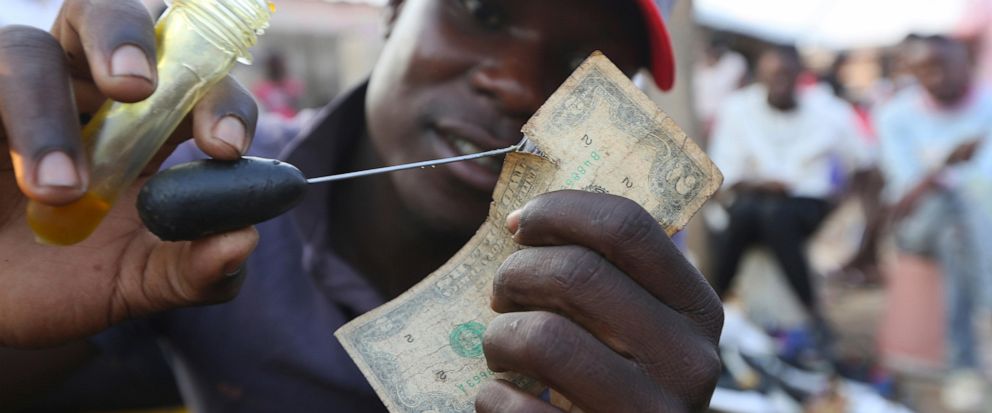
It has led to a niche business on the streets of the capital: Vendors mend worn out or shredded $1 notes for a small fee.

Source: abcNEWS

No Result
View All Result

Recent Posts

  • African and European markets open trading day update
  • A token launch by OpenAI could reshape how AI compute is financed
  • More pollution and higher energy costs: critics condemn Trump’s anti-environment agenda
  • “Using Blockchain, Artificial Intelligence, and the Internet of Things to Propel Innovation for Africa.”
  • 39th African Union Summit: AfDB’s four cardinal points target faster delivery of Agenda 2063

Recent Comments

    Archives

    • February 2026
    • January 2026
    • December 2025
    • November 2025
    • October 2025
    • September 2025
    • August 2025
    • July 2025
    • June 2025
    • May 2025
    • April 2025
    • March 2025
    • February 2025
    • January 2025
    • December 2024
    • November 2024
    • October 2024
    • September 2024
    • August 2024
    • July 2024
    • June 2024
    • May 2024
    • April 2024
    • March 2024
    • February 2024
    • January 2024
    • December 2023
    • November 2023
    • October 2023
    • September 2023
    • August 2023
    • July 2023
    • June 2023
    • May 2023
    • April 2023
    • March 2023
    • February 2023
    • January 2023
    • December 2022
    • November 2022
    • October 2022
    • September 2022
    • August 2022

    Categories

    • Africa
    • Africa finance
    • AI
    • An diesem Tag
    • Asia
    • Asia finance
    • Australia
    • Banking
    • Best chefs
    • Biden
    • Blockchain
    • Burundi
    • Business of the week
    • Carbon
    • Caribbean
    • Central America
    • Central Banks
    • China
    • Climate
    • Climate & Energy
    • Coal
    • Cocktail of the week
    • Commodities
    • Corporate
    • Deutsch
    • Deutsch PR
    • Digital Banking
    • English PR
    • Europe
    • Financial insights
    • Focus on neobanking
    • Gambia
    • Gas
    • Ghana
    • Global news
    • Harris
    • History
    • India
    • Indonesia
    • Influential women
    • Invest and Rest
    • Italiano PR
    • Jamaica
    • Japan
    • Kenya
    • Kenya
    • Laos
    • Laos
    • LATAM
    • Lifestyle
    • Malaysia
    • Metaverse
    • MSTRpay
    • Neobanking
    • News
    • Newshub long-read
    • newshub special
    • newshub-special
    • NFT
    • Nobel Prizes 2024
    • Nuclear
    • Oil
    • Philippines
    • Press
    • Press releases
    • Pressroom
    • Renewable
    • Russia
    • Senegal
    • Senegal
    • Solar
    • South America
    • South East Asia
    • South Korea
    • South Korea
    • Stocks
    • Svensk PR
    • Tech
    • Trump
    • Trump trials
    • UFO
    • Uganda
    • UK
    • UK News
    • Ukraine
    • US
    • US politics
    • Vietnam
    • Vietnam
    • Waves
    • WEX
    • Wind
    • World safety

    Meta

    • Log in
    • Entries feed
    • Comments feed
    • WordPress.org

    Recent Posts

    • African and European markets open trading day update
    • A token launch by OpenAI could reshape how AI compute is financed
    • More pollution and higher energy costs: critics condemn Trump’s anti-environment agenda
    • “Using Blockchain, Artificial Intelligence, and the Internet of Things to Propel Innovation for Africa.”
    • 39th African Union Summit: AfDB’s four cardinal points target faster delivery of Agenda 2063

    Categories

    • Africa
    • Africa finance
    • AI
    • An diesem Tag
    • Asia
    • Asia finance
    • Australia
    • Banking
    • Best chefs
    • Biden
    • Blockchain
    • Burundi
    • Business of the week
    • Carbon
    • Caribbean
    • Central America
    • Central Banks
    • China
    • Climate
    • Climate & Energy
    • Coal
    • Cocktail of the week
    • Commodities
    • Corporate
    • Deutsch
    • Deutsch PR
    • Digital Banking
    • English PR
    • Europe
    • Financial insights
    • Focus on neobanking
    • Gambia
    • Gas
    • Ghana
    • Global news
    • Harris
    • History
    • India
    • Indonesia
    • Influential women
    • Invest and Rest
    • Italiano PR
    • Jamaica
    • Japan
    • Kenya
    • Kenya
    • Laos
    • Laos
    • LATAM
    • Lifestyle
    • Malaysia
    • Metaverse
    • MSTRpay
    • Neobanking
    • News
    • Newshub long-read
    • newshub special
    • newshub-special
    • NFT
    • Nobel Prizes 2024
    • Nuclear
    • Oil
    • Philippines
    • Press
    • Press releases
    • Pressroom
    • Renewable
    • Russia
    • Senegal
    • Senegal
    • Solar
    • South America
    • South East Asia
    • South Korea
    • South Korea
    • Stocks
    • Svensk PR
    • Tech
    • Trump
    • Trump trials
    • UFO
    • Uganda
    • UK
    • UK News
    • Ukraine
    • US
    • US politics
    • Vietnam
    • Vietnam
    • Waves
    • WEX
    • Wind
    • World safety

    Archives

    • February 2026
    • January 2026
    • December 2025
    • November 2025
    • October 2025
    • September 2025
    • August 2025
    • July 2025
    • June 2025
    • May 2025
    • April 2025
    • March 2025
    • February 2025
    • January 2025
    • December 2024
    • November 2024
    • October 2024
    • September 2024
    • August 2024
    • July 2024
    • June 2024
    • May 2024
    • April 2024
    • March 2024
    • February 2024
    • January 2024
    • December 2023
    • November 2023
    • October 2023
    • September 2023
    • August 2023
    • July 2023
    • June 2023
    • May 2023
    • April 2023
    • March 2023
    • February 2023
    • January 2023
    • December 2022
    • November 2022
    • October 2022
    • September 2022
    • August 2022
    • Global
    • Finance
    • Fintech
    • Press releases
    • NF GPT

    © 2022-2025
    MSTRpay/Newshub Finance

    Welcome Back!

    Login to your account below

    Forgotten Password?

    Retrieve your password

    Please enter your username or email address to reset your password.

    Log In

    Add New Playlist

    No Result
    View All Result
    • Global
      • Africa
        • Burundi
        • Ghana
        • Gambia
        • Senegal
      • Asia
        • Indonesia
        • Laos
        • Malaysia
        • South Korea
      • Caribbean
        • Central America
      • Climate & energy
        • Climate
        • Carbon
        • Coal
        • Disruptive
        • Gas
        • Nuclear
        • Oil
        • Solar
        • Water
        • Waves
        • Wind
        • Renewable
        • South America
      • Lifestyle
        • Best chefs
        • Cocktail of the week
        • History
        • Influential women
        • Newshub long-read
    • Finance
      • Africa finance
      • Australia
      • Asia finance
      • Banking
      • Business of the week
      • Central Banks
      • China
      • Commodities
      • Corporate
      • Europe
      • Investment
      • Japan
      • MSTRpay
      • Neobanking
      • South East Asia
      • UK
      • US
    • Fintech
      • Tech
      • AI
      • Blockchain
    • Press releases
    • NF GPT

    © 2022-2025
    MSTRpay/Newshub Finance