
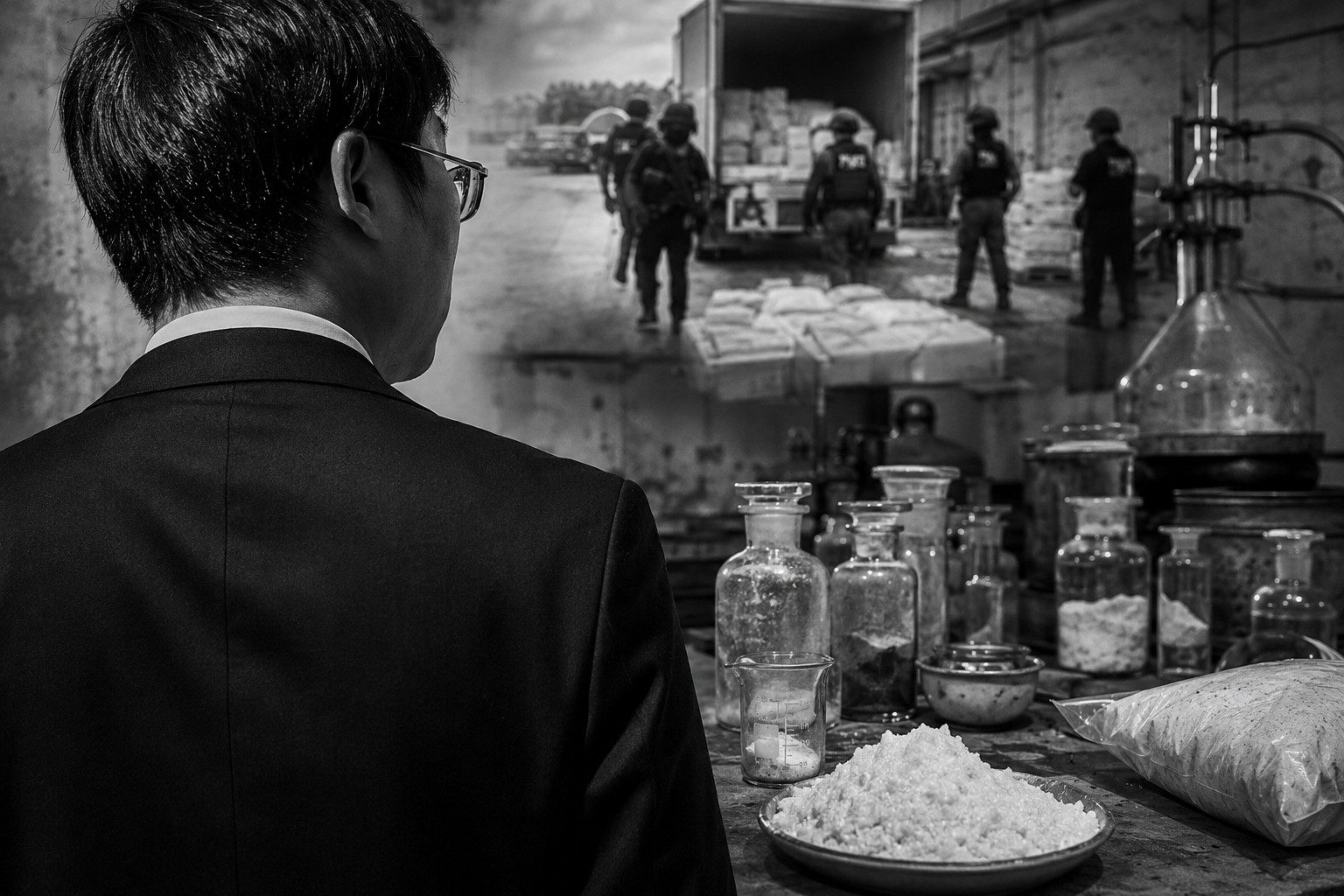
A university-educated Chinese businessman who moved to Mexico and reportedly began his career as a translator is now accused of becoming one of the most important links between Asian chemical suppliers and Mexico’s most powerful drug cartels. Zhi Dong Zhang, widely known as “Brother Wang”, is alleged to have helped build the international supply and money-laundering networks that support the production and distribution of fentanyl, cocaine and methamphetamine.
From Beijing graduate to alleged cartel broker
Zhang was born in Beijing in 1987 and is reported to have studied Spanish before moving to Mexico. His command of the language and familiarity with both Chinese and Mexican business culture may have made him unusually valuable in an underworld increasingly dependent on international trade, encrypted communications and complex financial transactions.
American prosecutors allege that his criminal organisation had operated in Mexico since at least 2016, using a broad network of couriers and co-ordinators to move narcotics into the United States. Court documents accuse Zhang of personally arranging deliveries of cocaine and fentanyl, while maintaining operational hubs linked to Atlanta and Los Angeles.

Members of the Sinaloa cartel have reportedly described “Brother Wang” as a central figure in establishing the supply chain that carries chemical ingredients from Chinese manufacturers to clandestine laboratories in Mexico.
The chemistry behind the fentanyl trade
Unlike plant-based narcotics, fentanyl can be manufactured using industrial chemicals sourced through legitimate global commerce. Mexican criminal organisations rely heavily on precursor chemicals and specialist equipment obtained from overseas suppliers, particularly in China.
Once the ingredients reach Mexico, cartel laboratories process them into fentanyl powder or counterfeit tablets before smuggling the finished product northwards. The United States Drug Enforcement Administration identifies the Sinaloa and Jalisco New Generation cartels as major participants in this global supply chain.
Zhang is accused of acting not merely as a supplier, but as a broker connecting chemical manufacturers, transport networks, drug producers and financial intermediaries. Mexican authorities have alleged that his network handled large quantities of fentanyl, cocaine and methamphetamine and generated approximately $150 million annually.
An international pursuit
Zhang was arrested in Mexico City in October 2024 following a request from the United States. However, after being placed under house arrest, he escaped in July 2025, reportedly leaving through an adjoining property before travelling abroad using false documentation.
He was subsequently detained in Cuba after attempting to enter Russia and was eventually returned through Mexico to face proceedings in the United States. The episode attracted criticism in Mexico, where President Claudia Sheinbaum questioned how such a significant suspect had been allowed to escape custody.
A network larger than one man
The case illustrates how the modern fentanyl economy crosses national borders without resembling a traditional cartel hierarchy. Chinese chemical brokers, Mexican laboratories, American distribution networks and underground financial systems can operate as interconnected but replaceable components.
Zhang has not been convicted of the allegations against him, and the charges remain to be tested in court. His capture may nevertheless provide investigators with valuable insight into the commercial and financial architecture behind one of the world’s deadliest illicit drug markets.
Newshub Editorial in Latin America – July 14, 2026

Ask NF GPT
If you have an account with ChatGPT you get deeper explanations,
background and context related to what you are reading.
Recent Comments